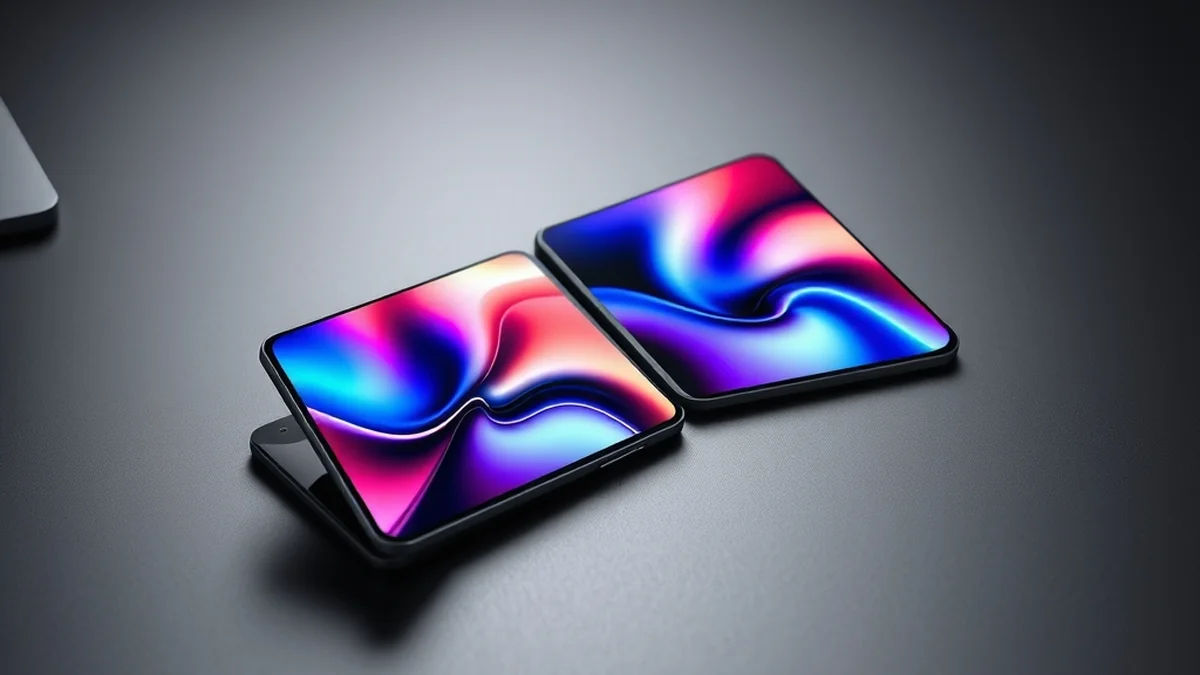
Xiaomi has officially commenced retail sales of its 18 Fold smartphone across the Chinese domestic market, arriving just two days after Apple announced its long-awaited entry into the foldable category. The rapid commercial rollout highlights the fierce competitive pressures defining the high-end mobile sector as major manufacturers race to capture market share in advanced form factors. While Apple positioned its newly revealed iPhone Duo for an October 23 market release, Xiaomi moved its device straight to consumer shelves following a September 7 launch event.
The timing of Xiaomi's commercial deployment underscores a broader industry pivot toward foldable devices, even as device makers grapple with divergent pricing strategies and hardware constraints. Apple's pricing structure for the iPhone Duo starts at $1,999 in the United States, reflecting higher input costs and premium positioning. In contrast, Xiaomi has priced the 18 Fold starting at approximately $1,540 in China, undercutting its American rival significantly while remaining restricted to its home market for the time being.
Hardware Engineering and Technical Specifications
Xiaomi characterizes the 18 Fold as a mid-size foldable handset designed to balance portability with expansive screen real estate. When folded, the device approximates the physical dimensions of a standard passport, measuring 5.02mm in thickness when fully opened and tipping the scales at 219 grams. The hardware houses a 7.58-inch primary internal display paired with a 5.38-inch cover screen for external interactions.
Processing performance is driven by Xiaomi's proprietary XRING O3 chip, supported by configurations offering either 12GB or 16GB of system memory. Storage tiers span 256GB, 512GB, and a maximum capacity of 1TB. To sustain power-intensive operations across both panels, the device incorporates a substantial 6,000mAh battery cell, paired with an imaging array carrying Leica branding that features a 200MP main sensor alongside dual 50MP secondary lenses.
Form Factor Comparison and Design Variations
Side-by-side design evaluations reveal notable similarities between the structural philosophies adopted by Xiaomi and Apple, with both manufacturers utilizing a short and wide aspect ratio. However, distinguishing architectural choices separate the two handsets. Xiaomi's engineering team opted for rounded edges and a marginally wider body profile to differentiate its physical presence from competing hardware.
Market availability for the 18 Fold spans multiple aesthetic finishes, including Black, White, Red, and a specialized Ceramic edition. Standard configurations are distributed across four distinct RAM and storage pairings, whereas the Ceramic variant is reserved exclusively for the top-tier 16GB and 1TB capacity model. International buyers, including consumers in markets such as India, face an extended wait as Xiaomi maintains a strictly domestic distribution strategy.
Software Innovation and Ecosystem Pressures
The simultaneous emergence of rival foldable devices has intensified industry scrutiny regarding software sophistication. Following Apple's hardware demonstration at Apple Park, technology observers highlighted fluid transition animations designed to bridge the display size gap on the iPhone Duo. Early developer demonstrations on Reddit indicated that comparable visual transitions could theoretically be ported to existing Android competitors like the Galaxy Z Fold series, though system-level permissions currently restrict user access without root modifications.
Industry analysts have noted that Apple's entry into the foldable arena exposes potential software stagnation among legacy pioneers. Prominent commentators and industry leakers have criticized incumbent manufacturers for prioritizing iterative hardware slimming over daily user experience enhancements. While Samsung retains the largest global market share in the foldable category, the rapid deployment of alternative devices by competitors like Xiaomi adds mounting pressure on established ecosystems to refine their software interfaces.
Wall Street Valuation and Market Reception
Financial markets have responded with polarized evaluations regarding Apple's pricing strategy for the iPhone Duo. Major financial institutions including Morgan Stanley noted that the $1,999 entry point sits below initial investor projections ranging from $2,300 to $2,500. Analysts suggest that Apple is deliberately prioritizing consumer adoption velocity over near-term margin maximization, absorbing component cost pressures to stimulate volume.
Conversely, firms such as Rosenblatt and Jefferies voiced caution regarding gross margin dilution driven by escalating memory component expenses. On retail investor platforms like Stocktwits, sentiment shifted notably bullish following the hardware reveals. Individual retail traders debated the practical utility of the new form factor, framing the competitive rivalry as a pivotal milestone for mobile device engineering.
Next steps include monitoring Apple's consumer launch scheduled for October 23, tracking component cost fluctuations across global supply chains, and observing whether Android manufacturers officially integrate system-level display transition animations in response to market demand.