
Edited by Editor-in-Chief, The Indus Pulse 19 Sept 2026, 04:34 PM 3 min readindia
PM Modi Highlights Climate Inequality at NGT Conference, Cites Emission Disparities
Sources & Citations
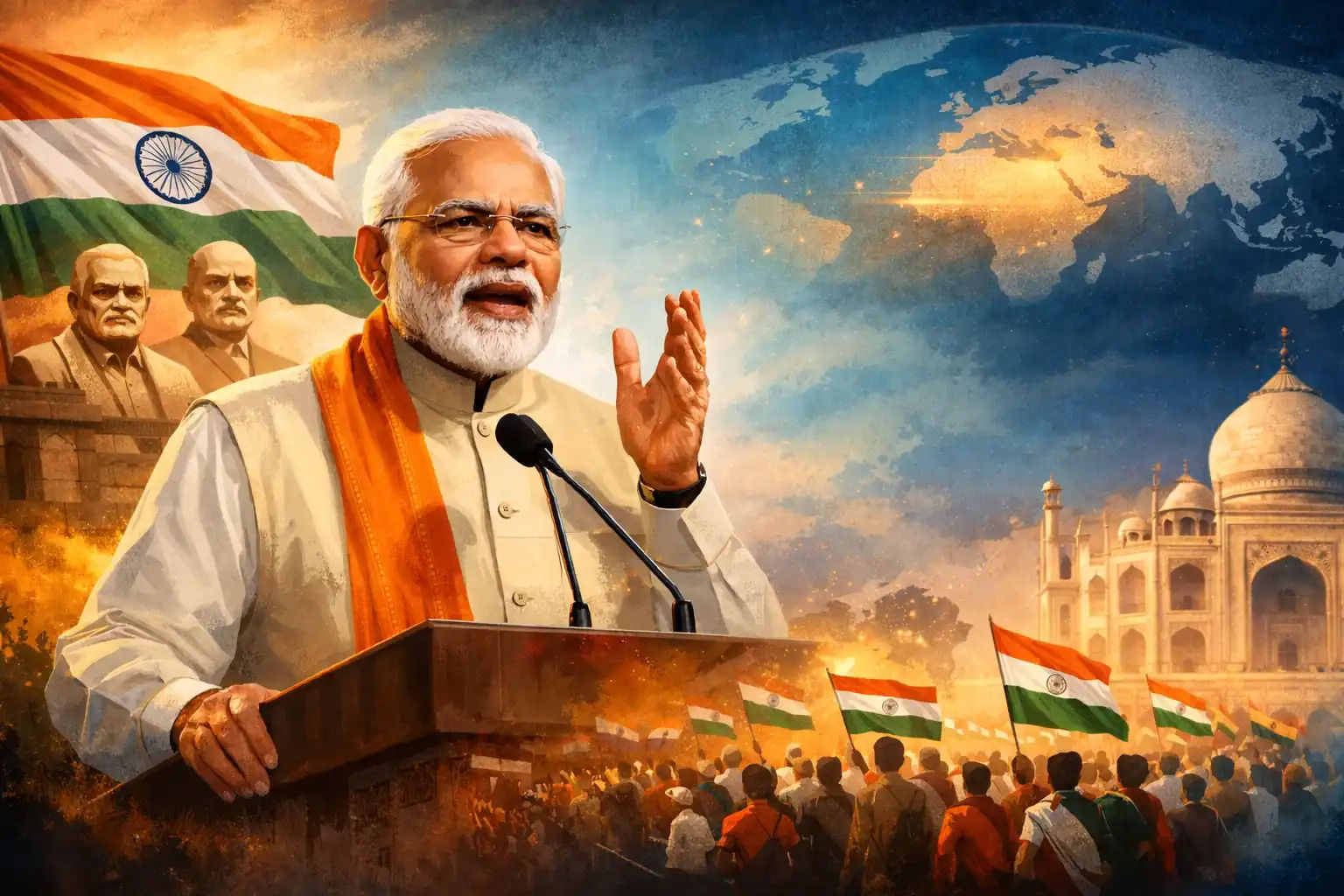
Prime Minister Narendra Modi asserted on Saturday that developing nations are frequently burdened with misplaced blame for carbon emissions while developed economies maintain per capita emission rates six times higher than India. Inaugurating a two-day international conference on environmental dynamics in New Delhi, the Prime Minister launched the National Green Tribunal (NGT) Mobile App and detailed India's clean energy expansion.
The high-level inaugural session at Vigyan Bhawan was attended by Chief Justice of India Justice Surya Kant, Union Environment, Forest and Climate Change Minister Bhupender Yadav, Attorney General R. Venkataramani, and NGT Chairperson Justice Prakash Shrivastava. Judicial representatives and experts from 17 countries are participating in the event, which is structured around four technical sessions aimed at identifying policy gaps and strengthening institutional cooperation across jurisdictions.
Addressing Global Emission Disparities
Addressing the international gathering, the Prime Minister emphasized that India's per capita carbon emissions remain less than half the global average, framing the current discourse on global warming around historical accountability. Quoting the disparity directly, Modi noted that developed nations produce six times more per capita carbon emissions compared to India, a position the nation has consistently articulated on global platforms.
He urged citizens to voice this structural imbalance with conviction, pointing out that developing countries across the Global South often absorb disproportionate criticism regarding industrial pollution despite historical data showing lower cumulative consumption footprints.
Renewable Energy Milestones and Paris Commitments
Detailing domestic environmental metrics over the past twelve years, Modi stated that India is the sole G20 nation to have fulfilled its commitments under the Paris Agreement (COP21) well ahead of the established timeline. He pointed to exponential growth in solar infrastructure, noting that national solar energy capacity has surged from 2 gigawatts twelve years ago to over 160 gigawatts.
This expansion is supported by targeted domestic initiatives such as the PM Surya Ghar Muft Bijli Yojana, which has introduced rooftop solar installations across more than 50 lakh households with an additional fiscal support of nearly Rs 80,000 per household. Wind and hydro energy capacities have registered significant upward trajectories over the same twelve-year review period.
Infrastructure and Institutional Challenges
Beyond power generation, the Prime Minister pointed to advancements in clean mobility, including the recent launch of the country's longest hydrogen train and a sharp rise in electric vehicle adoption, which scaled from 3,000 annual sales prior to 2014 to nearly 2.5 lakh vehicles last year. Urban transit networks have similarly expanded from five cities covering under 250 kilometers of metro lines to over 1,000 kilometers spanning 20 cities.
Modi also highlighted institutional friction points during the address, cautioning that government efforts to advance clean nuclear energy generation frequently encounter coordinated legal resistance. He stated that whenever the administration initiates nuclear power expansion, environmental advocates file court actions specifically designed to stall clean energy initiatives.
The two-day conference concludes on Sunday with a valedictory session scheduled to feature President Droupadi Murmu, Union Minister Manohar Lal, Supreme Court judge Justice P.S. Narasimha, and Solicitor General Tushar Mehta.
Sources & Citations
The Indus Pulse is committed to accuracy and transparency.