
Edited by Editor-in-Chief, The Indus Pulse 25 Sept 2026, 11:31 AM 4 min readentertainment
Nagaland Feature Film Angh Wins Platform Prize at Toronto Film Festival
An Indian feature film shot in the Konyak tribal language of Nagaland has claimed a major international award at the Toronto International Film Festival, securing an alternate qualification route toward the Academy Awards. Directed by debut filmmaker Theja Rio, Angh captured the festival's Platform Prize, a juried honor established to recognize distinctive directorial voices on the global stage.
The movie secured international and domestic distribution rights with Jungle Book Studios prior to the festival, marking the studio's entry into international sales and distribution according to executive producer Gaurav Dhingra. Other Indian films have also achieved notable recognition at the festival in past years.
The director is an Indigenous Naga filmmaker and a graduate of the UK's National Film and Television School who has previously directed multiple short films.
The victory places a regional cinematic work from India's northeastern frontier into contention for the 2027 Academy Awards under modern rules allowing winners of designated festival prizes to qualify for International Feature Film consideration without relying solely on official national submissions. Set in the early 1960s, the narrative examines the friction between tradition and modernization as an aging hereditary village chief and his son navigate shifting cultural and religious landscapes.
Cultural Transition and Historical Setting
The narrative centers on Anghba, a traditional Konyak chief in the eastern district of Mon, alongside his son as they encounter an incoming American missionary portrayed by Scottish actor Douglas Henshall. The film draws heavily upon the historical backdrop of 1963, the year Nagaland formally became an Indian state amidst rapid social and administrative restructuring. According to Konyak society scholar Dr B Amo Konyak, the period marked an era of profound cultural churn where ancestral customs either vanished entirely or persisted only in fragments through elder memories and heirlooms.
Director Theja Rio developed the concept after observing how tightly separated eras coexist within single households in Mon, where a grandfather bearing tattoos from historical headhunting traditions might live alongside grandchildren participating in contemporary rock culture. Rather than treating these generational shifts as rigid opposition, the film captures a nonlinear evolution where historical practices transform rather than disappear entirely. Cultural consultants from the Konyak community actively collaborated on dialogue, costume design, and production staging to ensure authenticity.
Reversing the Ethnographic Gaze
A central artistic choice involved dismantling the traditional external perspective historically imposed on indigenous Naga communities by foreign explorers, colonial administrators, and early photographers. Rio deliberately structured the visual storytelling to align with the viewpoints of the characters themselves rather than perpetuating outsider fascination with tattooed faces and ritual ornaments. Critics noted that the production treats the mountainous landscape not merely as an exotic backdrop, but as an inhabited home carrying deep historical weight.
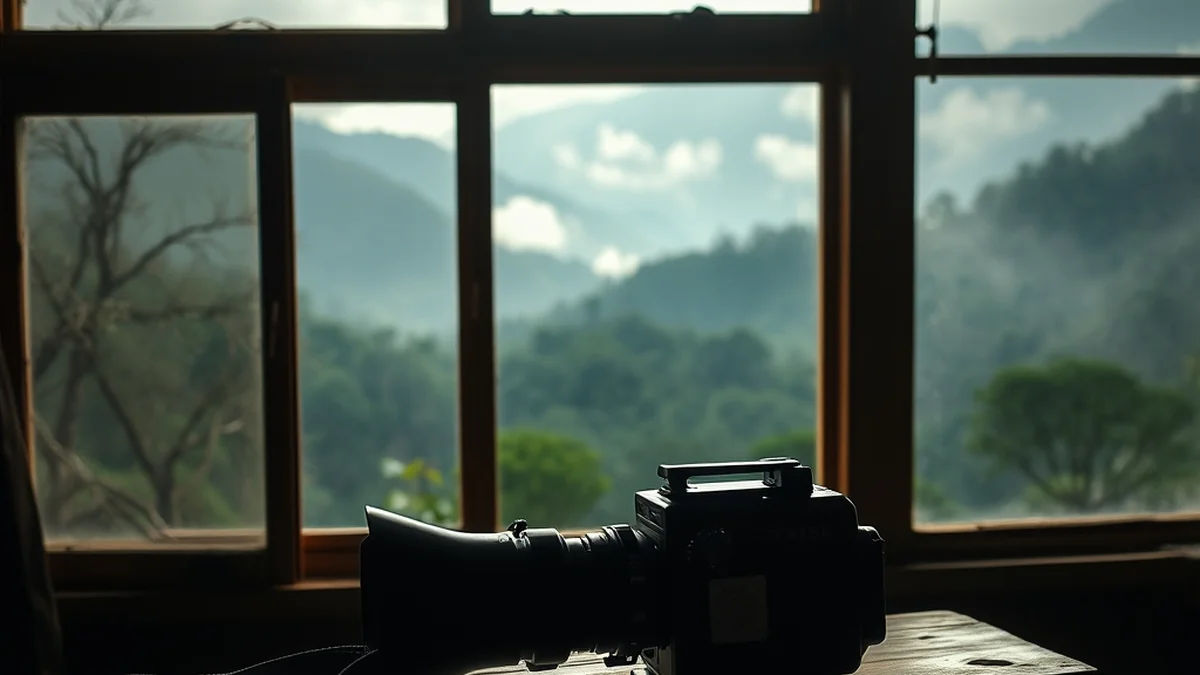
To achieve an authentic visual texture mirroring the period, Rio collaborated with cinematographer Adam Pietkiewicz to shoot the project entirely on 16mm film. The visual approach drew from archival photographs and missionary records dating back to the 1950s and 1960s, reproducing the grain and lighting atmosphere of historical documents while maintaining an interior narrative perspective.
Logistical Challenges and Production Hurdles
Shooting on physical film rather than digital formats introduced severe technical complications throughout production. Without the ability to review footage immediately on set, the camera crew had to package exposed film canisters every four or five days and dispatch them to Mumbai for chemical processing, continuing principal photography without immediate visual confirmation.
Additional operational difficulties emerged during night shoots involving historical equipment. During a sequence requiring a Second World War-era Jeep to enter the frame alongside Douglas Henshall, mechanical failures silenced the vehicle's engine repeatedly during active takes, narrowing the usable footage to a single successful recording.
Festival Reception and the Road Ahead
While Rio admitted surprise at outperforming seasoned international directors in the competitive selection, the jury lauded the feature for its refreshing perspective and nuanced depiction of unfamiliar social realities. The win elevates regional northeastern storytelling onto an international platform, highlighting an emerging regional industry that remains at a nascent stage compared to India's established commercial centers.
Rio has indicated his immediate priority following the festival circuit involves returning home to Nagaland to reunite with peers before deciding on future creative projects.
The Indus Pulse is committed to accuracy and transparency.