
US Army Detonates Lead Azide Stockpile in Iowa Amid Fallout Warnings
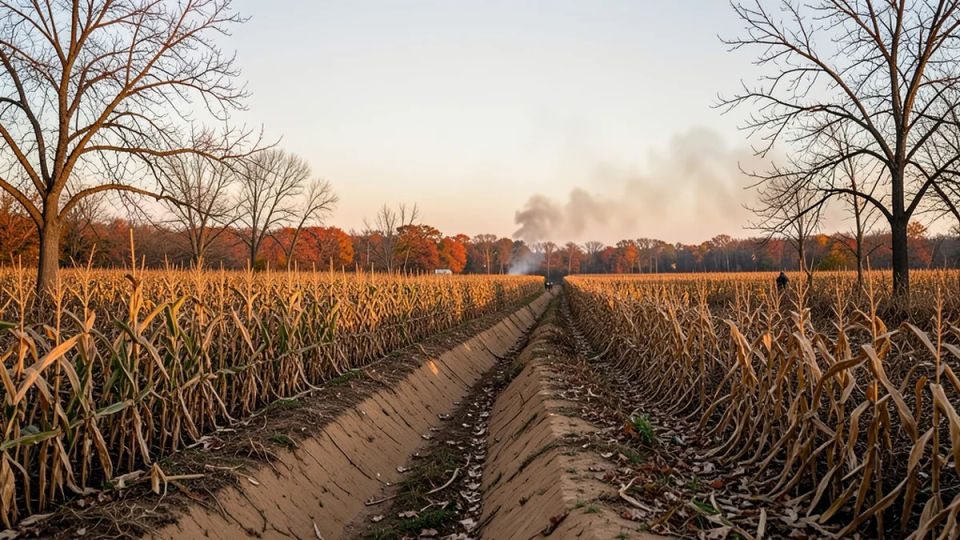
The U.S. Army destroyed a stockpile of deteriorating lead azide in two successive open-air controlled detonations at the Iowa Army Ammunition Plant in Middletown, Iowa, about 150 miles southwest of Des Moines, around 9 am CST (1500 GMT) on Wednesday, November 25, 2026.
Why the stockpile was blown up and how fallout was contained
Lead azide, a primary explosive used in military munitions since World War I and heavily produced during the Vietnam War until production stopped after the early 1980s, had been stored in two underground concrete areas submerged in ethanol and water since 2009.
Temperature fluctuations caused the compound to partially dissolve and slowly recrystallise, making it far more sensitive to shock and friction and risking an accidental explosion if moved, DNA India reported.
Before the blasts, Assistant Secretary of the Army Jordan Gillis said in a video on X that the choice was between a spontaneous uncontrolled explosion and a controlled detonation, while Army Secretary Adam Telle also defended controlled disposal.
Army officials said the operation would use C-4 explosives, other charges, and diesel fuel to consume the lead azide and direct the blast downward, surrounded by two-story sand barriers, four 16,000-gallon water tank walls, special screening, a two-foot foam layer, and drone air monitoring.
Monday's federal appeals court ruling lifted a temporary hold and rejected an environmental lawsuit to halt the blast, while outgoing Governor Kim Reynolds issued a disaster emergency for Des Moines, Lee, and Van Buren counties.
Shelter-in-place alerts and agricultural concerns
Live television broadcast the sound of a blast and gray smoke drifting above trees at the scheduled hour, with officials offering no immediate assessment of the operation's outcome.
The Federal Emergency Management Agency wrote on X after the blast that residents within 20 miles who had not evacuated should continue to shelter indoors and follow Environmental Protection Agency safety guidance until given an all-clear, adding that FEMA provided safe lodging for evacuees.
Revised Army wind projections on Tuesday showed airborne lead particles shifting southwest into northeast Missouri, prompting health advisories 8 km to 32 km (5 to 20 miles) southwest of the plant, while a Tuesday mobile alert warned of possible non-mandatory evacuations within five miles and environmental groups warned dust could travel more than 160 km (100 miles). As of 11:15 a.m., the EPA stated that real-time air monitors registered zero detection of airborne lead across the region.
Lead is a potent neurotoxin with no known safe exposure level, and the Army warned that heating lead azide can also produce lead metal oxides, hydrazoic acid vapours, and nitrogen oxides.
In Des Moines County, home to about 38,000 people across Burlington and Middletown with 38% of households below the ALICE threshold in 2024 per United for ALICE, Burlington Homelessness Task Force chairwoman Megan Brincks said shelter orders cannot halt daily obligations for food-insecure families and homeless residents.
USDA Undersecretary Richard Fordyce said the USDA and Iowa's agriculture department estimated about 350 farms across Iowa and Missouri could lie in the projected plume area, including part of Des Moines County's 648 farms spanning nearly 60,300 hectares (149,000 acres) with more than 49,775 hectares (123,000 acres) of cropland.
University of Illinois Urbana-Champaign associate professor Will Sander said most corn and soya bean harvesting was already finished and advised cattle producers to cover feed and water, while Emory University professor Eri Saikawa told Al Jazeera, "For [these] farmers, land is their currency."
Background
On Tuesday, the acting head of the U.S. Army said the service will conduct a thorough examination of its weapons storage facilities around the country and inventory to prevent a similar incident, according to Task & Purpose.
EPA crews are conducting independent air, water, and soil sampling and remediation efforts following the controlled detonation, according to U.S. Environmental Protection Agency.
The USDA advises producers to consult veterinarians for animal blood tests and will increase tissue sampling for lead residues in regional meat, poultry, and egg products, according to the U.S. Department of Agriculture.
USDA Farm Service Agency staff will be available to assist customers in filing claims with the Army, according to the U.S. Department of Agriculture.
Sources & Citations
- Al Jazeera
- The Straits Times
- DNA India
- The Guardian
- Task & Purpose
- U.S. Environmental Protection AgencyPrimary / official
- AgWeb
- U.S. Department of AgriculturePrimary / official