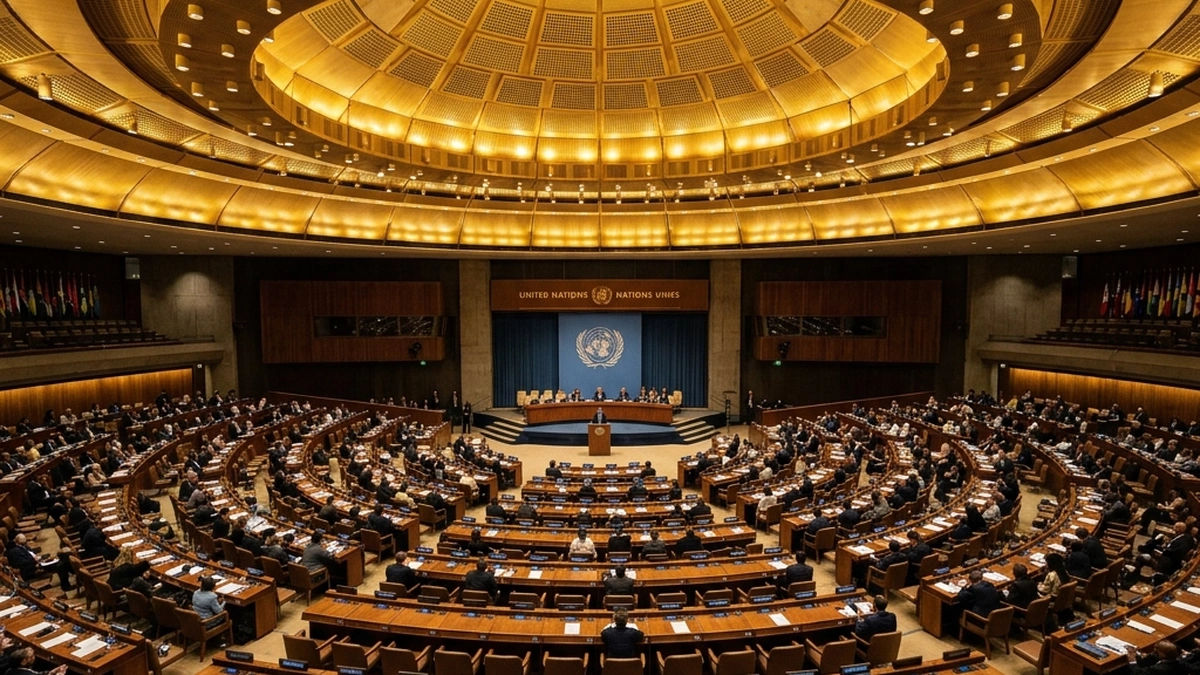
The United Nations General Assembly has officially endorsed a shift away from the 16th-century Mercator projection in favor of the Equal Earth map, a move aimed at correcting the long-standing visual distortion of the African continent. The resolution, which passed on Friday, September 4, 2026, with 164 votes in favor, represents a significant diplomatic victory for the African Union and the Togolese government, which spearheaded the initiative. By adopting this stance, the UN acknowledges that traditional mapping practices have historically minimized the perceived scale of Africa, often depicting it as roughly equivalent to Greenland, despite the continent being approximately 14 times larger in reality.
This endorsement is not legally binding and does not mandate the abandonment of the Mercator projection for specialized maritime or aerial navigation, where its utility remains undisputed. Instead, the resolution serves as a formal recommendation for governments, educational institutions, and technology firms to adopt more accurate representations in textbooks, digital platforms, and public discourse. The initiative is framed by its proponents as a necessary step toward decolonizing geographic education and aligning global perceptions with physical reality, effectively challenging the legacy of colonial-era cartography that has persisted in classrooms for centuries.
The Diplomatic Push for Cartographic Accuracy
Togo led the diplomatic effort at the United Nations, positioning the campaign as a matter of fairness and truth in global representation. Foreign Minister Robert Dussey, who championed the resolution, emphasized that the project is not an attack on any specific civilization but rather a correction of a historical imbalance. "A fair world begins with a fair map," Dussey stated ahead of the vote, highlighting that maps are not merely technical tools but instruments that shape collective imagination and influence how regions are perceived on the global stage.
The resolution gained overwhelming support from the international community, reflecting a broad consensus on the need to update educational standards. While the Mercator projection was designed by Flemish cartographer Gerardus Mercator to assist European navigators in the 1500s, its continued use in general education has been criticized by geographers for decades. Experts, including Syracuse University professor Mark Monmonier, have noted that outside of specific navigational applications, the projection’s distortion of landmasses near the poles—which artificially inflates the size of North America and Europe while shrinking equatorial regions—lacks contemporary justification.
Implementation and Educational Reform
Following the UN vote, the focus shifts to the practical implementation of the Equal Earth projection in school curricula and digital media. Togo has announced its intention to become the first nation to overhaul its national geography textbooks by the end of 2026. This move is intended to serve as a model for other African Union member states and international partners. The Togolese government plans to coordinate with other nations over the next six months to establish a framework for wider adoption, targeting both physical educational materials and the digital mapping services that underpin modern navigation and location-based technologies.
Advocacy groups, such as Africa No Filter, have lauded the resolution as a milestone in the effort to change how the continent is viewed. The group is actively pushing for technology companies to integrate the Equal Earth projection into their platforms, arguing that the digital maps used by billions of people daily should reflect accurate proportions. The transition is expected to be a gradual process, requiring collaboration between governments, private sector mapping providers, and educational publishers to ensure that the new standard becomes the default for future generations.
The Single Dissenting Voice
The resolution faced opposition from only one member state: the United States. In its explanation of the vote, the U.S. delegation characterized the initiative as an "ideological agenda" that distracts from more pressing global challenges, such as international peace, security, and economic prosperity. This solitary dissent highlights the political friction that can arise when symbolic or cultural initiatives are brought before the UN General Assembly, even when they enjoy broad support from the majority of the international community.
Six other nations—Serbia, Estonia, Georgia, Lithuania, Moldova, and Ukraine—chose to abstain from the vote. Despite the U.S. position, the overwhelming majority of 164 votes in favor underscores the success of the African Union’s campaign in framing the issue as a matter of objective accuracy rather than political conflict. The resolution’s passage has been welcomed by other international figures, including French Foreign Minister Jean-Noël Barrot, who remarked on social media that correcting a distorted representation is an act of truth, even if it does not fundamentally alter the physical world.
Addressing Colonial-Era Legacies
The campaign to adopt the Equal Earth map is deeply linked to broader African efforts to address the legacies of colonialism. Proponents argue that the dominance of the Mercator projection is a direct consequence of colonial-era cartography, which prioritized European perspectives and navigational needs. By shifting to a projection that respects the Earth’s curvature and maintains the relative size of continents, the initiative seeks to dismantle the visual biases that have persisted in global education for centuries.
Foreign Minister Dussey has been clear that the campaign is not intended to be an attack on Europe or any other civilization, but rather a necessary evolution in how the world is understood. As the global community moves toward a more interconnected future, the adoption of more accurate mapping is seen as a way to foster a more equitable perception of all regions. The success of this resolution marks a significant moment for the African Union, demonstrating its capacity to mobilize international support for initiatives that challenge long-standing, Eurocentric standards in global institutions.