
Ukraine Says It Hit Five Russian Jets at Savasleyka, Samara Refineries
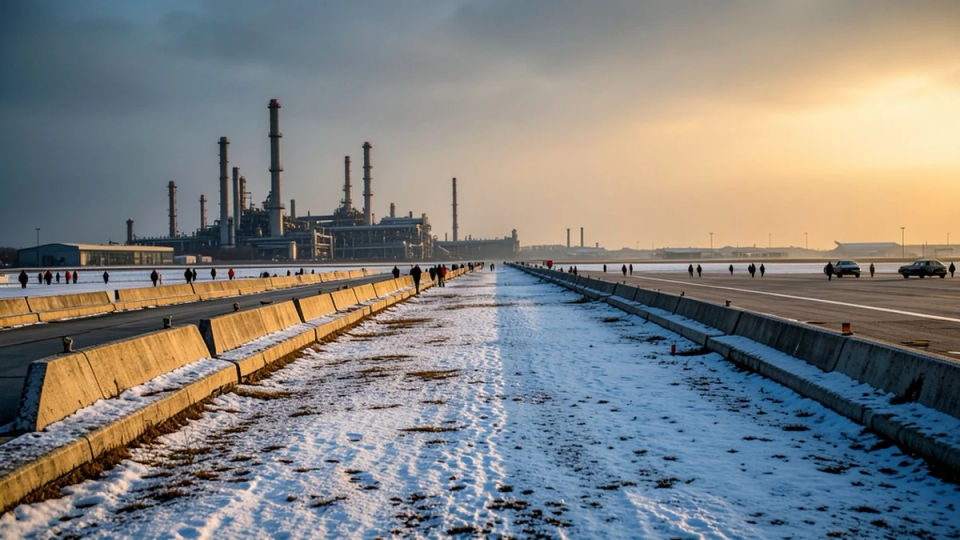
Ukraine said on Wednesday, November 25, 2026 that it damaged five Russian military jets at Russia's Savasleyka airfield, 300 km (185 miles) east of Moscow, and struck two oil refineries in the Samara region overnight.
Kyiv's General Staff said three MiG-31 and two Su-34s aircraft were hit at Savasleyka in the Nizhny Novgorod region, adding that damage was still being assessed and "there may be even better news to come".
Savasleyka airfield and occupied-territory targets
Ukraine did not disclose which weapons hit Savasleyka, and Russia has not commented on the airfield strike.
Savasleyka has been targeted by Ukraine for several years because it hosts aircraft Russia uses to launch glide bombs and Kinzhal hypersonic missiles, whose MiG-31 take-offs frequently trigger nationwide air alerts across Ukraine.
Kyiv also said it struck a radar system alongside fuel and logistics depots in Russian-occupied Ukrainian territories, with its defence ministry stating, "Without fuel, military vehicles cannot move; without ammunition, artillery falls silent."
Samara refinery strikes and Moscow's response
Overnight strikes also targeted Russia's Samara region along the Volga River, roughly 800 km (500 miles) from the front line, where Kyiv's defence ministry warned Moscow that repaired facilities would be struck again.
Syzran Mayor Andrei Sovetkin said industrial facilities came under drone attack, and unverified social media reports cited by The Hindu said the Syzran and Kuibyshev oil refineries were struck, though Reuters could not independently verify which refineries were hit.
Samara Governor Vyacheslav Fedorishchev said air defences downed more than 145 Ukrainian drones overnight in what he called "a true ordeal", while one person was killed in the city of Samara and several towns lost power.
Ukrainian attacks on Russian refineries had eased after U.S. President Donald Trump's mid-October energy ceasefire declaration before picking up again since late October, and on Tuesday, November 24, Russian President Vladimir Putin called for tighter energy security while saying Russia stabilised domestic fuel supplies without "critical damage" and would "inevitably" retaliate. Russian oil refining volumes fell by 45% during the first three weeks of November 2026, and Putin has called on oil companies to expand refining capacity in Siberia and the Far East, according to Kyiv Post.
Overnight Russian strikes on Ukraine's grid
In Ukraine, Russian strikes overnight damaged gas and electricity facilities, interrupting power across five regions, halting a DTEK thermal plant, igniting a large fire at a Naftogaz site in Poltava, and severing external electricity to the Russian-occupied Zaporizhzhia nuclear station for the 17th time this year. Following the external power cut on November 25, 2026, backup diesel generators began supplying electricity to the Zaporizhzhia plant while IAEA staff investigated the disconnection cause, according to Kyiv Post and Hromadske.
Ten people were killed across several Ukrainian regions between November 24 and 25, the BBC reported, and Prime Minister Sergiy Koretskyi said one person was killed in the Kyiv region, while in Zaporizhzhia six people were injured on Wednesday after a Tuesday strike on a residential building injured at least 50, and two women were wounded by shrapnel in Odesa.
Background
The Kuibyshev refinery strike targeted AVT-4 and AVT-5 units, catalytic reforming, and storage tanks, while Syzran preliminary hits included the AVT-6 unit, sulfur treatment, and hydrotreating, according to Kyiv Post and Interfax-Ukraine.
The Syzran facility maintains a crude distillation capacity of 8.5 million tons or 65.1 million barrels yearly, while the Kuibyshev site reaches about 7 million tons, according to Rosneft.
Trump posted an immediate "ENERGY CEASEFIRE" without providing additional details, according to TIME, and a White House official told Axios it referred to a potential arrangement where both nations halt strikes against oil refineries, potentially preceding a wider agreement protecting power plants and electricity networks.