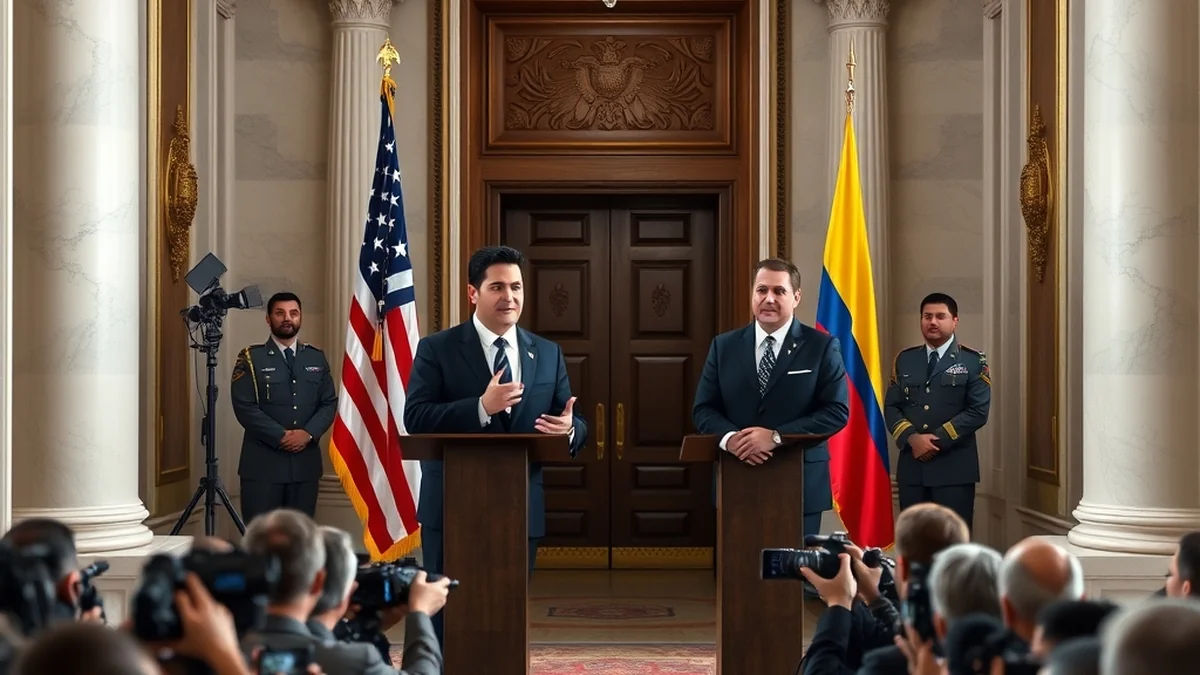
U.S. Secretary of State Marco Rubio defended the Trump administration's aggressive campaign of maritime airstrikes against suspected drug-trafficking vessels during an official visit to Quito, Ecuador, on September 9, 2026. Speaking at the presidential palace, Rubio warned that Latin American criminal cartels would eat these countries alive if left unchecked, while detailing an operational shift toward cooperative interdictions in sovereign territorial waters alongside lethal force in international corridors.
The announcement coincides with a new lethal action confirmed late Wednesday by U.S. Southern Command, which reported an airstrike in the Caribbean Sea that killed three people. The latest engagement brings the total recorded casualties from the U.S. military's anti-narcotics maritime operations to at least 230 deaths across 69 strikes launched since September 2025. During his appearance alongside Ecuadorian President Daniel Noboa, Rubio formally designated the Ecuadorian gang Los Tiguerones as a foreign terrorist organization and pledged to request $45 million from the U.S. Congress to fund joint counter-narcotics initiatives across the Western Hemisphere.
Tactical Transition to Joint Interdictions and Local Custody
The Trump administration's updated posture marks a procedural evolution from the initial wave of unilateral, lethal strikes against vessels accused of transporting illicit drugs. Under the refined operational model, U.S. forces have begun stopping floating refueling stations and suspected trafficking craft, detaining individuals on board, and transferring them directly to local authorities before destroying the empty vessels. Rubio emphasized that while Washington is prioritizing joint agreements that respect host-nation laws, the military retains full authority to execute lethal strikes when tactical conditions demand it, noting the military will still blow up ships if need be.
Rubio explained that engagement parameters are dictated on a strike-by-strike or operation-by-operation determination depending on the threat level and geographic location of the targeted vessel. Recent maritime actions reflect this hybrid approach, with U.S. and Ecuadorian forces executing six vessel interdictions in under two weeks. On Tuesday, joint forces intercepted a vessel allegedly tied to Los Choneros, a major Ecuadorian criminal syndicate, marking the second such maritime disruption in two days. Rubio praised the expanding framework, calling it an incredible advance to have regional partners willing to participate directly in security operations within their own territorial waters.
Ecuador Solidifies Strategic Axis with Washington
Ecuador has emerged as Washington's most cooperative partner in the administration's expanded regional anti-drug campaign. President Daniel Noboa has aggressively aligned his government with U.S. security initiatives and border policies since taking office, seeking external assistance to combat a severe domestic security crisis. During the Quito summit, Foreign Minister Roberto Kury described Ecuador as a loyal ally, an active ally and a decisive ally in constructing a safer and more prosperous hemisphere. Marking the diplomatic alignment, President Noboa presented Rubio with the National Order of Merit in the degree of Grand Cross, Ecuador's second-highest national honor.
The strategic partnership reflects Ecuador's critical position in the global narcotics trade, situated directly between Colombia and Peru, the world's two largest cocaine producers. Since 2021, Ecuador has suffered an escalation in violence as international cartels formed alliances with local street gangs to control key coastal ports and shipping lanes. The newly designated foreign terrorist organization, Los Tiguerones, was among 22 criminal entities classified as terrorist groups by Quito in 2024 following an internal armed conflict declaration sparked by armed gunmen invading a live television broadcast. Rubio stated that elite military units from the U.S. and Ecuador are now operating on a daily basis to dismantle these groups.
Regional Tour Anchors Conservative Security Coalition
Rubio's stop in Quito forms the central leg of a three-nation South American diplomatic tour aimed at institutionalizing security cooperation with conservative regional leaders. Before arriving in Ecuador, Rubio met with President Abelardo de la Espriella in Barranquilla, Colombia, where both officials celebrated a restoration of bilateral counter-narcotics coordination that had stalled under previous Colombian leadership. The diplomatic circuit reflects Washington's effort to assemble a coalition of aligned governments willing to deploy hardline military measures against transnational crime networks and human trafficking corridors.
Following his engagements in Quito, Rubio is scheduled to travel to Lima to meet with newly elected Peruvian President Keiko Fujimori. Fujimori has similarly endorsed uncompromising enforcement measures against drug cartels and unregulated migration. By coordinating operational protocols across Colombia, Ecuador, and Peru, the Trump administration seeks to systematically disrupt primary maritime export corridors in both the eastern Pacific Ocean and the Caribbean Sea.
Washington Increases Pressure on Mexico Over Cartel Governance
Despite praising progress with South American partners, Rubio singled out Mexico as representing an even graver challenge to regional security. The Secretary of State noted that while Mexican authorities have done more than they have ever done before to target organized crime, their efforts remain insufficient given the massive scale and institutional influence of Mexican cartels. Rubio stated that while Washington's ideal scenario is to address the cartel threat cooperatively with Mexican authorities, the sheer power of these criminal syndicates means the threat will eventually have to be confronted one way or the other.
The stark warning underlines growing friction between Washington and Mexico City over cross-border drug flows and cartel violence. While Ecuador and Colombia have integrated U.S. military assets into joint operational frameworks, Mexico has historically maintained strict limits on foreign military presence within its territory. Rubio reiterated that Washington hopes to build a cooperative security model with Mexican law enforcement, but warned that the status quo presents an unacceptably high risk to Western Hemisphere stability.
Pending Congressional Appropriations and Joint Deployment Terms
The implementation of the expanded regional counter-narcotics framework now moves to the U.S. Congress, where Rubio must secure legislative approval for the proposed $45 million funding package. While the Secretary did not detail the exact line-item allocation for the requested funds, the capital is expected to support sustained joint intelligence sharing, maritime surveillance equipment, and specialized training for partner military units.
Concurrently, U.S. Southern Command and Ecuadorian naval units are maintaining daily maritime patrols along known Pacific trade routes. With formal foreign terrorist organization designations now active against groups such as Los Tiguerones, U.S. forces possess broadened statutory scope to target infrastructure and assets linked to Ecuadorian gangs, setting the stage for continued interdictions and joint strikes across regional waters.