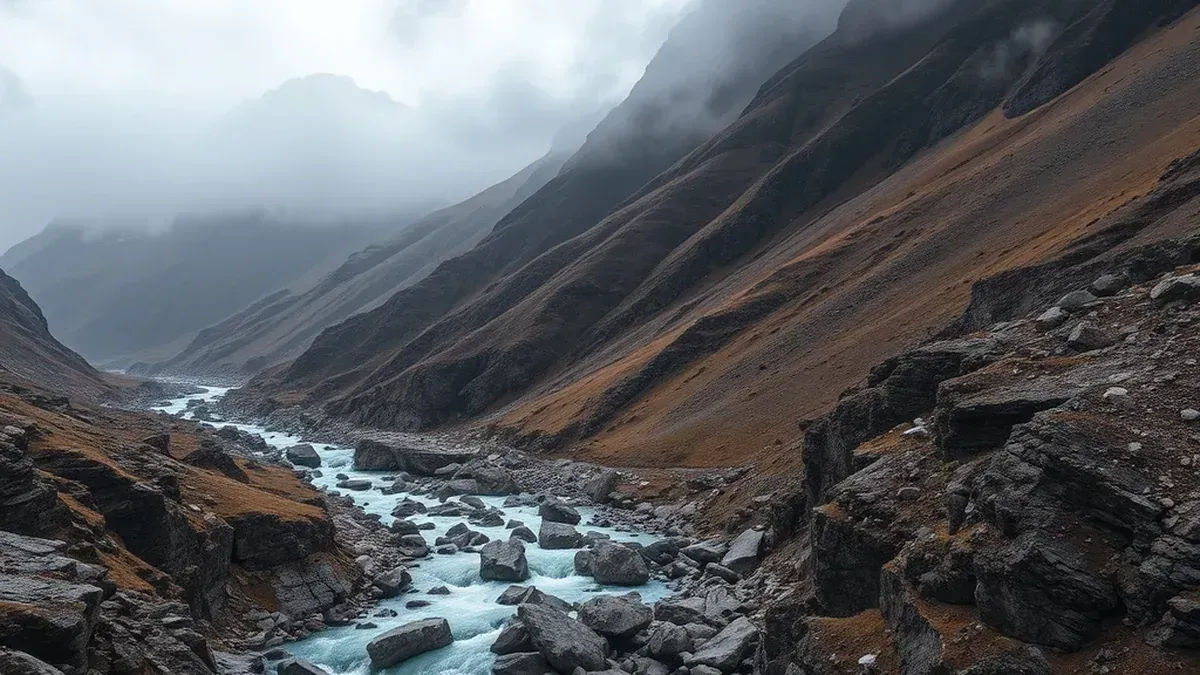
The death toll from the catastrophic flash floods that struck northern and central Nepal on August 26 has climbed to 1,282, with authorities reporting that more than 4,700 people remain missing. The disaster, which devastated villages and infrastructure along the Nepal-Tibet border, has left thousands of families in a state of uncertainty as search and rescue operations continue under challenging conditions. Among the missing are approximately 600 children from the Rasuwa and Nuwakot districts, according to reports from the region.
The floods were triggered by a massive ice-rock avalanche from the Langtang Lirung peak, which plunged into the Lhende Khola river. The resulting torrents swept through the Trishuli Valley, destroying homes, roads, and power infrastructure. Scientists are currently investigating the precise mechanisms behind the event, which has highlighted Nepal's extreme vulnerability to climate-induced disasters despite the country's minimal contribution to global greenhouse gas emissions.
Humanitarian Crisis and Search Operations
The scale of the destruction has overwhelmed local resources, with debris and thick layers of silt covering entire villages and blocking critical transport routes. Security forces are currently engaged in a massive joint search operation to locate the 4,798 individuals still unaccounted for. Rescuers are utilizing drones and rafts to navigate the treacherous, mud-filled terrain, though the search is hampered by the sheer volume of debris and the instability of the landscape.
In one notable instance of survival, two workers were rescued alive from a tunnel at a hydropower project in Rasuwa ten days after the initial flood. However, such successes remain rare as the window for finding survivors closes. The government is now coordinating with international partners to provide medical aid and forensic support, including DNA profiling services for the families of the missing, to assist in the identification of victims.
The Destruction of Tribhuvan Trishuli Secondary School
Among the infrastructure lost in the deluge was the Tribhuvan Trishuli Secondary School in the Nuwakot district. The school, which had been rebuilt with an Indian grant in 2022, was completely swept away by the rising waters of the Trishuli River. The building had stood approximately 60 meters above the riverbed, a testament to the unprecedented force of the flash flood.
Despite the total loss of the facility, the school's principal, Rajendra Dawadi, is credited with saving the lives of over 1,600 students. Upon receiving a warning about the rising water levels, Dawadi immediately ordered an evacuation, allowing the children to flee on foot and seek shelter on higher ground. Indian Ambassador to Nepal, Naveen Srivastava, met with Dawadi to commend his actions and has formally pledged that India will support the full reconstruction of the school.
Expert Analysis on Climate Risks
Safi Ahsan Rizvi, a disaster risk analyst and former advisor to India’s National Disaster Management Authority (NDMA), emphasized that the Nepal floods serve as a stark warning for the entire Himalayan region. In an interview, Rizvi identified the event as a classic glacial lake outburst flood (GLOF) scenario, exacerbated by the rapid melting of glaciers due to climate change. He noted that these events are becoming more frequent and intense, posing an existential threat to mountain communities.
Rizvi argued that South Asian nations must move beyond viewing disaster management as a purely national responsibility. He called for the establishment of a robust, regional data-sharing mechanism that treats real-time information on glacial stability and weather patterns as a shared public good. According to Rizvi, such cooperation is essential for developing effective early-warning systems that can save lives before the next disaster strikes.
Future Preparedness and Regional Cooperation
The disaster has reignited discussions regarding the need for long-term climate adaptation strategies in the Himalayas. With thousands of people still missing and the economic cost of rebuilding expected to reach into the billions, the Nepalese government faces the daunting task of recovery. The international community’s response, including aid from India, has been critical in the immediate aftermath, but experts warn that sustained investment in resilient infrastructure is required.
Moving forward, the focus will likely shift toward mapping high-risk glacial lakes and improving the structural integrity of critical facilities in flood-prone valleys. The tragedy has underscored the necessity of integrating climate risk assessments into all future development projects in the region. As the search for the missing continues, the focus remains on providing closure to grieving families and ensuring that the lessons learned from this catastrophe lead to tangible improvements in regional disaster preparedness.