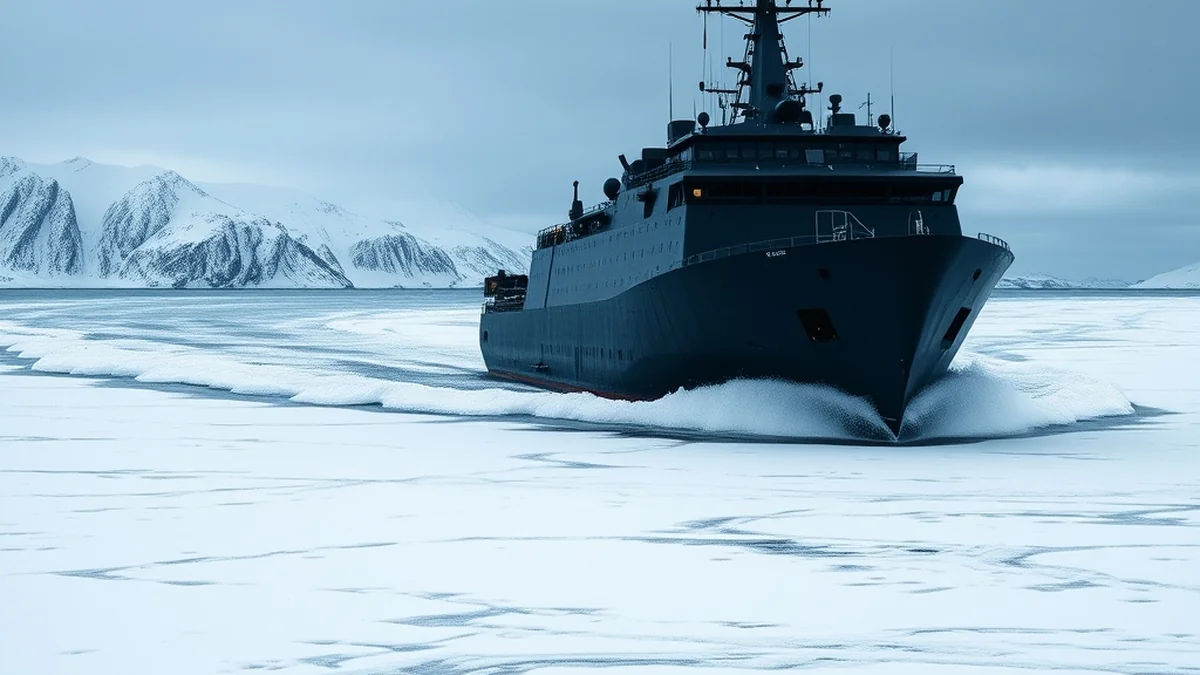
A combined naval force from Great Britain, Norway, and the United States intercepted and disrupted a covert Russian military exercise in Arctic waters near the Svalbard archipelago earlier this spring. The classified operation targeted deep-sea submersibles operated by Moscow's Main Directorate of Deep-Sea Research, known by its Russian acronym GUGI, as they tested specialized technology designed to disable critical underwater fiber-optic cables without leaving identifiable traces. Western defense officials confirmed that allied maritime forces tracked the stealth vessels at sea and directly confronted them, forcing the Russian submersibles to abort their exercise and withdraw from the sensitive zone.
Although British and Norwegian authorities publicly acknowledged detecting covert Russian naval movements in April, the deployment of this specific destructive technology, the exact Arctic coordinates near Svalbard, and direct American military participation were kept strictly confidential until now. The deep-sea encounter highlights acute security concerns among Western intelligence agencies that the Kremlin is systematically refining infrastructure sabotage capabilities while testing the operational resolve of NATO's Article 5 mutual defense commitments.
Deep-Sea Face-Off Near Svalbard Satellite Infrastructure
The intercepted Russian maneuver took place in high-altitude polar waters situated directly above vital seabed communications corridors. Lying at depths reaching 2,700 meters below the surface, two 1,400-kilometer fiber-optic lines connect mainland Norway to Svalbard. These undersea conduits transmit massive volumes of polar orbit data from the SvalSat ground station, the largest facility of its kind globally and a core component of NASA's Near Space Network.
Western officials disclosed that Russian crews were actively simulating the precise operational steps required to deploy the subsea weapon against commercial and scientific communications lines. Following the maritime confrontation, diplomatic and military envoys from London and Oslo traveled directly to Moscow to present captured tactical data. The joint delegation warned Russian counterparts that NATO allies had full visibility over the secret deep-sea capability, aiming to deter any operational employment during potential military conflicts.
Escalating Hybrid Operations Across European Frontiers
Security analysts view the Arctic subsea exercise as part of a broader acceleration in Russian hybrid warfare targeting European sovereign territory as static frontlines persist in Ukraine. Multiple European governments, including Poland, Lithuania, and Romania, have documented territorial airspace and infrastructure violations over recent months. In August, an attempted drone assault aimed at Germany's Leipzig/Halle Airport prompted Berlin to shut down a Russian consulate in Bonn and close a cultural center operating in Berlin.
Concerns over escalating covert actions prompted Central Intelligence Agency Director John Ratcliffe to conduct an unannounced official visit to Moscow in August. Intelligence sources confirmed that Ratcliffe met directly with Russian intelligence chiefs to deliver explicit warnings against continuing sabotage operations in Western Europe, though details regarding specific discussions on subsea activity remain undisclosed by both Washington and the Kremlin.
Strategic Significance of the Bear Gap Maritime Passage
The tactical standoff near Svalbard focuses military attention on the Bear Gap, a critical 400-mile maritime choke point situated between the southern edge of the Svalbard archipelago and northern Norway. Russian nuclear submarines homeported on the Kola Peninsula must transit this icy gateway and pass Norway's volcanic island of Jan Mayen to gain unrestricted access to the North Atlantic Ocean.
In response to the heightened subsea activity, Britain deployed military units to Jan Mayen in August alongside Norwegian and American forces. The triad conducted joint High North exercises specifically designed to project allied surveillance capabilities and demonstrate rapid-response readiness across the strategic maritime corridor.
Seabed Intelligence Gathering and Maritime Drifting Surveillance
The Svalbard operation highlights a broader, measurable increase in Russian maritime intelligence collection targeting critical subsea energy and telecommunications grids across European waters. Industry data from maritime analytics firm Windward reveals that suspicious vessel behavior, specifically slow-speed hovering over seabed cables known as drifting, surged 52 percent in the North Sea during 2025 to reach 13,079 recorded instances. Global drifting in the South China Sea similarly rose 88 percent to 18,401 vessels.
While surveying seabed geography in international waters remains legal under international maritime law, Western defense planners characterize systematic mapping as direct operational targeting. In the Baltic Sea, where at least 11 subsea cables suffered physical cuts or damage between October 2023 and late 2025, defensive measures such as NATO's Baltic Sentry program and the UK-led Nordic Warden taskforce helped reduce regional drifting by 5 percent to 526 vessels last year.
Commenting on the underwater threat landscape, Windward Chief Executive Ami Daniel observed that "the current thinking is that Russia and China are probably the most active and critical underwater threats." Institutional analysts stress that Europe's rapid adoption of digital and energy infrastructure has outpaced its defensive posture. Bruce Jones, a senior fellow at the Brookings Institution, stated: "In the last 25 years, Europe did two things simultaneously. It dramatically expanded the extent to which it relies on seabed infrastructure, and it dramatically shrunk its capacity to protect that infrastructure. It's belatedly rebuilding now, in the face of a burgeoning Russian threat."
High North Infrastructure Upgrades and Allied Monitoring Milestones
Official statements from regional leadership emphasize that NATO allies intend to maintain permanent surveillance over High North corridors. Norwegian Defence Minister Tore Sandvik underscored the deterrent stance in an official statement: "Through our joint operation, we sent a clear message to Russia that they cannot operate covertly. We have made it unequivocally clear to Russian authorities that any attempt to target our critical infrastructure will be detected and met with consequences. It is in no one's interest to escalate tensions in the High North."
To secure long-term digital resilience, Norway has finalized infrastructure plans to construct and commission a new subsea fiber-optic cable network connecting mainland Norway to Svalbard and Jan Mayen by 2028. Concurrently, Western intelligence agencies and NATO naval commands are expanding joint Baltic and Arctic maritime monitoring patrols to guard deep-water infrastructure against potential covert interdiction.