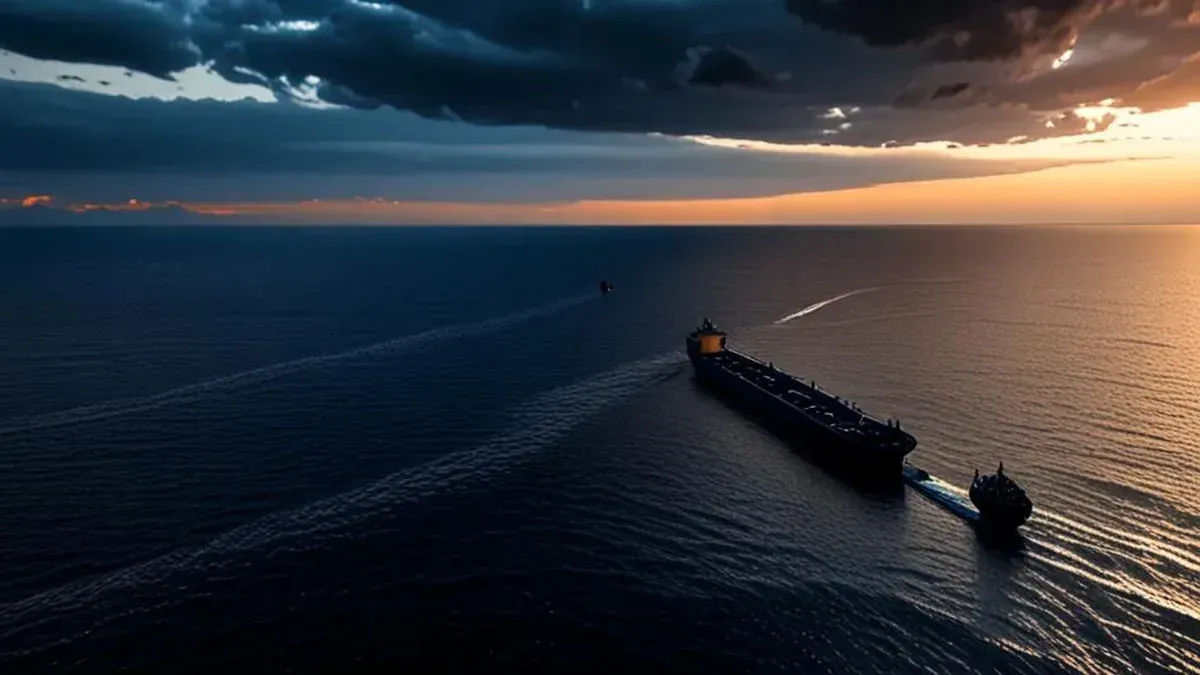
Iran’s leadership announced plans on Sunday to establish a contested maritime exclusion zone near the strategic Strait of Hormuz, escalating an ongoing six-month military conflict with the United States. Mohsen Rezaei, the newly appointed head of Iran’s Supreme National Security Council, stated in a broadcast on state television that vessels attempting to transit the vital waterway will face Iranian sanctions if they enter the newly demarcated perimeter.
The declaration follows a weekend flare-up in hostilities that involved ballistic missile launches at American warships, U.S. airstrikes destroying three oil tankers linked to the Iranian Revolutionary Guards, and disputed claims over an attacked naval drone. The renewed violence shatters a month of relative quiet in the region, threatening vital international shipping lanes through which a significant portion of global energy supplies flows.
Demarcation of the Prohibited Maritime Zone
According to Iranian officials, the planned exclusion zone will originate from the boundary of the U.S. naval blockade and extend across portions of the Persian Gulf leading into the Strait of Hormuz. "In the coming days, a prohibited zone will be announced outside the Strait of Hormuz. This zone will start from the US Navy’s blockade line and include areas of the Persian Gulf," Mohsen Rezaei told state television. Tehran has warned that any commercial ship entering this corridor without authorization will be placed immediately on an Iranian sanctions blacklist.
The precise geographic coordinates and operational boundaries of this proposed zone remain ambiguous, particularly regarding where Iran officially calculates the U.S. blockade line. The American military maintains a robust presence of more than 20 warships enforcing restrictions aimed at halting Iranian oil exports. According to U.S. tracking data, the blockade has redirected 92 commercial vessels and disabled three ships since operations intensified following the collapse of diplomatic negotiations.
Retaliatory Strikes and Naval Clashes
The announcement of the exclusion zone directly follows a violent exchange that began when U.S. Central Command reported that Iranian forces unsuccessfully targeted two American warships—an aircraft carrier and a destroyer. In swift retaliation, U.S. military forces launched airstrikes targeting three oil tankers identified by Washington as integral components of a shadow financial network funding the Iranian Revolutionary Guards and regional proxies. Video footage released by the military showed massive fireballs consuming the vessels.
Iran countered with its own military claims, asserting that its naval units successfully struck three unauthorized oil tankers in the strait alongside three vessels affiliated with the United States. Furthermore, Iranian state media reported the destruction of an unmanned U.S. naval drone attempting to enter the strait. However, CENTCOM spokesman Captain Tim Hawkins dismissed the drone destruction claim as "a complete lie," underscoring the deep information divide accompanying the kinetic conflict.
Hardening Political Postures and Deadlocked Diplomacy
Senior political figures in Tehran have signaled an uncompromising approach as the six-month conflict grinds forward without an apparent diplomatic off-ramp. Iranian Parliament speaker Mohammad Bagher Ghalibaf declared that "the era of proportionate responses has come to an end," warning that future attacks would trigger faster and more severe retaliation. Iranian leadership has similarly expressed profound frustration with regional mediators from Oman, Qatar, and Pakistan, arguing that diplomatic guarantees failed to prevent violations during the brief mid-June memorandum of understanding.
Washington figures have maintained an equally firm posture, linking any potential resumption of talks directly to the cessation of attacks on commercial shipping. U.S. Energy Secretary Chris Wright argued during television appearances that Iran’s persistent naval maneuvers reflect desperation as its military capabilities dwindle under economic pressure. Despite ongoing hostilities, Wright asserted that global energy markets remain partially cushioned, with roughly two-thirds of pre-conflict oil volumes continuing to flow through regional pipelines and naval-escorted tanker routes.
Economic Pressures and Energy Market Realities
The protracted maritime confrontation continues to strain global supply chains while testing the economic endurance of both adversaries. The Strait of Hormuz historically serves as a crucial artery for global oil and natural gas shipments, making every military engagement a matter of immediate international concern. While Washington attempts to choke Iran’s fiscal lifelines through comprehensive secondary sanctions targeting foreign financial institutions, Tehran insists its trade apparatus remains resilient.
Iranian officials claim that petroleum exports continue at a rate of one million to one and a half million barrels per day through circumvented channels, maintaining state revenues despite the Western blockade. Concurrently, U.S. officials maintain that active naval escorts are successfully preserving essential throughput, dampening the potential for catastrophic energy price spikes as the conflict enters an increasingly unpredictable phase.