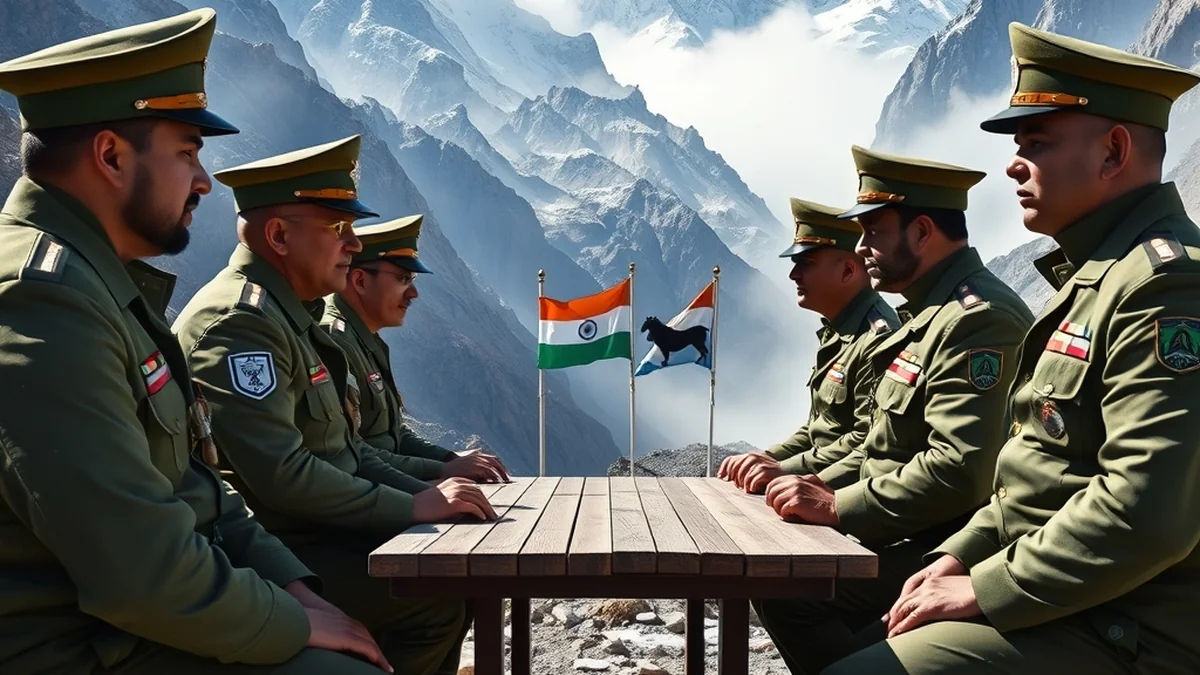
India and China have conducted their first-ever Corps Commander-level military talks in the eastern sector, holding a two-day bilateral engagement across the Line of Actual Control (LAC) in Arunachal Pradesh. The Ministry of External Affairs (MEA) announced the milestone on Tuesday, characterizing the high-level military dialogue as a critical step in ongoing efforts to maintain peace and stability along the disputed border.
The meetings, which took place on September 6 and September 7, 2026, occurred amid persistent localized tensions in the Taksing area of Arunachal Pradesh’s Upper Subansiri district. This development represents a major expansion of the high-level military-to-military communication channels, which have previously been concentrated almost exclusively in the western sector of Ladakh since the major border standoff began in 2020.
Cross-Border Military Dialogue in Arunachal Pradesh
The two-day military engagement was split between venues on both sides of the LAC to ensure diplomatic parity. According to MEA spokesperson Randhir Jaiswal, the first session of the highest military Corps Commander-level flag meeting took place on September 6 at Wacha on the Indian side of the border in Arunachal Pradesh. The second session followed on September 7 at Damai, located on the Chinese side of the boundary.
The Indian delegation was led by Lt Gen Girish Kalia, Commander of the Rangapahar-based 3 Corps. Known colloquially as the "Spear Corps," this formation is headquartered near Dimapur in Nagaland and holds the primary operational responsibility for guarding India's sensitive and rugged far-eastern frontier. The moniker "Spear Corps" historically reflects the unit's role as the forward-deployed, sharp edge of India's defense posture in the northeast, tasked with rapid response along the difficult terrain of the eastern LAC. The Indian Army manages this sector through two primary formations: the 3 Corps and the Tezpur-based 4 Corps.
Diplomatic Foundations and the Eight-Point Consensus
This inaugural eastern sector military dialogue did not occur in isolation; it was the culmination of intensive diplomatic groundwork laid over the past year. MEA spokesperson Jaiswal noted that the talks followed foundational agreements reached between the special representatives of both nations in August 2025 and between May and August 2026. These agreements were further refined during Working Mechanism for Consultation and Coordination (WMCC) meetings held alternately in Beijing and New Delhi.
A critical catalyst for the military talks was a high-level meeting in Beijing on August 25, 2026, between Indian National Security Adviser (NSA) Ajit Doval and Chinese Foreign Minister Wang Yi, who serve as the respective Special Representatives for boundary negotiations. During their discussions, the two representatives agreed to an eight-point consensus designed to secure long-term peace and stability along the LAC, paving the way for direct operational coordination between local corps commanders.
Contrast with Western Sector Mechanisms and Taksing Tensions
The establishment of the eastern sector dialogue mirrors a long-standing communication framework used in Ladakh. Since the 2020 border standoff, India and China have held 23 rounds of Corps Commander-level meetings at the Chushul-Moldo border meeting point in the western sector. While those talks focused on resolving friction points in Ladakh, the eastern sector had lacked a corresponding high-level military mechanism until this week.
The urgency of the new mechanism is highlighted by ongoing operational challenges in Arunachal Pradesh. Indian troops remain deployed in large numbers in the Taksing area of the Upper Subansiri district to prevent any escalation of localized standoffs. Prior to the Corps Commander-level talks, local military commanders from both sides had held multiple rounds of meetings in recent weeks to manage immediate operational friction on the ground.
Path to Normalization and the Upcoming BRICS Summit
The military talks coincide with broader efforts to stabilize the diplomatic and economic relationship between the two nuclear-armed neighbors. Addressing the prospects of normalisation, MEA spokesperson Jaiswal stated, "India-China ties are gradually moving in a positive direction. This gradual normalisation of ties, people-to-people ties are very important. And when we talk of people-to-people ties or normalisation of people ties, we also talk about visa issues that help in promoting them."
These diplomatic maneuvers occur just ahead of the BRICS Summit, scheduled for September 12-13, 2026, in India. Chinese President Xi Jinping is expected to travel to India for the summit, marking his first visit to the country since October 2019, when he attended the second informal bilateral summit in Mamallapuram, Tamil Nadu. The military de-escalation talks are widely seen as crucial to establishing a stable political environment ahead of the multilateral summit.
Broader Regional Security: Rajnath Singh’s Landmark Sri Lanka Visit
As military commanders negotiated along the northern border, India simultaneously moved to reinforce its southern maritime alliances. Indian Defence Minister Rajnath Singh arrived in Colombo on Tuesday for a three-day official visit, marking the first time an Indian defence minister has traveled to Sri Lanka for bilateral defence talks in nearly 40 years, since KC Pant’s visit in 1988.
Addressing the Indian diaspora in Colombo, Singh emphasized the deep civilizational ties between the two nations, stating, "The relationship between India and Sri Lanka is based on shared history, culture, and faith. We stand with Sri Lanka through thick and thin and are committed to the peace, prosperity, and development of both countries." Singh highlighted that Sri Lanka remains a vital partner under India's "Neighbourhood First" and "MAHASAGAR" maritime security initiatives. He also briefed the diaspora on India's domestic economic trajectory, noting that the national economy has doubled to approximately $4 trillion over the past decade, registering a 7.8% growth rate in the first quarter of the 2026-27 financial year.
Next Steps in Border Management and Regional Diplomacy
The immediate focus for both military delegations is the implementation of the newly established eastern sector communication protocols to resolve the localized standoff in the Taksing area. Military officials from the 3 Corps and their Chinese counterparts are expected to establish regular communication channels modeled on the Chushul-Moldo framework. Diplomatically, the focus shifts to the BRICS Summit on September 12-13, where bilateral meetings may further address pending issues, including the relaxation of visa restrictions and the resumption of direct people-to-people exchanges.