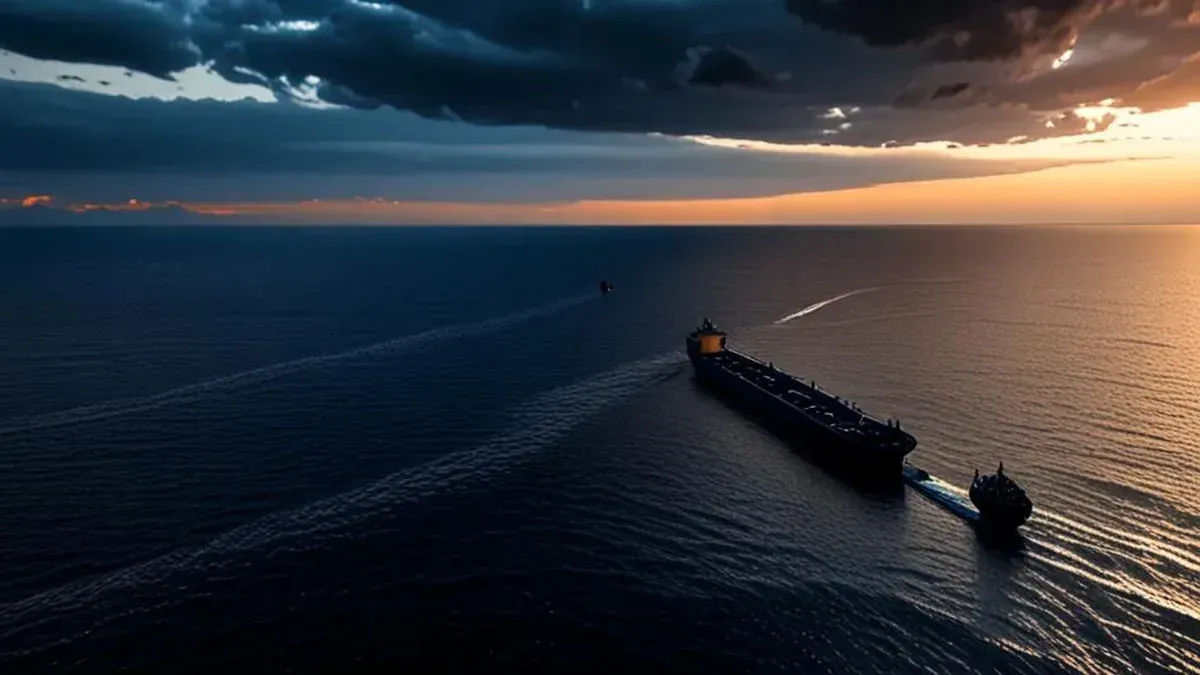
On September 8, 2026, the United States military destroyed five Iranian oil tankers near the Strait of Hormuz, triggering a swift retaliatory barrage from Tehran. Iranian forces launched ballistic missiles at a U.S. military base in Jordan and targeted over a dozen commercial and military vessels in the strategic waterway, driving global oil prices past the $100-per-barrel threshold.
The conflict, which entered its seventh month after erupting in February 2026, has severely disrupted global energy corridors. With the Strait of Hormuz virtually paralyzed, the latest military exchanges have intensified economic anxieties in Washington ahead of the upcoming U.S. midterm elections, even as diplomatic pressure mounts on Tehran through a formal referral to the United Nations Security Council.
Retaliatory Strikes and the Expansion of Maritime Prohibitions
Following the destruction of the five tankers by U.S. Central Command, the Islamic Revolutionary Guard Corps (IRGC) retaliated by targeting two U.S. Navy vessels, eight oil tankers, and ten other ships attempting to navigate the Strait of Hormuz. The United Kingdom Maritime Trade Operations (UKMTO) confirmed that several vessels in the Gulf of Oman and the Persian Gulf were subjected to disabling fire. Additionally, Iran launched a barrage of ballistic missiles at the Al-Azraq airbase in Jordan, though the Jordanian military reported shooting down 18 of the incoming projectiles.
In an expansion of its maritime blockade, the IRGC declared parts of the Gulf of Oman and the Arabian Sea as a new prohibited zone. IRGC spokesman Hossein Mohebi announced on state television that exact coordinates would be released shortly, warning, "If a vessel enters that area without coordination, it will be subject to our sanctions." This move extends Iran's leverage beyond the narrow Strait of Hormuz, through which approximately one-fifth of the world's oil and liquefied natural gas typically flows.
Global Energy Markets React as Crude Breaches Key Threshold
The military escalation immediately reverberated through global energy markets, pushing Brent crude futures above $100 per barrel on September 9 for the first time since July 2024. West Texas Intermediate crude similarly climbed to approximately $95 per barrel. While these prices remain below the peak of $120 recorded during the initial weeks of the war, they represent a 40 percent increase over pre-war levels, compounding inflationary pressures on global economies.
In the United States, the average retail price of gasoline reached $4.22 per gallon, its highest level since early June. This price surge has elevated the political stakes for the White House and congressional campaigns as the November midterm elections approach. U.S. Secretary of State Marco Rubio defended the maritime strikes during a diplomatic visit to Colombia, stating, "Iran continues to try to hit US naval ships, and for every time they do that or try to do that, they're going to lose tankers, and I think you'll see that again today."
Diplomatic Demands and the UN Security Council Referral
The IRGC, which functions as the ideological arm of the Iranian military, indicated that the maritime conflict could be resolved if Washington agreed to a specific set of geopolitical concessions. Spokesman Hossein Mohebi outlined these terms through the Fars news agency, stating that the United States "must... refrain from renewed threats, withdraw the Israeli regime's army from Lebanon, end the blockade of Yemen, release US$24 billion in Iran's frozen assets and refrain from any interference in the country's nuclear and missile capabilities."
Instead of easing pressure, Western allies accelerated diplomatic maneuvers. On September 9, the International Atomic Energy Agency (IAEA) board of governors voted to refer Iran to the United Nations Security Council over nuclear non-compliance. The resolution passed with 23 votes in favor, three against, and eight abstentions. Russia, China, and Niger cast the dissenting votes, highlighting the deep geopolitical divisions surrounding the conflict.
Political Predictions and Regional Conflict Alliances
U.S. President Donald Trump offered a highly optimistic timeline for the war, predicting a swift conclusion tied to domestic political cycles. Speaking to reporters before departing for the Republican National Convention in Dallas, Trump asserted, "I think war is going to end immediately after the election because they can't hold out any longer. They're desperate to try and affect the election." Trump also claimed on social media that "oil prices will drop precipitously, like everything else is dropping (but more!), when we WIN the war with Iran," suggesting retail gasoline could fall to two dollars a gallon.
Despite these predictions, the conflict continues to expand across multiple fronts. In the Red Sea, the Iran-backed Houthi rebels in Yemen have sustained attacks on commercial shipping and recently launched strikes on Saudi Arabian energy facilities, setting oil installations ablaze. Meanwhile, Israeli Prime Minister Benjamin Netanyahu, visiting troops in an occupied security zone in southern Syria, claimed that the Iranian government was nearing its end, stating, "There is still work to be done, the main task is to bring down the terror regime in Iran. We are very close to that."
Pending Security Council Action and Maritime Coordinates
The immediate focus of the maritime standoff turns to the implementation of Iran's newly declared prohibited zone in the Gulf of Oman and the Arabian Sea, with shipping companies awaiting the publication of exact coordinates. Concurrently, the United Nations Security Council is expected to schedule a formal session to address the IAEA nuclear non-compliance referral. The U.S. military maintains its counter-blockade of Iranian ports, leaving shipping lanes highly volatile as both sides brace for further retaliatory strikes.