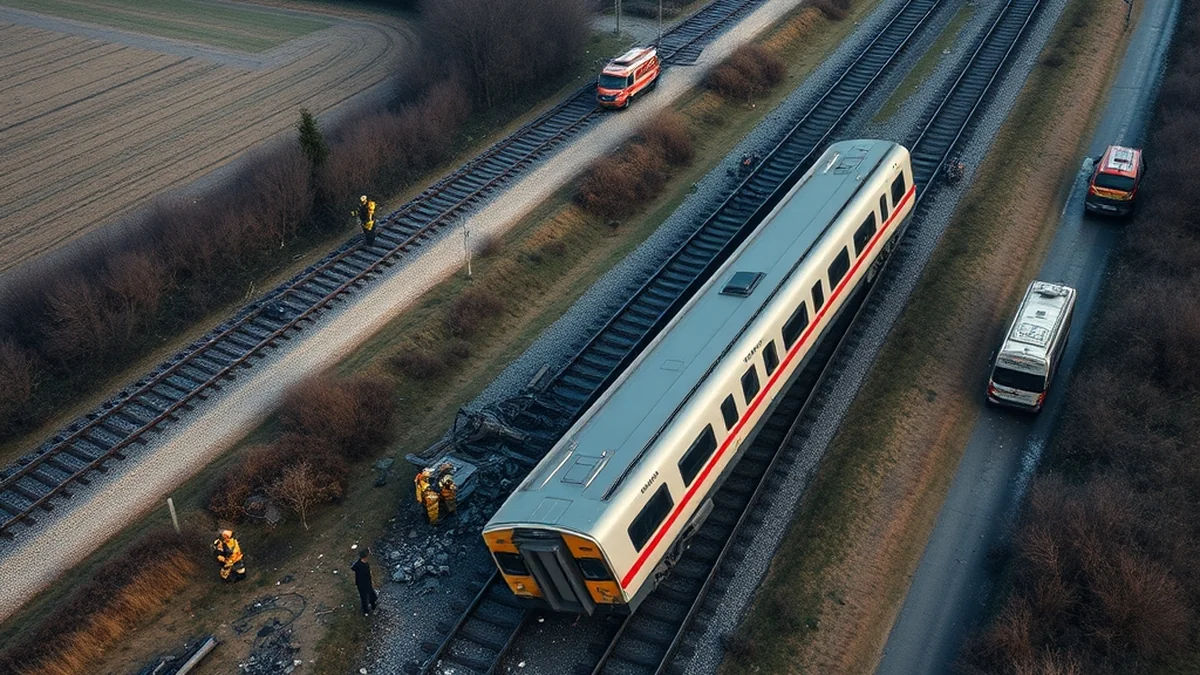
A passenger train traveling between the Normandy cities of Rouen and Caen derailed on Friday evening near the commune of Cléon, leaving at least 44 people injured. Authorities have launched a criminal investigation into the incident, with police sources indicating that the discovery of a rail fragment on the track has led them to treat sabotage as the primary line of inquiry.
The accident occurred shortly before 8:00 pm local time, prompting an immediate mass-casualty response. Emergency services, including 130 firefighters and five medical teams, were deployed to the site near a Renault factory. While most injuries were reported as non-life-threatening, an 18-year-old woman was airlifted to a hospital in Rouen in critical condition. The train, which was carrying approximately 186 passengers, suffered significant damage, with reports indicating that at least one carriage overturned during the derailment.
Investigation into Potential Sabotage
French investigators are currently prioritizing the theory of a malicious act following the discovery of physical evidence at the scene. A police source confirmed that a fragment of rail was found on the track, which has become the central focus of the ongoing probe. The incident is being treated with high priority by local authorities, who are working to determine how the object came to be positioned on the line.
While the investigation remains in its early stages, officials have moved to rule out other potential causes. Rouen prosecutor Sebastien Gallois confirmed that the train driver underwent mandatory testing for drugs and alcohol, with all results returning negative. The rail operator, SNCF, has pledged full cooperation and transparency with the judicial inquiry, stating that the train will remain on-site until the public prosecutor authorizes its removal for further forensic analysis.
Emergency Response and Passenger Impact
The scale of the derailment necessitated the activation of a regional mass-casualty response plan. Beyond the 130 firefighters and five medical teams, authorities deployed 80 vehicles to the site to manage the evacuation and provide immediate medical care. Passengers who were not injured were transported to a facility made available by the mayor of Cléon, where they received support from local authorities.
Witness accounts from the scene describe a sudden and violent event. One passenger, 24-year-old Louis, recounted the experience to local media, stating, "Suddenly there were a few jolts, and then after about three seconds it got stronger and stronger." He added that the impact caused windows to shatter, allowing debris from the track to enter the carriage. The psychological impact on those involved was immediate, with many reporting shock in the aftermath of the crash.
Operational Disruptions and Rail Infrastructure
Following the derailment, SNCF Reseau, the manager of the French rail network, took immediate steps to secure the area. Power to the tracks was cut to allow emergency services to operate safely, and traffic on the Rouen-Caen line was suspended in both directions. The disruption also affected services between Caen and Le Havre, creating significant logistical challenges for commuters in the Normandy region.
By the morning of September 12, SNCF reported that some services had begun to resume, though the affected section remained under strict control. To mitigate the impact on travelers, the operator deployed a fleet of replacement buses to cover the route. SNCF officials have emphasized that their primary focus remains the welfare of the passengers and the restoration of safe operating conditions, though they have not provided a definitive timeline for the full reopening of the damaged track.
Next Steps in the Judicial Inquiry
As of Saturday, the site remains a restricted area under police supervision. The investigation is being conducted jointly by police and rail authorities, who are examining the track infrastructure and the train's technical data to reconstruct the exact sequence of events. The prosecutor's office has not yet released further details regarding potential suspects or the origin of the rail fragment found on the tracks.
Authorities have urged the public to continue avoiding the area near Cléon to allow investigators to complete their work. The next phase of the inquiry will involve a detailed forensic examination of the train carriages and the track bed. Further updates are expected as the prosecutor reviews the evidence collected by the technical teams currently working at the site.