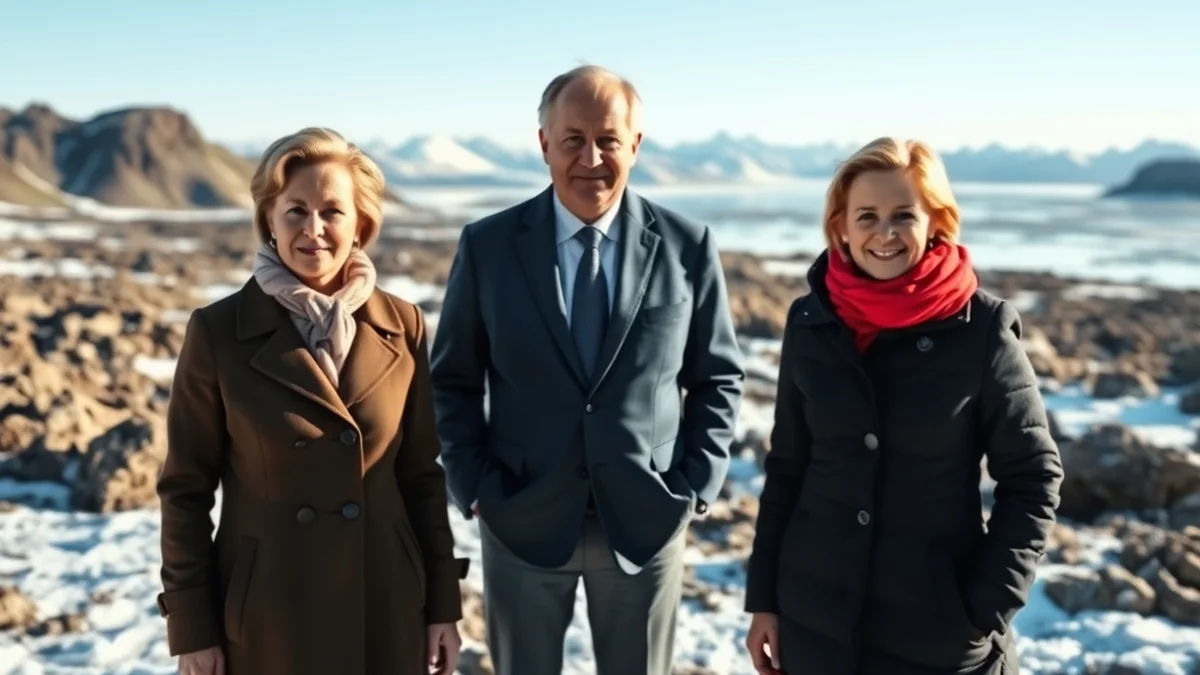
European Commission President Ursula von der Leyen announced a €200 million ($232.3 million) investment package for Greenland on Monday, signaling a significant deepening of the European Union’s economic and strategic engagement in the Arctic. The funding, which is scheduled for deployment throughout 2026 and 2027, was unveiled during a high-profile visit to Nuuk, where von der Leyen signed a joint declaration alongside Greenlandic Prime Minister Jens-Frederik Nielsen and Danish Prime Minister Mette Frederiksen.
The initiative arrives at a period of heightened geopolitical sensitivity regarding the vast, self-governing Danish territory. U.S. President Donald Trump has repeatedly asserted that the United States should acquire Greenland on national security grounds, a stance that has strained trans-Atlantic relations and prompted concerns regarding the island's sovereignty. By bolstering its financial footprint, the European Union is positioning itself as a primary partner for Greenland, emphasizing the bloc's commitment to the region's stability and development.
Strategic Priorities and Economic Focus
The €200 million investment package is structured around three primary strategic pillars, which von der Leyen described as the "big Cs": connectivity, clean energy, and critical raw materials. These sectors are viewed as essential for Greenland’s long-term economic autonomy and its integration into the global supply chain. The funding is intended to support infrastructure projects, including the development of hydropower systems and the expansion of satellite communications, which are vital for the island's remote settlements.
Beyond these core priorities, the package allocates resources toward education, fisheries, sustainable tourism, and housing improvements. The investment represents a substantial commitment, estimated by some observers to be equivalent to approximately 7-8% of Greenland’s annual gross domestic product. This financial injection is designed to provide tangible benefits to local residents while simultaneously securing European access to the island's strategic resources and geographic position.
Diplomatic Solidarity and Sovereignty
During the announcement, von der Leyen emphasized the European Union's unwavering support for the territorial integrity of Greenland. "Greenland can count on the EU," she stated, framing the partnership as a response to the external pressure the island has faced. Her remarks were echoed by Greenlandic Prime Minister Jens-Frederik Nielsen, who expressed deep gratitude for the bloc's support during what he characterized as "challenging times."
The visit served as a clear diplomatic signal that the European Union intends to remain a central player in Arctic affairs. By standing alongside the Danish and Greenlandic leadership, the Commission president reinforced the principle that the future of the territory remains exclusively in the hands of the people of Greenland and Denmark. This stance directly counters the narrative of U.S. annexation, which has been a source of diplomatic friction between Washington and its European allies throughout the year.
The Arctic Security Context
The announcement of the funding package coincides with ongoing military activity in the region, highlighting the island's growing importance in global security calculations. On the same day as the visit, 11 NATO countries commenced "Arctic Shield" military exercises, involving approximately 400 personnel, including special forces trained for extreme cold-weather operations. While these drills are officially aimed at strengthening regional security, they also serve as a visible demonstration of support for Greenlandic sovereignty.
Denmark has navigated a delicate path, seeking to maintain close security and defense cooperation with the United States while simultaneously deepening its ties with European partners. Prime Minister Mette Frederiksen noted that while Denmark values its relationship with the U.S., the current climate has necessitated a stronger, more integrated approach with European allies. The trilateral working group established earlier this year between the U.S., Denmark, and Greenland to resolve sovereignty disputes remains active, though it has yet to produce a definitive agreement.
Future Funding and Long-Term Strategy
Looking ahead, the European Commission has signaled that this €200 million package is merely the beginning of a more robust Arctic strategy. The Commission has proposed a significant increase in funding for the 2028-2034 period, with plans to potentially raise the total commitment to €530 million. This long-term financial roadmap is intended to solidify the EU's role as a primary economic partner for Greenland, moving beyond immediate crisis response to sustainable, multi-year development.
The success of these investments will depend on the effective implementation of projects in remote areas, such as the satellite-based internet services currently being co-financed by Denmark in East and North Greenland. As the Arctic continues to thaw and become more accessible for shipping and resource extraction, the competition for influence in the region is expected to intensify. The EU's current strategy appears to be one of proactive engagement, aiming to secure its interests through economic partnership rather than the territorial posturing that has characterized recent U.S. rhetoric.