
13 Sept 2026, 01:20 PM 4 min readworld
Chile Arrests 284 Amid Mass Protests Commemorating Pinochet Victims
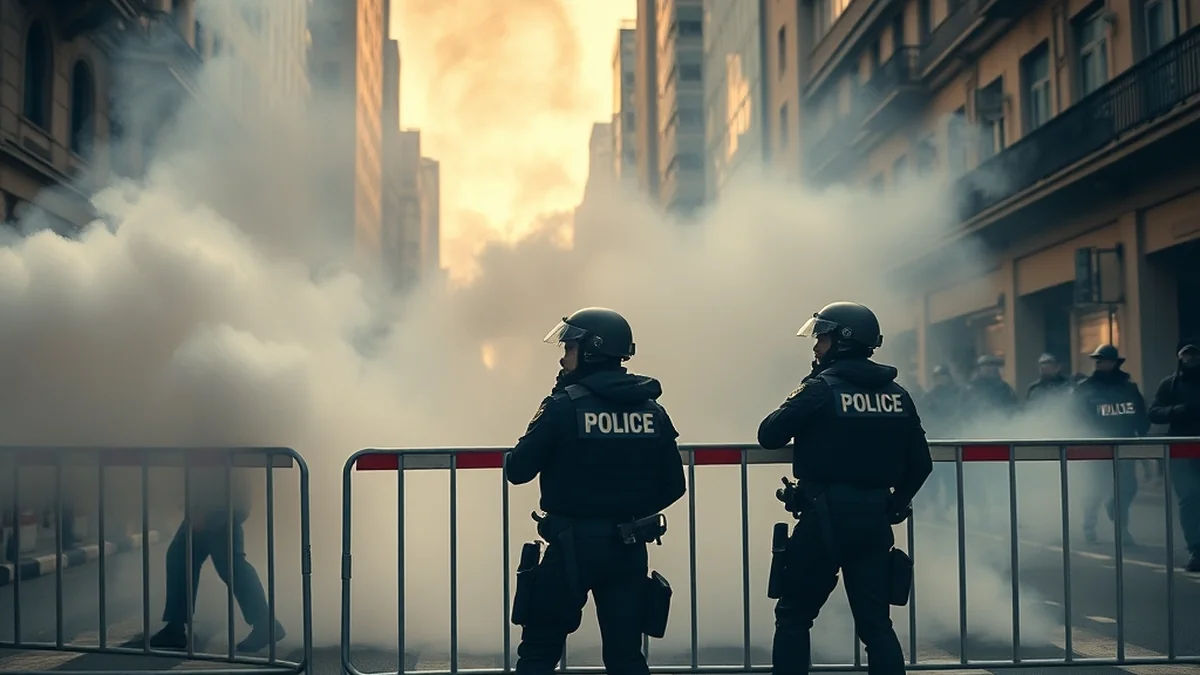
Chilean security forces arrested 284 individuals during widespread demonstrations marking the 53rd anniversary of the 1973 military coup led by Augusto Pinochet. Public Security Minister Martin Arrau confirmed the total following clashes across Santiago on Thursday and Friday, noting an eighty percent surge in detentions compared to the prior year. The unrest unfolded against a tense national backdrop as the administration of President Jose Antonio Kast broke with decades of precedent by forgoing official state commemorations for the historical era.
The demonstrations drew thousands of citizens to iconic historical sites across the capital, including Santiago General Cemetery, the La Moneda presidential palace, and the National Stadium. Protesters clashed directly with riot police, hurling sticks and stones while law enforcement responded with tear gas and water cannons. Among the notable participants at the General Cemetery rally was leftist former president Gabriel Boric, who joined marchers outside the Allende family mausoleum to condemn the legacy of the military regime.
Unprecedented Absence of Official State Commemorations
This year marked the first time since the democratic transition in 1990 that the Chilean government did not hold any official events to observe the anniversary of the coup d'etat. The military dictatorship, which governed the South American nation for seventeen years, left a profound and enduring trauma across society. According to government and human rights documentation, the Pinochet regime was responsible for more than 3,200 deaths and disappearances, alongside the arbitrary imprisonment and torture of tens of thousands of citizens.
The decision to cancel state-sponsored remembrance events stems from the political shift following the election of President Jose Antonio Kast, the country's first far-right head of state since the end of the dictatorship. Defending the administration's stance on national history, President Kast stated that he cannot erase the past or force citizens to remain permanently trapped by historical division. "I cannot erase history, nor can I ask our compatriots to accept that we are condemned by our history to be unable to look toward our nation's future," President Kast said.
Breakdown of Arrests and Violent Clashes in Santiago
Public Security Minister Martin Arrau released official statistics detailing the scope of the police intervention on social media platform X. Authorities logged 198 separate incidents of violence during the two days of demonstrations, though officials confirmed that no civilian injuries were officially recorded. The crackdown involved heavy deployment of riot control units tasked with clearing thoroughfares and protecting critical public infrastructure.
Of the 284 individuals detained by the Carabineros, the demographic breakdown highlighted significant involvement by vulnerable groups and foreign nationals. Public Security Minister Arrau specified that the arrested total included 31 minors and 16 foreign nationals. The heavy-handed policing drew sharp criticism from human rights advocates and opposition groups who monitor state responses to civil unrest and public expression.
Historical Resonance of Protests Across the Capital
The annual demonstrations consistently converge on locations bearing deep historical significance from the dark chapter of the military regime. The National Stadium served as a massive clandestine detention and torture center in the immediate aftermath of the September 11, 1973 overthrow of socialist president Salvador Allende. Meanwhile, the La Moneda Palace remains the site where Allende died by suicide during the military assault on the seat of government.
Demonstrators utilized these symbolic coordinates to voice their ongoing rejection of authoritarian rule and impunity. The convergence of large crowds at these landmarks underscores the unresolved societal grievances surrounding justice and human rights accountability in contemporary Chile. The absence of state recognition this year amplified the urgency felt by demonstrators seeking to keep the historical memory of the victims alive.
Next Steps and Monitoring of Public Security Measures
Judicial authorities in Santiago are currently processing the detained individuals through local courts to determine formal charges related to public disorder and attacks on law enforcement. The Ministry of Public Security has indicated that police forces will maintain an elevated state of readiness in the capital to deter further sporadic protests. Meanwhile, civil society organizations continue to demand full transparency regarding police tactics employed during the two-day security operation.
The Indus Pulse is committed to accuracy and transparency.