
Xreal Launches Aura Wired Smart Glasses Powered by Android XR
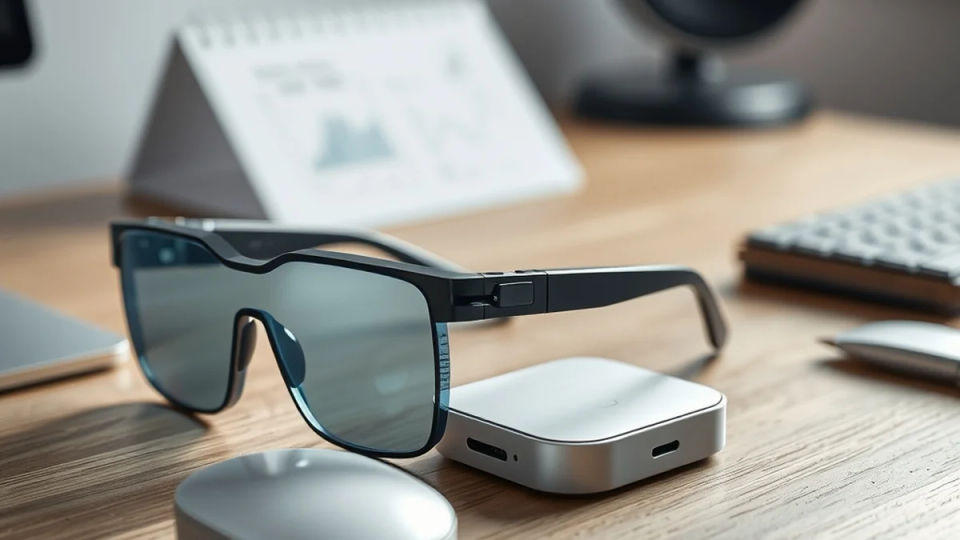
Xreal has introduced the Xreal Aura wired smart glasses during Google's Android Developer Summit on October 28, 2026, marking the first commercially available optical see-through glasses running the Android XR operating system. The wearable headset operates on Qualcomm's Snapdragon Reality Elite platform and relies on a tethered split-compute puck housing the processing core and battery to maintain an ergonomic eyewear weight below 95 grams, compared to 69 grams for competing devices like Ray-Ban Meta. In contrast to bulkier spatial headsets such as Apple's Vision Pro, the physical form factor of the Aura maintains the appearance of traditional glasses by transferring heavy hardware modules to the external hub.
The optical system utilizes Sony Micro-OLED display panels providing 1200p resolution per eye at a 120Hz refresh rate alongside a 70-degree field of view, paired with transparent see-through lenses that overlay interactive digital workspaces onto physical surroundings. Integrated audio hardware is engineered using Bose sound technologies, while Google's Gemini AI provides multimodal assistance by analyzing visual on-screen context and interpreting voice and spatial hand inputs across daily workflows.
Software Ecosystem and Spatial Applications
The device ships with direct access to standard mobile applications and games through the Google Play storefront alongside a catalog of over 150 customized spatial software titles built for Android XR. Featured interactive titles available at launch include the NBA App for Android XR featuring live tabletop court viewing, Andy Serkis's digital narrative Nevatars, tactical skirmish title Fallout: Factions, mixed-reality adventure Project Hail Mary: Journey Among the Stars, NASCAR XR, and an 8K stereoscopic presentation of the San Francisco Ballet Company's The Nutcracker.
For computing productivity, the headset supports wired USB-C mirroring, permitting users to connect personal computers or handheld gaming consoles directly into the glasses to generate private multi-monitor virtual workstations. The platform also incorporates electrochromic dimming to adjust light transmission during multimedia playback.
Regional Availability and Hardware Configurations
Xreal opened consumer preorders for the Aura hardware across the United States, Canada, Japan, and South Korea, with retail shipments scheduled to commence in mid-November 2026. The baseline configuration featuring 12GB of RAM and 256GB of onboard storage carries a standard retail price of $1,279, accompanied by an introductory promotional discount of $200 bringing the initial cost to $1,099 through December.
Consumer reservations for the Xreal Aura topped 10,000 units around August 2026 prior to its official launch, according to Android Central.
Xreal scheduled broader distribution of the Aura XR glasses to select Google Stores and other retail partners across Japan and the United States during 2027, according to Android Central.
A higher-tier edition equipped with 16GB of RAM and 512GB of internal storage retails for $1,499, discounted to $1,299 during the launch period. Xreal co-founder and Chief Executive Officer Chi Xu noted that combining mature optical components, unified software platforms, and multimodal artificial intelligence marks an important inflection point for the broader extended reality hardware sector.
In 2019, Xreal founder and CEO Chi Xu showcased the company's early augmented reality hardware with the nReal Light smart glasses, according to CNET.