
13 Sept 2026, 05:23 PM 3 min readtech
US Researchers Build 40-Foot Highway Sign Structure Using Retired Wind Turbine Blades
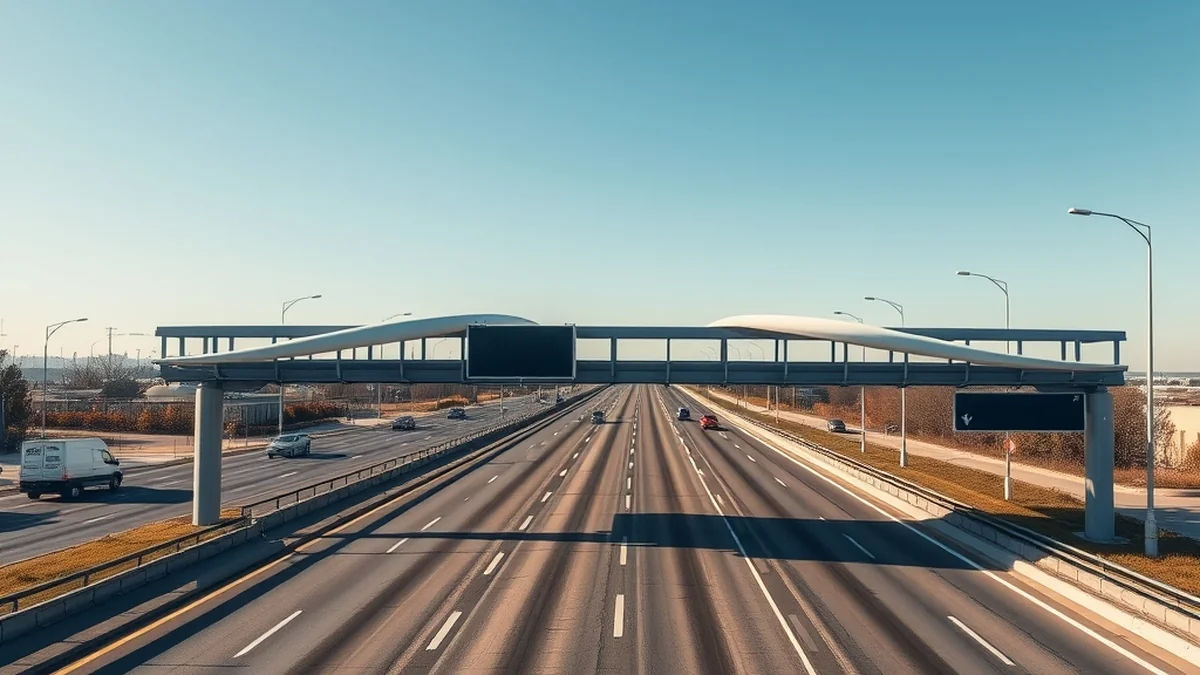
Engineers at the University of Houston have constructed a 40-foot overhead highway sign structure using retired wind turbine blades, bypassing traditional steel trusses and concrete columns. The prototype demonstrates a novel approach to repurposing durable fibre-reinforced polymer composites that otherwise pose significant landfill challenges as thousands of older wind turbines reach the end of their 20 to 25-year service lives.
Testing conducted on retired GE37 turbine blades supplied by Carbon Rivers revealed that the main load-bearing components retained substantial structural strength after decades of service. Full-scale evaluations of 25-foot sections encouraged the research team to advance from laboratory testing to constructing a full-scale prototype spanning roughly 40 feet with an 18.5-foot roadway clearance.
Overcoming Composite Recycling Hurdles
Wind turbine blades are predominantly composed of glass-fibre-reinforced polymer composites engineered to endure extreme weather conditions for decades. While the US Department of Energy notes that approximately 85% to 90% of a wind turbine's total mass can be commercially recycled, the remaining fraction consisting of blade materials and nacelle covers remains notoriously difficult and expensive to process.
Industry projections from the American Society of Civil Engineers indicate that nearly 4 million tons of blade material will require end-of-life management in the United States by 2050. Rather than attempting to break down these complex composite materials into basic chemical constituents, University of Houston researchers investigated whether structural integrity could be preserved by utilizing the blades in their near-original form.
Real-World Weather Testing Under Extreme Winds
The experimental structure received an unintended and rigorous real-world test when a derecho and Hurricane Beryl swept through the Houston area in 2024. Despite experiencing severe meteorological conditions with wind gusts exceeding 100 mph, the repurposed blade structure remained completely intact and stable above the highway.
Engineers had to develop specialized connection methods for the installation, as turbine blades cannot be joined using standard techniques applied to conventional steel beams. The successful weather test provided vital empirical data confirming that the load-bearing capacity of retired blades translates effectively into heavy-duty civil infrastructure applications.
Material Cost Reductions And Emissions Savings
According to research data published by the American Society of Civil Engineers, the repurposed blade design achieved a material cost reduction of approximately 73% compared with standard steel overhead sign installations. Furthermore, the construction method lowered embodied energy and greenhouse-gas emissions by more than 65%.
Each constructed structure has the potential to prevent roughly 248 metric tons of carbon dioxide emissions by extending the lifecycle of existing composite materials rather than manufacturing new structural elements or sending retired blades to landfills. Federal agencies continue to explore supplemental funding and innovation pathways for the remaining hard-to-recycle turbine fractions.
Expanding Civil Infrastructure Applications
The successful deployment of the Houston prototype points toward a wider paradigm shift in civil engineering regarding structural reuse. Instead of defaulting to energy-intensive material breakdown processes, researchers suggest that entire structural components possessing certified mechanical strength can be redirected into secondary infrastructure roles.
Potential future applications range from secondary highway supports to pedestrian bridges and localized civil engineering projects where the residual load-bearing capacity of composite materials can be safely harnessed. The approach aligns with broader federal initiatives to optimize end-of-life management for renewable energy infrastructure as aging wind farms nationwide approach decommissioning phases.
The Indus Pulse is committed to accuracy and transparency.