
India Advances Semicon 2.0 as Telecom, Auto, and Chemical Makers Scale
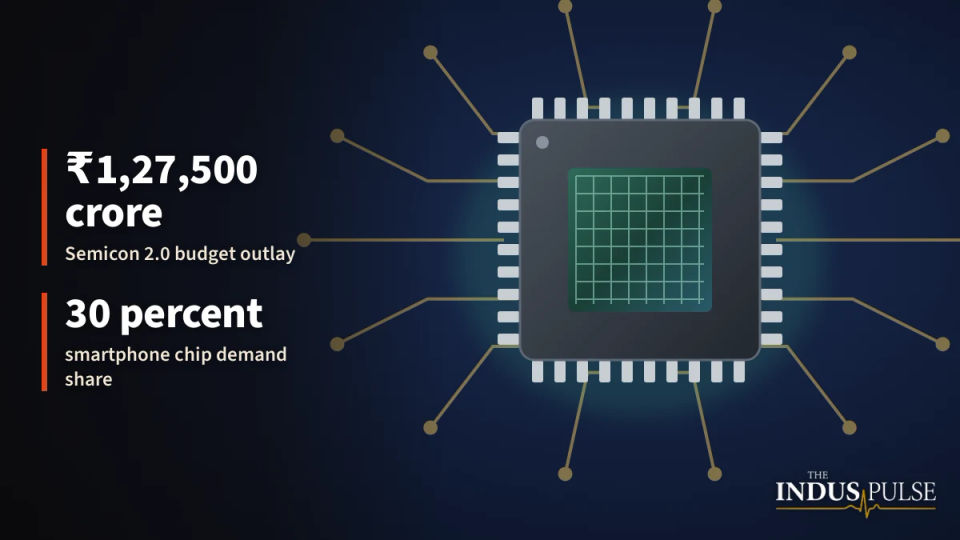
Following Semicon 1.0, India's Union Cabinet, chaired by Prime Minister Narendra Modi, approved Semicon 2.0 in July 2026 with a ₹1,27,500 crore budget to expand domestic chip design and fabrication, Convergence Now reported. Ministry of Electronics and Information Technology Joint Secretary Sushil Pal stated that India's semiconductor sector is transitioning past a supply-driven approach, driven by telecom and automotive industries shaping chip architecture and computing requirements, Convergence Now reported.
Shift toward customised silicon and edge computing
Pal explained that chipmakers and foundries once formed a small group that controlled manufacturing capacity and technology roadmaps, Convergence Now reported. He also pointed to growing adoption of edge computing to bring data processing closer to where information is generated, and said the next decade could benefit from private investment and domestic supply-chain partners, Convergence Now reported.
Industry demand at ET Silicon Shift 2026
At the ET Silicon Shift 2026 event in New Delhi, industry leaders said India's semiconductor future will be shaped by demand across multiple sectors given the capital-intensive nature of chip manufacturing, Economic Times reported. Ashok Chandak, president of SEMI and IESA, said domestic demand can provide anchor customers and initial support while semiconductor manufacturing ultimately serves a global market, according to Economic Times.
Infineon Technologies vice president Vivek Mahajan said demand will emerge across energy infrastructure, mobility, vehicle electrification, homes, appliances, smart-home technologies, and the industrial sector rather than one single segment, Economic Times reported. Oppo and OnePlus R&D managing director Tasleem Arif added that smartphones account for nearly 30 percent of the semiconductor market, with a typical smartphone using around 500 to 600 semiconductor components, according to Economic Times.
Domestic electronic-grade chemical supply
Alongside chip design and fabrication efforts, Shivtek Spechemi Industries, part of the Shiva Group of Industries, said it will establish a dedicated electronic-grade chemicals manufacturing facility at Pungam in Gujarat, Chemindigest reported. Building on nearly 40 years of chemical manufacturing experience and in-house R&D, the company plans to begin phased commercial production in 2027 and 2028 of ultra-high-purity hydrochloric acid, isopropyl alcohol, and hydrogen peroxide for wafer cleaning and fabrication, according to Chemindigest. Union Minister Ashwini Vaishnaw now expects Tata Electronics' wafer fab to begin commercial operations in mid-2028 rather than Tata's earlier target of end-2026, according to ExpertLancing.
Background
Under Pillar 4 of Semicon 2.0, applicants must have at least ₹1,000 crore of investment and ₹200 crore of revenue, with support released over six years and applications open for three years from the September 16, 2026 guidelines, according to Skill-Lync.
India's original ₹76,000 crore mission included a ₹1,000 crore Design Linked Incentive (DLI) scheme whose 24 sanctioned projects produced 16 tape-outs, six fabricated chips, and ten patent filings by January 2026, according to ExpertLancing.
Under Pillar 4 of Semicon 2.0, the government pays 35% of eligible capital expenditure for advanced packaging and advanced substrates, and 25% for legacy packaging, pari-passu, according to Skill-Lync.
The Union Cabinet approved Semicon 2.0 on July 15, 2026, according to Press Information Bureau (PIB).