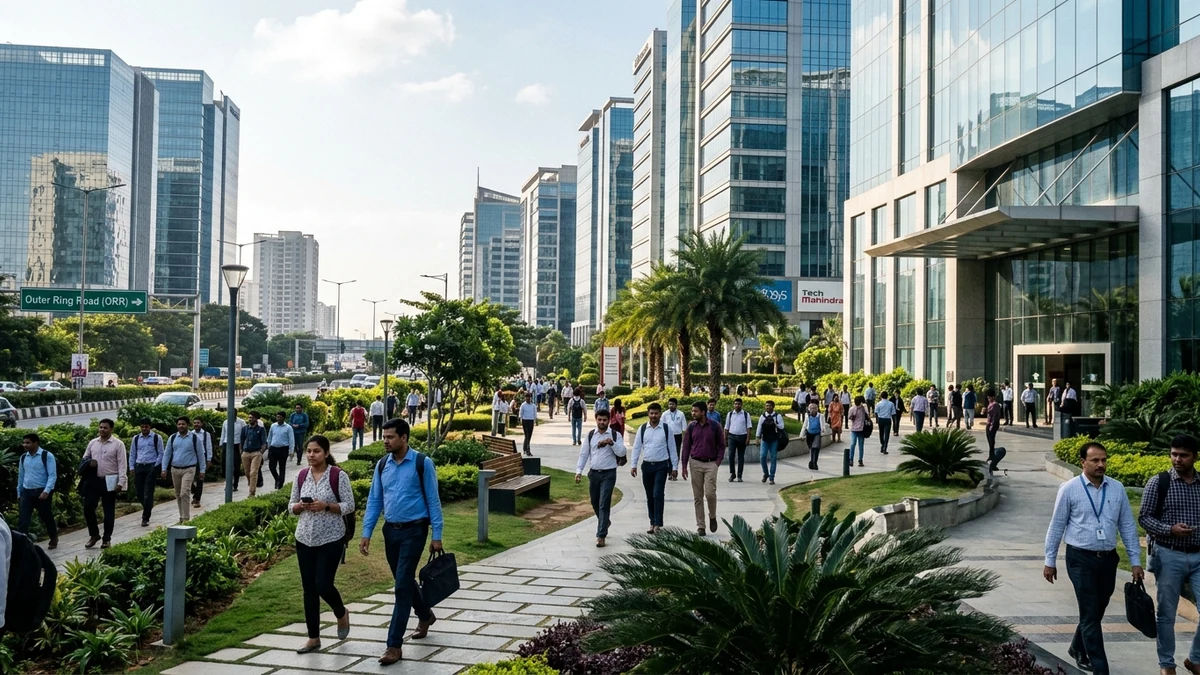
A viral public discourse regarding a mid-career Bengaluru technology professional earning a monthly take-home salary of ₹2 lakh (equivalent to an annual gross compensation package exceeding ₹30 lakh) who voiced feelings of acute financial anxiety has ignited a nationwide debate on urban cost-of-living inflation in India’s high-tech capitals. While an income placing an individual comfortably within the top 2 percent of national wage earners was historically considered the foundation of upper-middle-class affluence, shifting economic realities across Bengaluru, Hyderabad, and Pune have complicated that assumption.
Economic analysts, wealth managers, and urban sociologists emphasize that the sentiment, while frequently greeted with skepticism from wider public observers, reflects structural financial pressures unique to metropolitan technology corridors. Skyrocketing residential rental inflation, exorbitant private school tuition fees, hyper-inflated healthcare insurance copays, and mandatory lifestyle expenditures in gated satellite suburbs have dramatically compressed real discretionary savings, fundamentally transforming the purchasing power of elite corporate compensation.
Granular Cash Flow Breakdown: Where Does a ₹2 Lakh Monthly Salary Go?
To understand how a ₹2,00,000 monthly net salary can feel constrained, financial planners have modeled the typical fixed expenditure ledger of a mid-career technology couple with one or two school-going children living along Bengaluru’s high-density IT corridors (Outer Ring Road, Bellandur, Whitefield, or Sarjapur):
1. Residential Housing and Maintenance: Rent for a standard three-bedroom apartment in a gated residential society near tech parks currently commands between ₹65,000 and ₹85,000 monthly, accompanied by maintenance levies of ₹6,000 to ₹10,000. For those who purchased apartments at peak prices, home loan EMIs routinely absorb between ₹80,000 and ₹1,10,000 monthly.
2. Private School Education: Annual tuition fees across premier international curricula (IB, IGCSE, or elite ICSE institutions) range from ₹2.5 lakh to ₹4.5 lakh per child annually. Factoring in school transport, specialized sports coaching, and extracurricular tutoring, educational outlays account for approximately ₹30,000 to ₹50,000 per month.
3. Transportation and Commuting Costs: Fuel, vehicle EMI, and insurance for a family car, alongside ride-hailing subscriptions to navigate congested metropolitan roads, consume between ₹15,000 and ₹25,000 monthly.
4. Household Groceries, Utilities, and Domestic Support: Quality organic groceries, broadband, electricity bills, and domestic household help (cook and maid services) total ₹25,000 to ₹35,000 per month.
5. Healthcare and Discretionary Buffer: Out-of-pocket medical expenses, term insurance premiums, and modest family leisure activities absorb the remaining ₹15,000 to ₹25,000.
Under this realistic urban ledger, fixed monthly outlays easily surpass ₹1,60,000 to ₹1,85,000, leaving a precarious discretionary surplus of less than 10 to 15 percent for liquid long-term retirement investments or unforeseen medical emergencies.
The Engine of Hyper-Inflation: Bengaluru’s Post-Pandemic Rental Shock
The primary driver behind compressed urban cash flows is the unprecedented post-pandemic rental explosion across Bengaluru’s eastern and southern suburbs. With multinational tech corporations and Global Capability Centers (GCCs) enforcing strict Return-to-Office (RTO) mandates requiring employees to be physically present in offices three to four days weekly, over half a million professionals converged back on tech hubs within an eighteen-month window.
With high-density residential supply along the Outer Ring Road severely constrained by delayed civic infrastructure projects and zoning regulations, residential rents surged by 40 to 65 percent between 2022 and 2024. Landlords routinely demand ten-month security deposits upfront (amounting to ₹6 lakh to ₹8 lakh in locked liquid capital) and enforce annual escalation clauses of 10 to 12 percent. This shelter inflation has disproportionately absorbed white-collar salary increments, preventing young families from accumulating liquid wealth.
The Psychological Dimension: Lifestyle Creep and Relative Deprivation
Beyond hard mathematical expenditures, sociologists point toward the powerful psychological phenomenon of 'lifestyle creep' and relative deprivation operating within closed corporate ecosystems. Technology professionals in gated communities exist within high-consumption micro-environments where peer spending patterns dictate normative behavior.
When an individual's peer circle routinely enrolls children in elite sports academies, vacations internationally during school holidays, and upgrades to luxury electric vehicles, the psychological threshold for what constitutes 'basic middle-class stability' shifts upward. This social pressure, combined with tech sector employment volatility, characterized by sudden corporate layoffs and restructuring in the era of generative AI automation, generates deep underlying financial vulnerability despite top-tier headline compensation.
Macroeconomic Divergence: Top 2% Income vs. Capital Asset Inflation
The financial squeeze experienced by high-earning salaried employees highlights a broader macroeconomic divergence between wage growth and capital asset inflation in India. While white-collar nominal salaries have grown at modest single-digit rates (6 to 9 percent annually) over the past five years, the cost of acquiring core urban capital assets, such as residential land, quality healthcare, and elite educational credentials, has compounded at double-digit rates exceeding 15 percent annually.
Because high-earning salaried professionals pay the highest marginal income tax rate (effective tax rates of 31 to 39 percent under direct taxation slabs), their gross earnings are heavily taxed at source, while property owners and capital asset holders benefit from preferential long-term capital gains treatments. Consequently, salaried professionals find it increasingly difficult to transition from high-income consumers to self-sustaining wealth owners.
Strategic Interventions: Financial Restructuring for Urban Professionals
Wealth advisory specialists recommend that technology professionals navigating high-cost urban hubs implement disciplined financial restructuring to avoid the high-income liquidity trap. Key interventions include:
- De-coupling Proximity from High-Rent Nodes: Leveraging hybrid working flexibilities to relocate to emerging, well-connected peripheral suburbs where rental rates are 30 to 40 percent lower.
- Automated Systematic Investment Discipline: Mandating that at least 25 percent of gross compensation is routed into equity index mutual funds and sovereign retirement instruments before discretionary lifestyle budgets are allocated.
- Resisting Educational Luxury Creep: Evaluating academic institutions based on holistic learning outcomes rather than commercial brand status, preserving millions in liquid savings over a child's educational lifecycle.
The national conversation surrounding Bengaluru tech salaries highlights a profound economic reality: without disciplined financial literacy and structural urban housing reforms, even top-tier earnings can be rapidly eroded by the relentless tides of modern metropolitan inflation.