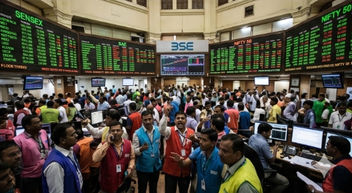
Indian benchmark indices, the Nifty 50 and BSE Sensex, fell on Tuesday, September 8, 2026, as surging global crude oil prices neared the $100 per barrel mark. The slide was driven by escalating geopolitical tensions in the Middle East and renewed hostilities between the United States and Iran, which dampened investor risk appetite across Asian markets.
By the close of trading, the Nifty 50 had declined 0.61% to settle at 23,635, while the BSE Sensex dropped 0.73% to end at 75,577. This downward movement followed a highly volatile session, particularly during the closing auction, as market participants grappled with the macroeconomic implications of elevated energy costs on India's import-dependent economy.
Geopolitical Friction and the Crude Oil Surge
Brent crude futures climbed for a third consecutive day, trading near $98 per barrel and threatening to breach the $100 threshold. The price surge followed warnings from Iran that any new attacks on Tehran would be met with retaliation on U.S. assets. Iranian officials also warned that energy infrastructure across the Gulf, including U.S. oil and gas interests, remains highly vulnerable, raising fears of supply disruptions in the Strait of Hormuz.
This geopolitical friction directly impacts India, which meets more than 80% of its crude oil requirements through imports. A sustained increase in oil prices threatens to escalate domestic inflation, weaken the rupee, and squeeze corporate profit margins due to higher input costs. Analysts noted that the combination of rising energy costs and geopolitical uncertainty has kept risk-taking to a minimum.
Sectoral Damage and Heavyweight Drags
Twelve of the 16 major domestic sectors in India logged losses during Tuesday's session. Heavyweight financial and private banking indices led the decline, with both sectors shedding nearly 1%. The market's three heaviest benchmark stocks—HDFC Bank, ICICI Bank, and Reliance Industries—fell by 0.7%, 1.1%, and 0.6%, respectively, dragging down the broader indices.
Shrikant Chouhan, Head of Equity Research at Kotak Securities, detailed the day's market movements, stating, "Today, the benchmark indices continued profit booking at higher levels. The Nifty ends 144 points lower, while the Sensex was down by 555 points. Among sectors, the Defense index outperformed, rallying 2.52 percent, whereas the Private Bank and Financial indices shed nearly 1 percent."
Primary Market Resilience Amid Secondary Slump
Despite the lacklustre performance of the secondary market, India's primary market showed robust activity. A massive wave of initial public offerings (IPOs) is currently underway, providing a stark contrast to the broader equity sell-off.
Siddhartha Khemka, head of research of wealth management at Motilal Oswal Financial, highlighted this divergence, stating, "While the secondary market remains lacklustre, primary market continues to see strong action, with 12 IPOs opening this week, aiming to raise a combined 70 billion rupees in one of the busiest weeks of the current IPO cycle."
Individual stock highlights included GE Vernova T&D India, which climbed 8% after securing a high-voltage direct current contract from Power Grid. Temasek-backed logistics firm Shiprocket, which went public on August 19, gained 3.2% after narrowing its first-quarter loss. Additionally, state-owned defense firms Bharat Electronics and Hindustan Aeronautics rose 2.3% and 3.7%, respectively, following the Defence Acquisition Council's approval of procurement proposals valued at 1.1 trillion rupees.
Broader Asian Markets and the Yen Swing Factor
Across the region, Asian equities faced downward pressure. Tokyo's Nikkei 225 gave up its early gains to sink 1.7%, closing at 65,269.33. This drop was largely driven by a sharp surge in the Japanese yen, which strengthened to 152.89 per dollar as investors unwound carry trades. The stronger currency hurt major Japanese exporters, causing Toyota Motor Corp. to shed 4.1% and Panasonic Holdings Corp. to fall 5.8%.
South Korea’s KOSPI also surrendered its morning gains, falling 0.6% to close at 6,954.52, despite an initial rally led by semiconductor giants Samsung Electronics and SK Hynix. Hong Kong's Hang Seng index declined 0.4%, while China's Shanghai Composite managed a minor 0.2% gain, supported by data showing that Chinese exports jumped 25% year-on-year in August.
Technical Support Levels and Near-Term Outlook
From a technical perspective, the Indian market has consistently faced selling pressure at higher levels, forming a bearish candle on daily charts. Analysts suggest that the near-term trajectory will depend on whether key support levels can hold.
According to Kotak Securities' technical analysis, the 23,750 level for the Nifty and 75,800 for the Sensex will act as immediate resistance zones. If the indices remain below these levels, the weak formation is likely to continue, potentially leading to a retest of the 23,500–23,450 range for the Nifty and 75,200–75,000 for the Sensex. Conversely, a close above these resistance levels could extend a pullback toward 23,900 and 76,300, respectively.
Key Catalysts and Upcoming Milestones
Investors are now shifting their focus to upcoming global macroeconomic events that will dictate monetary policy. The U.S. Federal Reserve is scheduled to meet on September 16, 2026, with markets currently pricing in a 60% probability of a 25-basis-point interest rate hike following a strong U.S. jobs report. The U.S. 10-year Treasury yield remains elevated around 4.788%.
the upcoming U.S. inflation report will serve as a critical catalyst for global markets. Domestically, market participants will continue to monitor the operational efficiency of the National Stock Exchange's (NSE) closing auction system (CAS). While the system recently absorbed a major index-rebalancing flow of Rs 39,718 crore in a 15-minute window, its daily stability will be tested if geopolitical volatility continues to drive capital outflows.