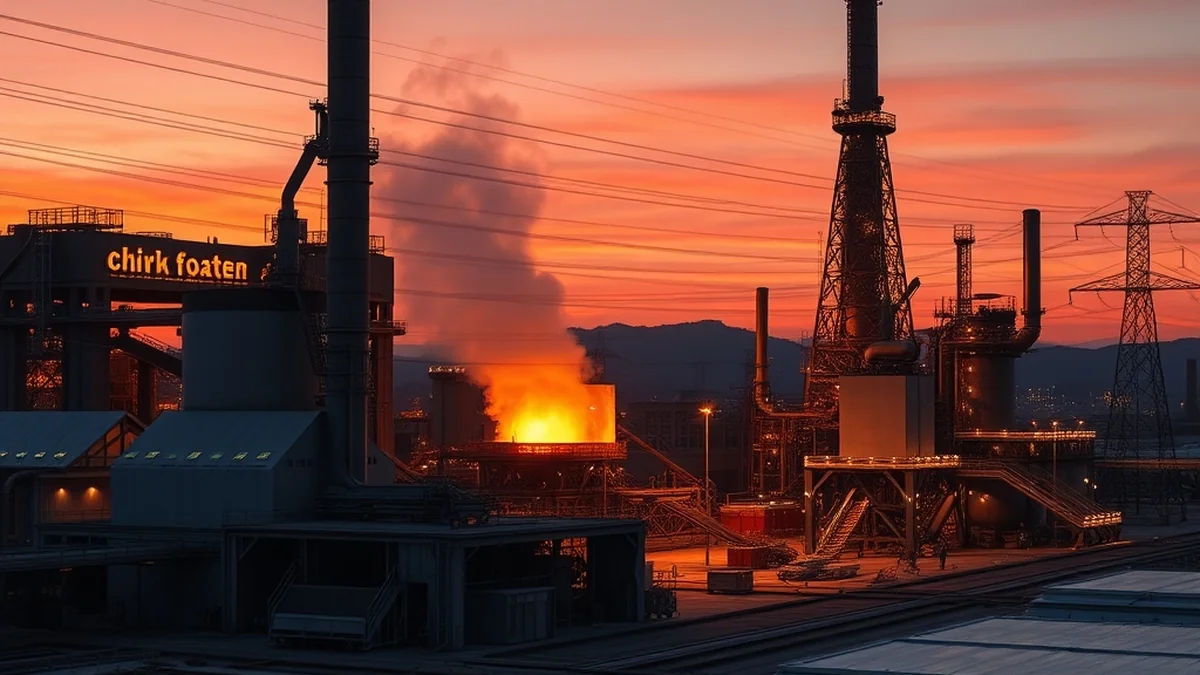
Copper futures reached an all-time peak of $14,858.50 per metric ton on the London Metal Exchange and $6.894 per pound on the COMEX exchange in New York, extending a 19 percent rally this year driven by acute raw material shortages and panic stockpiling. Yet despite record pricing across international exchanges, global primary processing facilities face unprecedented financial strain as treatment margins completely evaporate.
The stark disconnect between record metal prices and processing profitability stems from a severe structural deficit in copper concentrate. While global smelting infrastructure has expanded aggressively over two decades, aging mines and operational disruptions have restricted raw ore output, granting mining companies total pricing leverage over industrial refiners.
Smelting Fees Collapse to Record Zero as Spot Margins Turn Negative
The annual benchmark treatment and refining charge, the fee that mining corporations pay processing plants to convert raw copper concentrate into refined cathode, settled at zero dollars per ton for 2026. This collapse represents the lowest annual settlement on record, down precipitously from $21.25 per ton in 2025 and $80 per ton in 2024.
Conditions in the physical spot market have deteriorated even further, with spot processing rates falling to roughly negative $127 per ton by midyear. Under these negative rates, copper smelters are effectively forced to pay mining companies for the privilege of refining their raw ore. "It's really hard to fix a number between miners and smelters, with both having strong arguments," stated one Shanghai trader involved in annual negotiations in comments reported by Fastmarkets, noting that mine owners currently command complete bargaining control.
Mine Disruptions and Ageing Assets Constrain Global Raw Supply
The primary driver of the processing crisis is a widespread stagnation in global mining production rather than a bottleneck at refining facilities. Chile, the world's leading copper producer, recorded its weakest second-quarter output performance in at least 19 years, while major producer Antofagasta reported a 9.5 percent drop in first-half production.
Operational disruptions have further constrained output across key mining jurisdictions. Operations at the Kamoa-Kakula deposit in the Democratic Republic of Congo and Freeport facilities in Indonesia faced unexpected operational hiccups. Concurrently, First Quantum Minerals' massive Cobre Panama mine remains completely shuttered following an ongoing legal conflict with the national government, removing hundreds of thousands of tons of concentrate from global supply chains.
Asian Capacity Expansion Overwhelms Concentrated Mining Output
Despite the severe shortage of raw concentrate, state-backed and private industrial investments continue to expand global processing capacity. China currently refines approximately half of the world's copper and accounts for more than 90 percent of global smelting capacity expansion since 2005. Chinese industrial planners constructed this processing ecosystem under the assumption that primary mine supply would scale proportionally, an expectation that has failed to materialize.
Other emerging industrial centers are copying China's downstream processing playbook. Indonesia has attracted over $9 billion in copper smelter investments in recent years, attempting to replicate its dominant industrial strategy in nickel processing. Active project pipelines globally threaten to add another 8 million tons of smelting capacity by the early 2040s, predominantly concentrated in Asia, ensuring that negative spot treatment charges could persist as a permanent feature of metal markets.
US Tariff Expectations Distort Global Inventory Distribution
Policy uncertainty in Washington is compounding physical supply distortions across global commodity markets. Anticipation of potential US import tariffs on refined copper has triggered a massive movement of physical metal onto American shores ahead of any official mandate. The US Commerce Department was expected to submit a formal recommendation report to the White House regarding potential copper import levies by late June, but missed its internal deadline, maintaining trade anxiety.
This regulatory uncertainty has severely skewed inventory distribution between Western and Asian trading hubs. Stockpiles held in COMEX warehouses in the United States reached a record high near 700,000 tons. In contrast, combined inventories across London Metal Exchange and Shanghai Futures Exchange facilities have dropped to barely 300,000 tons, leaving physical buyers outside North America facing tight supply conditions and elevated spot premiums.
Energy Transition and Computational Infrastructure Drive Demand
Risiing price benchmarks are supported by accelerating demand from structural global transitions, including power grid modernizations, electric vehicle manufacturing, and artificial intelligence infrastructure. Global tech giants are committing billions to secure dedicated power infrastructure for computational data centers, illustrated by Google signing a 22-year nuclear power purchase agreement with Fortum in Finland to support European AI expansion.
These industrial demand drivers collide directly with a mining sector where developing a new greenfield copper mine requires a decade or more of environmental permitting, capital deployment, and construction. Consequently, market participants expect the structural gap between mine supply and industrial demand to persist, forcing downstream buyers to secure physical metal regardless of processing economics.
Impending Economic Milestones and Smelter Production Cuts
Market participants are closely tracking macro financial indicators alongside physical trade flows. "Caution remains warranted at the macroeconomic level," wrote analysts at Guangzhou Futures Co. in a market note, pointing to ongoing uncertainty surrounding US inflation metrics and shifting Federal Reserve interest rate expectations that could exert broader economic pressure on industrial metal pricing.
In the physical supply chain, smelters across Asia and Europe are evaluating forced production curtailments as negative processing margins make continued operation unsustainable without subsidization. Analysts expect the US Commerce Department to clarify its trade policy posture in coming months, a decision that will determine whether physical stockpiles begin rebalancing toward Asian and European consumption centers.