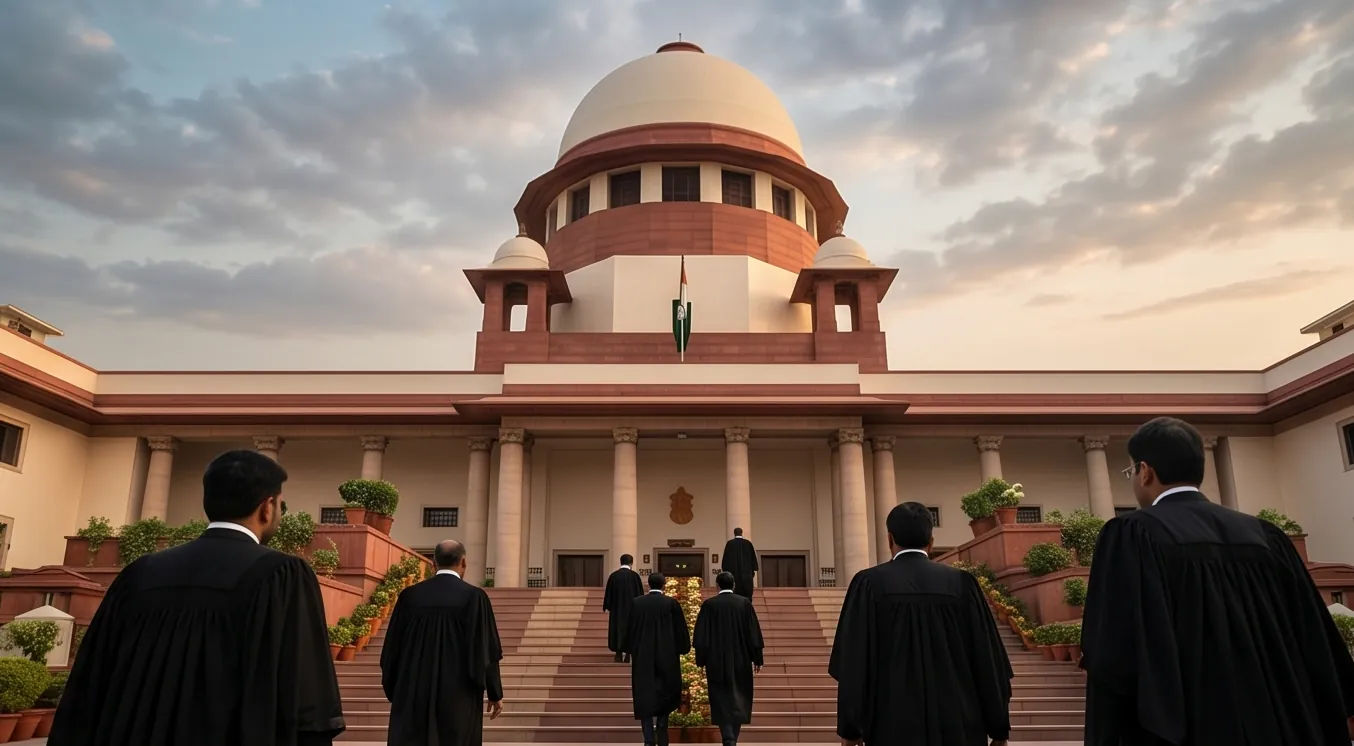
The Supreme Court of India on September 10, 2026 dismissed an appeal filed by 1993 Bombay serial blasts convict Abu Salem seeking premature release from prison. A two-judge bench comprising Justice Vikram Nath and Justice Sandeep Mehta upheld a prior decision of the Bombay High Court, ruling that Salem's mandatory 25-year incarceration period pursuant to India's sovereign extradition commitments to Portugal will conclude only in November 2030. The top court rejected Salem's contention that good conduct prison remissions and undertrial detention could be stacked together to satisfy his sentence early.
Pronouncing the order in court, Justice Vikram Nath stated that the bench found no legal infirmity in the April 15, 2026 judgment of the Bombay High Court. The ruling affirms that the 25-year cap agreed upon during Salem's 2005 extradition serves as an absolute outer boundary for his life sentence, rather than a standard term subject to routine prison rules. As a result, Salem's claim that his continued detention beyond March 2025 constituted illegal custody was formally rejected.
Sovereign Guarantees and the International Extradition Framework
The legal controversy originates from diplomatic undertakings given by the Indian government to Portuguese authorities to secure Salem's extradition. Salem was apprehended alongside Monika Bedi in Lisbon on September 18, 2002. To comply with Portuguese domestic law and international extradition conventions prohibiting life imprisonment without parole or capital punishment, the Government of India issued a formal solemn assurance on December 17, 2002, pledging that Salem would neither face the death penalty nor serve imprisonment exceeding 25 years if surrendered for trial.
Following extensive judicial proceedings in Portugal, Salem was extradited and brought to India on November 11, 2005, where he was immediately taken into custody by the Central Bureau of Investigation in connection with the 1993 Mumbai serial blasts case. In a landmark 2022 judgment involving Salem's sentence, a Supreme Court bench of Justices Sanjay Kishan Kaul and M.M. Sundaresh affirmed that the Indian executive remains legally bound to honor its international commitments. That ruling directed the Central Government to facilitate Salem's release upon his completion of 25 years in jail, advising the exercise of presidential clemency powers under Article 72 of the Constitution when the threshold is reached.
Computation Disagreements and Earned Prison Remissions
In his petition before the apex court, Salem argued through Senior Advocate Rishi Malhotra that he had already fulfilled the 25-year requirement as of March 31, 2025. Defense counsel presented a cumulative calculation incorporating three distinct periods: nearly 11 years and 10 months spent as an undertrial prisoner between November 2005 and September 2017, approximately 9 years and 10 months spent as a convicted prisoner, and over three years of earned prison remission awarded for good behavior in jail.
Citing the Supreme Court precedent in Swamy Shraddananda alias Murali Manohar versus State of Karnataka, Malhotra argued that earned remissions granted for daily conduct and assigned prison duties form an integral component of actual imprisonment served. The defense asserted that such good-conduct credits under state prison rules were distinct from statutory remissions granted by executive order under Section 432 of the Code of Criminal Procedure, arguing that denying credit for earned remissions violated Salem's constitutional rights under Article 21.
High Court Rationale and Statutory Remission Exclusions
The Supreme Court rejected these arguments, fully endorsing the findings of the Bombay High Court in Writ Petition No. 1586 of 2025. The High Court had determined that a simple chronological calculation from the date of Salem's initial arrest in India on November 11, 2005 establishes that the 25-year period expires strictly in November 2030. The High Court held that attempts to reduce this period through prison remissions were legally unsustainable because the 25-year ceiling itself acts as a massive concession against a life sentence.
In its detailed order, the High Court observed that the petitioner cannot claim an automatic reduction of the 25-year term through the inclusion of earned remissions under prison rules. The judicial rationale emphasized that permitting ordinary prison remissions under Rule 4 of the Maharashtra Prisons Remission System Rules 1962 to shorten the treaty cap would undermine the specific structure established by the extradition arrangement. Concurring with this reasoning, the Supreme Court bench dismissed the special leave petition in limine, concluding the judicial challenge against his ongoing detention.
Terror Convictions and Parallel Murder Sentences
Abu Salem's long-standing incarceration stems from his involvement in catastrophic organized crime events in Mumbai during the 1990s. In June 2017, a Special TADA Court found Salem and five co-accused guilty of conspiring and executing the March 1993 serial bomb blasts in Mumbai, which resulted in 257 deaths and injured over 700 people. He was convicted under multiple provisions of the Indian Penal Code, the Terrorist and Disruptive Activities Prevention Act, the Arms Act, and the Explosive Substances Act, receiving a life sentence in September 2017.
In addition to the serial blasts case, Salem was separately tried and convicted for his role in high-profile gangland homicides. In February 2015, a special TADA court sentenced him to life imprisonment for the 1995 murder of Mumbai builder Pradeep Jain. Although extradited for trial across multiple cases, including the murder of builder Ajit Diwani, his prison sentences operate concurrently within the framework established by the 2002 bilateral assurances.
Binding Release Timeline and Future Executive Proceedings
With the dismissal of Salem's appeal, the judicial determination regarding his sentence length is settled. The ruling establishes November 11, 2030 as the definitive date marking his completion of 25 years of actual imprisonment in India. Upon reaching that milestone in November 2030, the Central Government will be required under the Supreme Court's 2022 directives to tender formal advice to the President of India to exercise executive clemency under Article 72 and authorize Salem's release from custody, ensuring compliance with international treaty obligations.