
14 Sept 2026, 06:18 PM 3 min readindia
Kashmiri Pandits Observe Balidan Diwas, Reiterate Demands for Genocide Recognition
Sources & Citations
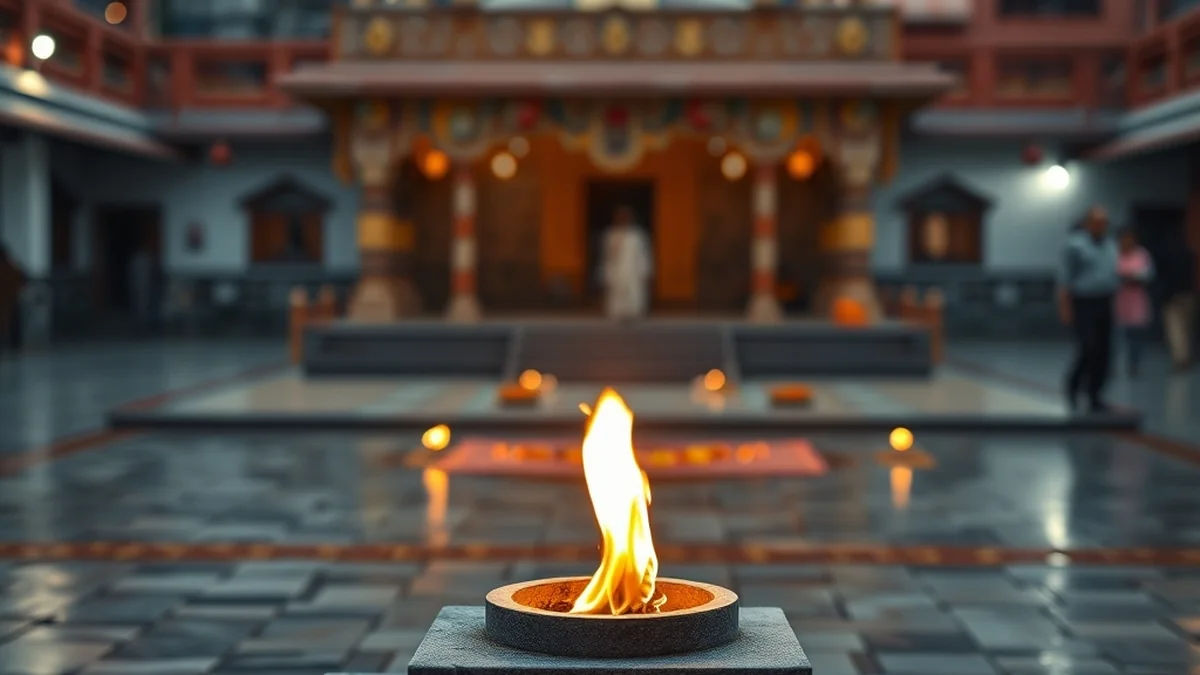
Displaced Kashmiri Pandits gathered in Jammu on September 14, 2026, to observe the 36th annual Balidan Diwas, a day dedicated to honoring community members and security personnel killed during decades of violence in Jammu and Kashmir. Participants wore black armbands as a sign of mourning and remembrance, while organizers from the representative body Panun Kashmir led a ceremony to light a 'Veer Jyoti' flame, which was later installed as an 'Amar Jyoti' at the Bhadrakali Temple in Thalwal.
The event served as a platform for the community to restate its long-standing political and legal demands, specifically calling for the formal recognition of the displacement and violence against Kashmiri Pandits as genocide. Panun Kashmir chairman Tito Ganju stated that the organization has been observing the day since 1990 to maintain the momentum of their struggle, which is rooted in the community's Margdarshan Resolution. This resolution, adopted following the mass migration of Hindus from the Valley in early 1990, outlines the demand for a separate homeland within the region under direct Union protection.
Legislative and Security Demands
Central to the community's current advocacy is the enactment of a genocide bill, a proposal first introduced by Panun Kashmir in 2020. Mr. Ganju argued that the absence of statutory recognition has relegated the historical violence to a matter of narrative interpretation rather than acknowledging it as a crime of the highest legal order. He contended that this failure to legally define the events has prevented the establishment of necessary accountability and guarantees against future recurrence, asserting that the state has not yet fulfilled its constitutional responsibility to prioritize the rights of the victims.
Beyond the legislative push, the organization expressed deep concern regarding the security of Kashmiri Pandit employees currently working in the Valley under the Prime Minister's employment package. Mr. Ganju described these employees as effectively living as hostages, noting that recent threats have highlighted the limitations of current rehabilitation efforts. He maintained that government measures would remain ineffective unless the fundamental security environment is transformed, reiterating that a separate homeland remains the only viable solution for the community's return.
Regional Political Alliances
During the proceedings, the demand for a separate homeland for displaced Kashmiri Hindus was linked to broader regional political goals. Col (Retd) Ajay Raina, chairman of the Jammu State People's Movement, advocated for a convergence between the Kashmiri Pandit demand and the movement for statehood in the Jammu region. He argued that the two causes are interdependent, suggesting that a stronger, autonomous Jammu region would be essential for ensuring the security and dignity of Kashmiri Pandits who wish to return to the Valley.
Panun Kashmir convenor Agnishekhar emphasized that the date of September 14 holds particular significance, as it is tied to the 1989 killing of Kashmiri Pandit leader Tika Lal Taploo. He stated that the community's ongoing struggle is focused on confronting the intent behind the historical violence and creating conditions where those who identify with Indian civilization can return to their homes with security and dignity. The organization confirmed that it intends to continue its advocacy until these specific goals are met.
Sources & Citations
The Indus Pulse is committed to accuracy and transparency.