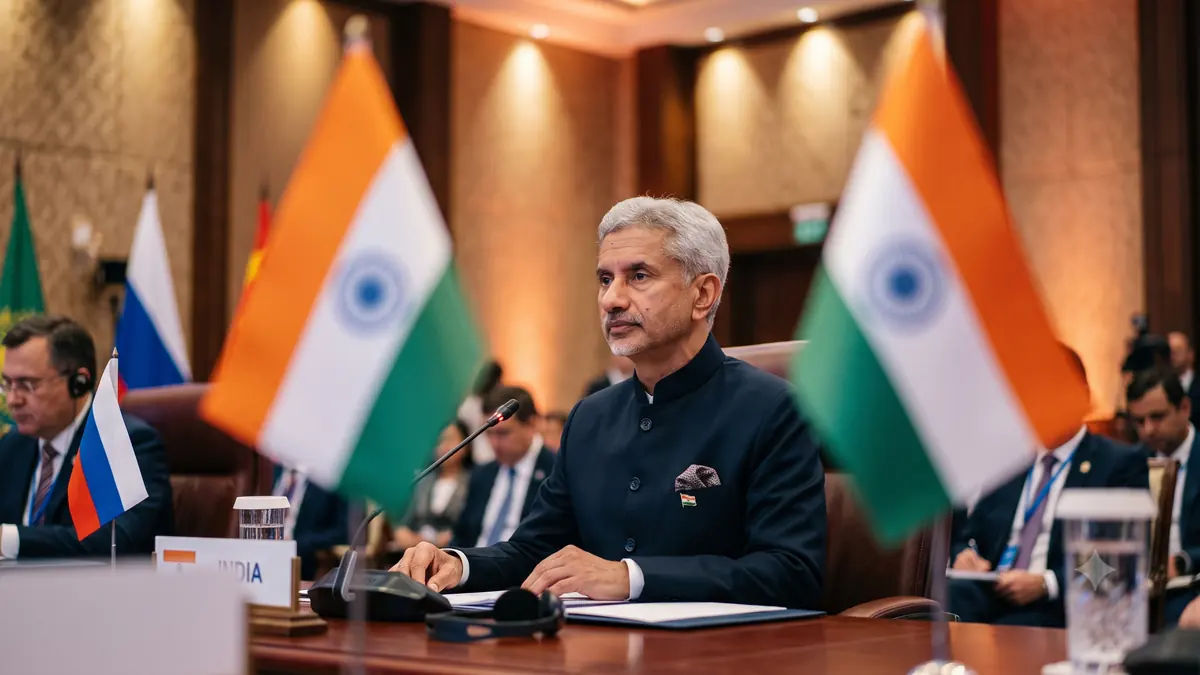
External Affairs Minister S. Jaishankar has formally assured Janata Dal (United) national working president Sanjay Kumar Jha that the Union government will account for Bihar's water requirements prior to renewing the India-Bangladesh Ganga Water Sharing Treaty.
The bilateral agreement, originally signed on December 12, 1996, by then Indian Prime Minister H.D. Deve Gowda and Bangladeshi Prime Minister Sheikh Hasina, carries a 30-year validity period and is scheduled to expire on December 12, 2026. The pact regulates the sharing of Ganga waters at the Farakka barrage during the lean dry season spanning from January 1 to May 31, utilizing 10-day average availability metrics.
External Affairs Ministry Responds to Parliamentarians
Jaishankar's assurance was conveyed through an official letter dated August 28, 2026. The communication followed parliamentary interventions initiated by Sanjay Kumar Jha in the Rajya Sabha on August 6, 2026, alongside subsequent consultations between regional lawmakers and Union cabinet ministers.
In his August 28 letter to Sanjay Kumar Jha, External Affairs Minister S. Jaishankar stated that the Union government "fully understood the concerns raised over the treaty and would take an appropriate decision after examining all relevant factors."
While the Ministry of External Affairs has committed to factoring in domestic needs, the specific details regarding the final terms of the renewed treaty or the precise framework of the forthcoming decision have not yet been publicly disclosed.
Regional Opposition to Current Treaty Terms
The JD(U) leadership has consistently pushed against renewing the bilateral treaty in its current framework. Sanjay Kumar Jha argued that the 1996 agreement has inflicted serious injustice upon Bihar over the past thirty years by accelerating upstream silt accumulation in the Ganga River and severely depleting water levels during agricultural lean seasons.
State representatives have urged New Delhi to incorporate projected population figures for the year 2050, alongside comprehensive provisions guaranteeing adequate water supply for agriculture, irrigation, industrial expansion, and drinking water infrastructure across Bihar.
On the diplomatic front, Bangladesh has signaled its intent to pursue the restoration of a formal guarantee clause comparable to the safeguard provisions featured in the preceding 1977 Ganges Water Agreement. Unlike the 1977 framework, the 1996 treaty omitted a general 80 percent minimum-guarantee clause, a point of ongoing diplomatic discussion.
Historical Context and Downstream Stakes
The 1996 accord succeeded multiple temporary river-sharing arrangements, including the 1977 agreement and subsequent memorandums of understanding signed in 1982 and 1985. The diplomatic management of shared river basins echoes long-standing regional water accords, such as the 1960 Indus Waters Treaty between India and Pakistan.
For the estimated 13 crore residents of Bihar, the renewal outcome carries immediate real-world consequences. The final terms will directly determine regional access to drinking water, irrigation flows, and industrial supplies during summer months, while also influencing ongoing flood mitigation efforts tied to upstream siltation. For broader India-Bangladesh bilateral ties, the diplomatic handling of the December 2026 expiration remains a definitive test of cross-border water diplomacy.