
ISRO Successfully Launches NVS-03 Navigation Satellite Aboard GSLV-F18
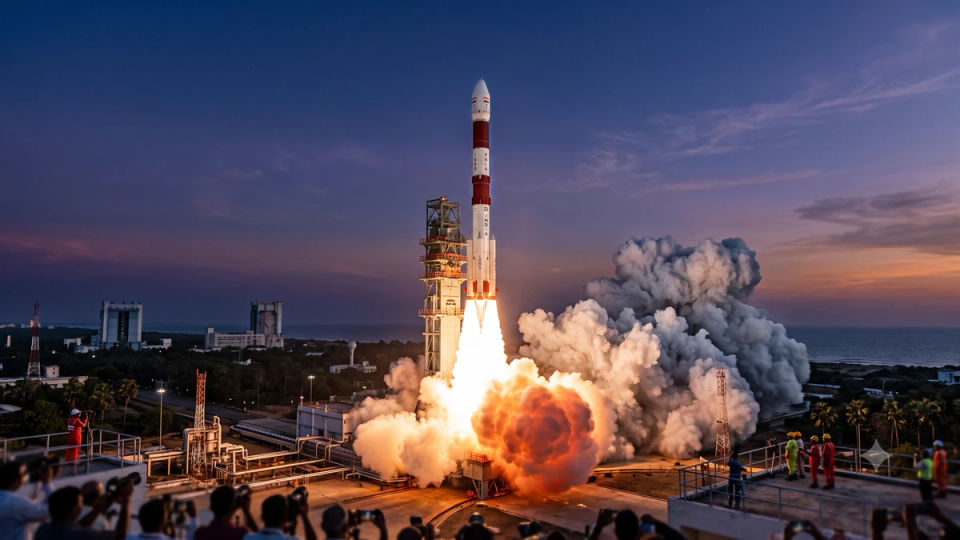
The Indian Space Research Organisation (ISRO) successfully launched its next-generation navigation satellite NVS-03 aboard the GSLV-F18 launch vehicle from the Satish Dhawan Space Centre in Sriharikota on Friday, October 30, 2026, according to reporting by The Hindu. The 2,250 kg spacecraft separated smoothly from the launch vehicle and was injected into its designated Geosynchronous Transfer Orbit. The mission lifted off from the Second Launch Pad at 11.51 pm, marking the 20th flight of India's Geosynchronous Satellite Launch Vehicle. The deployment restores India's independent regional navigation satellite system, NavIC (Navigation with Indian Constellation), to its minimum operational baseline of four functioning satellites, advancing self-reliance under the Indian Regional Navigation Satellite System.
Next-Generation Payload and Indigenous Atomic Clock Integration
NVS-03 represents the third spacecraft in ISRO's second-generation navigation satellite series, developed to sustain and modernize positioning services under the regional network. The operational four-satellite constellation enables standalone position tracking capabilities across the Indian landmass and extends coverage roughly 1,500 kilometers (930 miles) beyond national borders. The spacecraft incorporates an indigenously developed rubidium atomic clock, providing highly precise timekeeping measurements to support Position, Navigation, and Timing (PNT) signals for civilian navigation and strategic mobility. In addition to legacy L5 and S-band frequencies, the payload introduces the L1 civilian band to ensure interoperability with common commercial receivers.
On October 31, 2026, the first orbit manoeuvre of NVS-03 was completed with a LAM engine burn duration of 2174.8 seconds, achieving an estimated orbit of 5477.6 km x 37833.4 km.
Executive Commendations and Forthcoming Constellation Expansions
Prime Minister Narendra Modi commended ISRO and its scientists on Saturday, stating that the GSLV-F18 mission represents an important step in strengthening the indigenous satellite navigation system. Union Minister of State for Space Jitendra Singh stated that the achievement reflects growing national prowess in sovereign space infrastructure. ISRO Chairman V Narayanan revealed that the space agency plans two additional navigation satellite launches in upcoming mission cycles to expand the constellation's resilience, accuracy, and operational coverage.
The GSLV Launch vehicle successfully injected the NVS-03 satellite into an orbit of 170.3 km x 38080 km on October 30, 2026 at 23.51 hrs, according to ISRO.
Domestic Industry Contributions and Strategic Navigation Capabilities
Domestic industrial partners contributed significantly to the mission's technical execution. Aerospace and defence player Ananth Technologies supplied 46 flight hardware packages for the GSLV-F18 rocket, supporting telemetry, navigation, and power management across multiple vehicle stages. The company also provided nine critical spacecraft subsystems for NVS-03, including power-management packages and star sensors. The successful deployment delivers strategic autonomy by providing secure targeting and navigation support without reliance on foreign-controlled networks. NavIC operates under the sovereign control of the Government of India, delivering standard civilian positioning alongside restricted authorized services.