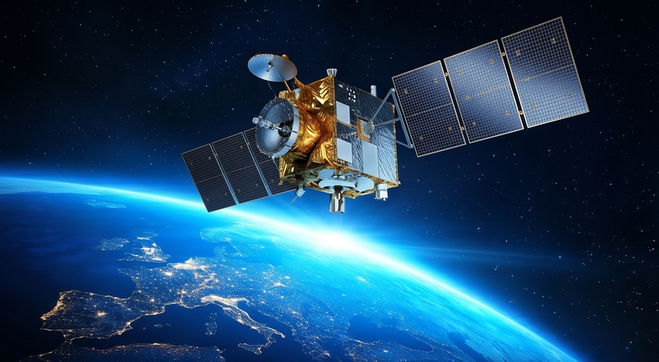
The Indian Space Research Organisation (ISRO) successfully launched its latest Earth observation satellite, EOS-05, on September 4, 2026, marking a significant milestone in the nation's space capabilities. The spacecraft was carried into space by the Geosynchronous Satellite Launch Vehicle (GSLV-F17), which lifted off from the second launch pad at the Satish Dhawan Space Centre in Sriharikota at 2:55 a.m. IST. This mission represents India’s first-ever imaging satellite specifically designed to operate from a geosynchronous orbit, situated approximately 36,000 kilometers above the Earth.
This launch is particularly notable as it demonstrates India's ability to maintain persistent monitoring of the Indian subcontinent from a high-altitude vantage point. By operating from a geosynchronous orbit, the satellite can effectively 'hover' over a specific region, providing continuous coverage that is essential for tracking dynamic environmental events, severe weather patterns, and monitoring strategic border areas. The mission serves both civilian and military applications, enhancing India's national security and disaster management infrastructure.
Mission Success and Technical Achievement
The GSLV-F17 rocket, on its 19th flight, performed as expected, placing the EOS-05 satellite into its intended sub-geosynchronous transfer orbit 18 minutes after liftoff. The 51.7-meter-tall, 420.5-tonne rocket utilized a three-stage configuration, including a S139 solid core, four L40H liquid strap-ons, a GL40HT liquid second stage, and an indigenous cryogenic upper stage. This successful deployment follows a period of relative quiet for the Indian space agency, signaling a return to operational momentum.
ISRO Chairman V. Narayanan confirmed the precision of the injection, noting that the mission achieved a nominal perigee of 171 kilometers and an apogee of 31,026 kilometers. The satellite, which weighs approximately 2,367 kilograms, will now undergo a series of maneuvers using its onboard thrusters to reach its final operational orbit. The chairman highlighted that the GSLV-F17 carried the heaviest payload in the vehicle's history, a testament to ongoing optimizations in structural mass and propulsion systems.
Strategic Significance of Geosynchronous Imaging
Unlike traditional Earth observation satellites that typically operate in low-Earth or sun-synchronous polar orbits, the EOS-05 is uniquely positioned to provide persistent, real-time data. This capability is a critical upgrade for India's space-based surveillance. While India already possesses a robust fleet of over 20 operational Earth observation satellites, most are restricted by their orbital paths, which only allow for periodic passes over specific locations. The new geosynchronous capability removes this limitation for high-priority areas.
Experts note that the ability to maintain a 'permanent eye' on the Indian subcontinent from 36,000 kilometers away is a game-changer for strategic asset monitoring. The satellite's persistent coverage is expected to be instrumental in responding to rapid-onset events, such as floods or border incursions, where timely data is paramount. This mission effectively bridges a gap in India's existing geostationary-orbit capabilities, which were previously limited primarily to meteorological monitoring through the INSAT series.
Overcoming Past Challenges
The successful launch of EOS-05 is a significant recovery for ISRO, particularly following the failure of the EOS-03 mission in August 2021. During that previous attempt, an anomaly in the rocket's third stage resulted in the loss of the satellite. The GSLV program has since undergone rigorous reviews and technical refinements, with the GSLV-F17 mission marking the fifth consecutive successful launch for the vehicle since its return to flight in May 2023.
This mission also stands as a bright spot in a year that saw mixed results for the Indian space sector. Earlier in 2026, a Polar Satellite Launch Vehicle (PSLV-C62) mission failed to deliver its payload, including the EOS-N1 satellite, due to a third-stage anomaly. The success of the GSLV-F17 mission provides a much-needed boost to ISRO's operational schedule, which includes six additional planned launches for the current financial year, such as the NVS-03 navigation satellite and the first uncrewed Gaganyaan mission.
Future Milestones and Operational Outlook
With the EOS-05 now in orbit, ISRO is shifting its focus toward the upcoming phases of its ambitious space roadmap. The agency is preparing for the Gaganyaan program, which aims to demonstrate India's human spaceflight capabilities. The success of the GSLV-F17 mission reinforces confidence in the launch vehicle's reliability, which is essential for the heavy-lift requirements of future missions.
As the agency moves forward, the data generated by EOS-05 will be integrated into India's national monitoring networks. The focus remains on optimizing the satellite's performance in its new orbit and ensuring the seamless delivery of high-resolution imagery to end-users. With the successful deployment of this state-of-the-art spacecraft, India has solidified its position as a key player in high-altitude Earth observation, setting the stage for more complex missions in the coming months.