
India Expects Over 5 GW Agrivoltaic Solar Capacity in 3 to 4 Years
Projections for Rapid Scaling of Agrivoltaic Capacity
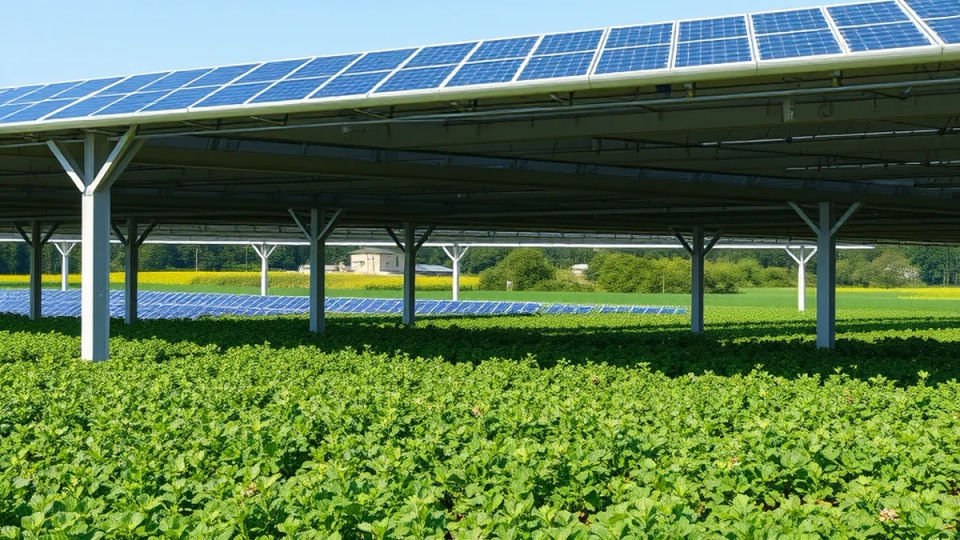
India could scale its domestic agrivoltaic power generation capacity to exceed five gigawatts over the next three to four years. Agrivoltaic systems utilize agricultural acreage simultaneously for primary food crop cultivation and overhead solar photovoltaic energy harvesting. Senior ministry officials emphasized that commercial scaling will depend on state enthusiasm and proactive administrative support. Achieving five gigawatts of decentralized farm-level installations will establish India as a global frontrunner in dual-use clean energy deployment. Co-locating photovoltaic infrastructure directly over active cultivation zones allows farmers to generate clean electricity while preserving traditional harvest outputs.
Government assessment studies established that agri-photovoltaic systems are suitable for fruits and leafy vegetables, but unsuitable for crops such as rice and sugarcane.
As of October 2026, India's total installed solar capacity stands at 171 GW.
Regulatory Tariffs and Farmer Cooperative Investment Enablers
National renewable energy leadership urged provincial governments to introduce formal electricity purchase tariffs to create predictable investment conditions. Timely notification of feed-in tariffs will provide essential financial clarity for farmer-producer organizations and agricultural cooperatives. Several regional administrations including Odisha, Maharashtra, and Madhya Pradesh have already executed successful preliminary pilot projects. Clear feed-in tariffs will encourage local agricultural cooperatives to commit long-term capital toward overhead solar infrastructure. Senior officials stressed that sustained capacity addition requires state administrations to create attractive conditions for rural developers.
Alleviating Transmission Bottlenecks Across Non-Solar States
Secretary Sarangi explained that agrivoltaic deployment will help distribute renewable electricity beyond traditional western solar corridors. Approximately eighty-five percent of India's current solar capacity remains concentrated in just five states, led predominantly by Rajasthan and Gujarat. This heavy geographical clustering places substantial operational strain on national high-voltage transmission networks to evacuate power eastward. Decentralizing solar generation across agricultural regions reduces dependency on long-distance transmission corridors and prevents steep interstate transit fees. Dual-use solar installations offer immense strategic advantages for states with extensive farmland but minimal non-arable wasteland.
Central Sector Scheme and Agro-Climatic Research Studies
The Union government is actively formulating a dedicated central sector funding scheme to support state-level agrivoltaic programs. The renewable energy ministry is coordinating with the Finance Ministry to establish targeted incentive mechanisms for diverse farm models. Policy architects are evaluating options to integrate dedicated agrivoltaic components into existing flagship schemes such as PM-KUSUM. Agricultural scientists must conduct further localized field trials to determine compatible crop varieties for distinct agro-climatic zones. The forthcoming Agrivoltaics World Conference in New Delhi will gather international specialists to transition pilot demonstrations into large-scale commercial deployments.