
Edited by Editor-in-Chief, The Indus Pulse 25 Sept 2026, 03:35 AM 4 min readindia
Haryana Revives Panchgram Project to Build Five Greenfield Cities Along KMP Expressway
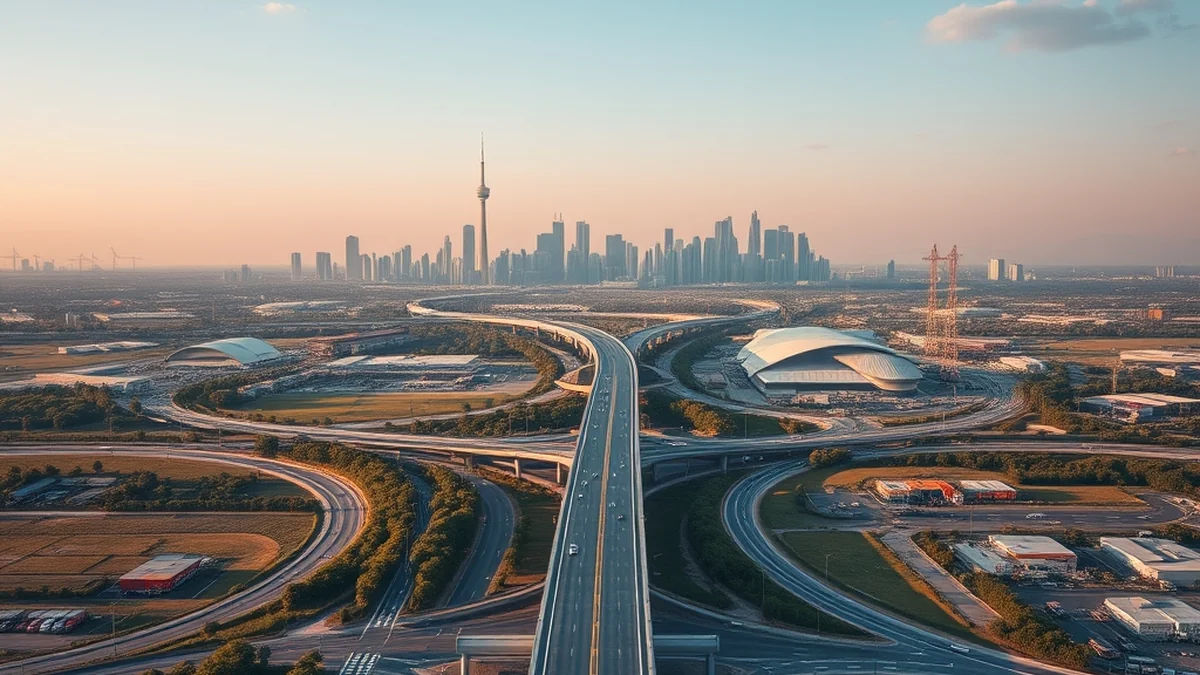
The Haryana government has officially revived the Panchgram Project, launching an ambitious initiative to construct five new greenfield urban centres along the Kundli-Manesar-Palwal Expressway to relieve mounting traffic and population pressures around the national capital region. Spanning approximately 2.5 lakh hectares, the state-of-the-art urban corridor will extend two to six kilometers on either side of the 135-kilometer expressway, incorporating modern municipal utilities, extensive green spaces, and high-capacity transit links designed to accommodate projected population demands through the year 2041.
The Panchgram project was initially designed during the tenure of former Chief Minister Manohar Lal Khattar, though it previously faced stall periods stemming from administrative hurdles and land acquisition obstacles. Its recent revival has sparked renewed optimism among investors and industry participants, while ongoing discussions centre on farmer rehabilitation, compensation terms, and potential impacts on fertile agricultural land.
The planned urban centers will be situated along both flanks of the Kundli-Manesar-Palwal Expressway, spanning nearly 2.5 lakh hectares. Furthermore, the economic corridor incorporates key infrastructural pillars such as the 121.7-kilometer orbital rail track linking Palwal to Sonipat directly through Manesar, alongside transit connections to the proposed Gurugram-Panchgaon Metro corridor and the NH-152D highway.
Originally conceptualized in 2018 under former Chief Minister Manohar Lal Khattar, the multi-district undertaking spans eight administrative jurisdictions including Sonepat, Rohtak, Jhajjar, Gurugram, Rewari, Mewat, Faridabad, and Palwal. Under the current administration led by Chief Minister Nayab Singh Saini, the state initiated steps in June to establish the dedicated Panchgram Development Authority to oversee land planning, administrative execution, and municipal infrastructure deployment across the expansive corridor.
Infrastructure and Mass Transit Connectivity Plans
Transportation integration forms the core of the revived urban framework, with planners proposing extensive expansions of existing rapid transit networks. The operational framework includes extending current metro rail networks outward from Delhi, Gurugram, and Faridabad into the newly planned urban districts, alongside integration with the high-speed Namo Bharat Regional Rapid Transit System corridor to link peripheral settlements with central NCR commercial hubs.
In addition to regional rapid transit, state planning documents detail a proposed 35.25-kilometer metro corridor connecting Gurugram directly to Panchgaon, featuring 28 dedicated stations along its alignment. The existing 135-kilometer Kundli-Manesar-Palwal Expressway will function as the primary development axis, supporting fast freight movement and commuter transit across the multi-district expanse.
Economic Expansion and Industrial Model Townships
Industrial development is slated to run parallel to urban residential expansion, with the state government setting a formal target to establish 10 new Industrial Model Townships by the year 2030. Official records indicate that administrative approval has already been granted for five initial industrial townships, with three slated for direct physical connection to the expressway corridor.
According to estimates cited from a report in The Tribune, fulfilling the broader housing, transport, and civic infrastructure requirements across the National Capital Region will necessitate capital outlays approaching Rs 20 lakh crore. State officials emphasize that private and public capital deployment will depend heavily on phased land acquisition, pooling decisions, and clear regulatory notifications.
Singapore Urban Model and Administrative Next Steps
Haryana Industries and Commerce Minister Rao Narbir Singh stated that the development corridor will draw upon elements of the Singapore urban planning model to transform the surrounding region into an advanced center for industrial expansion and organized municipal growth. Chief Minister Nayab Singh Saini has already briefed the NCR Planning Board on the renewed blueprint.
As part of the ongoing planning phase, a high-level administrative delegation from the state government is scheduled to visit Singapore to examine its urban infrastructure management practices. Immediate administrative milestones include finalizing the institutional framework of the Panchgram Development Authority, delineating exact municipal boundaries, and establishing coordinated land-use policies for the five planned urban centres.
The Indus Pulse is committed to accuracy and transparency.