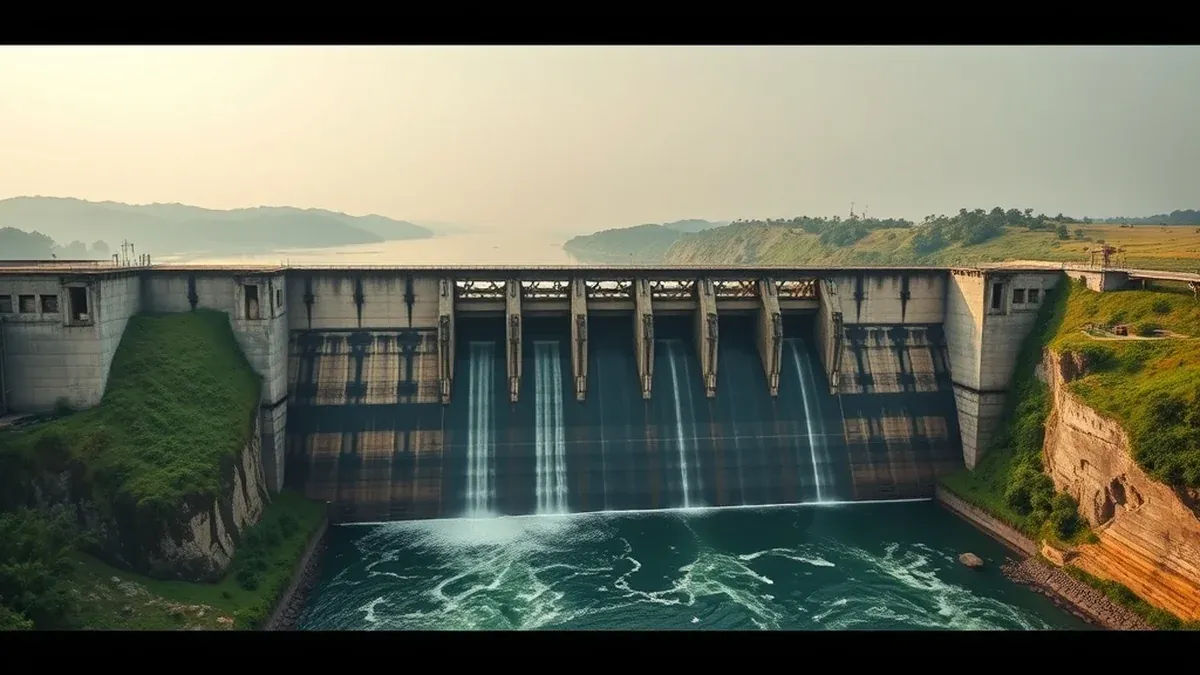
A catastrophic flash flood tore through the Bhotekoshi and Trishuli river corridors in northern Nepal, leaving more than 1,200 people dead and thousands missing following the collapse of a high-altitude glacier on the Tibetan border. The disaster, described by officials as an unprecedented Himalayan tsunami, struck without warning on August 26, 2026, obliterating bridges, hydropower installations, and entire settlements across Rasuwa and Nuwakot districts.
According to geological assessments cited in the reporting, the disaster began when a massive 600-meter-wide section of glacier and bedrock detached at an elevation of roughly 5,200 meters near Langtang Lirung. Plunging 1,200 meters to the valley floor, the falling mass generated an immense kinetic force that pulverized ice and rock into a fast-moving slurry. This debris flow dammed the Lhende Khola before bursting out in a violent surge that traveled nearly 100 kilometers downstream.
Failure of Cross-Border Early Warning Systems
The disaster exposed critical vulnerabilities in regional disaster management, notably the absence of real-time hazard monitoring across international borders. Automatic flood-monitoring stations on the upper Bhotekoshi were destroyed before they could transmit alerts, leaving downstream communities with zero advance notice. Binod Parajuli, a senior divisional hydrologist at Nepal’s Flood Forecasting Division, acknowledged the failure to the Kathmandu Post, stating that sensors placed solely inside Nepal cannot outrun a hazard originating across the border.
While Nepal and China signed a memorandum of understanding in 2019 covering emergency response and hydrological data sharing, effective cross-border warning protocols failed to materialize. Anil Pokhrel, former chief executive of Nepal’s disaster authority, noted that previous floods originating on the Chinese side had not been taken seriously enough. Following the recent tragedy, Nepal's Department of Hydrology and Meteorology held virtual talks with the China Meteorological Administration, securing a renewed commitment for immediate notification when water levels rise.
Scientific Analysis of Glacial Hazards
Independent experts have drawn parallels between the Bhotekoshi disaster and previous Himalayan catastrophes, warning that such events are becoming part of a dangerous regional pattern. Jeffrey Kargel, a senior scientist at the Planetary Science Institute, noted that the physical process closely mirrored the 2021 Chamoli disaster in India, though the Nepal event was estimated to be significantly larger by volume. Researchers point out that Himalayan glaciers are melting at an accelerated pace as regional temperatures rise.
Scientists caution that traditional risk-mapping methods, which evaluate glacial lakes and monsoon floods individually, fail to account for complex rock-ice avalanches. The steep, unstable terrain of the young mountain range features fractured rock and hanging ice that remain difficult to monitor. This growing hazard poses severe questions for the rapid expansion of hydropower infrastructure across vulnerable valleys in Nepal, India, China, and Pakistan.
Humanitarian Crisis and Rescue Operations
The human toll of the disaster has overwhelmed local rescue capacities, with confirmed fatalities exceeding 1,200 and thousands remaining unaccounted for. Among the missing are numerous Hindu pilgrims traveling to Kailash Mansarovar in Tibet, as well as nearly a thousand hydropower workers. Communications infrastructure, roads, and power grids across the affected districts were completely wiped out, restricting rescue operations primarily to helicopters and foot patrols.
Foreign Minister Shisir Khanal briefed international diplomatic missions in Kathmandu, detailing the severe impact across Rasuwa, Nuwakot, Dhading, Gorkha, and Chitwan. “I would like to term this catastrophic incident a ‘Himalayan tsunami’ because we had never witnessed such unprecedented disaster,” Khanal told international representatives. The government mobilized over 2,100 security personnel and accepted emergency assistance, forensic aid, and equipment from international partners including India, China, the United States, and various UN agencies.
Glimmers of Hope Amid Ongoing Recovery
Despite the grim conditions, search and rescue operations have yielded occasional breakthroughs. Rescue teams successfully extracted trapped workers alive from complex tunnel systems at hydropower projects days after the initial flood. In the Trishuli 3A project tunnel, workers survived underground for over a week before being brought out by emergency personnel, offering rare moments of relief to anxious families.
Authorities continue to grapple with logistical hurdles, including the establishment of DNA profiling services for first-degree relatives to identify recovered remains. While reconstruction costs are expected to reach billions of dollars, government officials have emphasized that the broader tourism corridors and major cultural sites in unaffected regions of Nepal remain open and safe for visitors as the nation begins its long recovery.