
Delhi's Air Stays 'Poor' With AQI Readings of 213 to 218 on 16 November as 'Very Poor' Spell Is Forecast
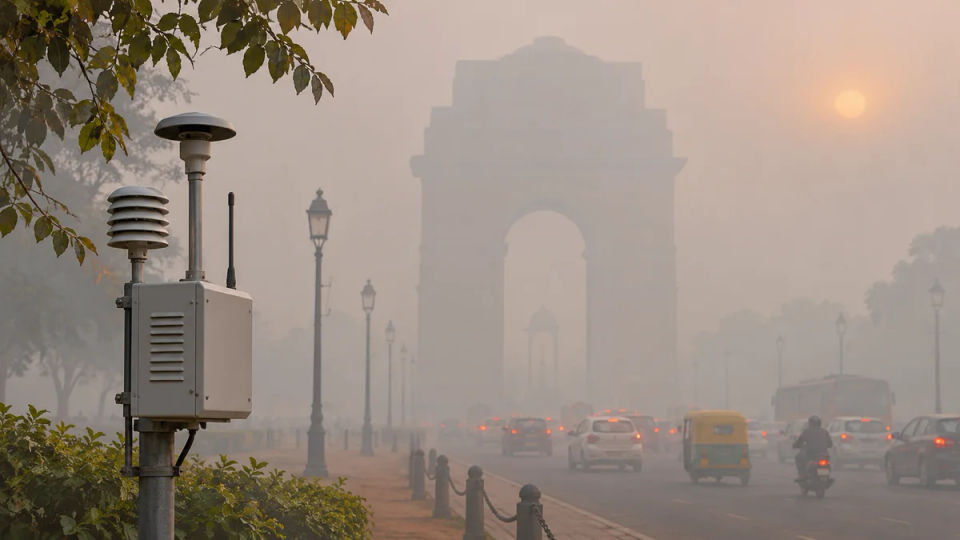
Delhi's air quality index (AQI) was 218 at 8am on Monday, in the 'poor' category, Hindustan Times reported. Business Standard, citing the Central Pollution Control Board's real-time data, put the city-level AQI at 216 at 7am, in the 'poor' category. India Today put the city's average AQI at 213 at around 6am on Monday, 16 November.
Station Readings Across the City
Of 59 monitoring stations, Siri Fort recorded the worst air, with an AQI of 350 at 8am in the 'very poor' category, Hindustan Times said. NSIT Dwarka was next at 327, and Hindustan Times counted 38 stations in the 'poor' band and 18 as 'moderate'. Only the Cantonment station reported 'satisfactory' air, at an AQI of 98, the newspaper said. At 7am, according to Business Standard, 39 of Delhi's 59 monitoring stations had AQI readings above 200, only two crossed 300 and none was in the 'severe' category. In Business Standard's tally, Sirifort had the highest reading at 346, with NSIT Dwarka at 330, Pusa at 282, Punjabi Bagh at 276 and Chandni Chowk at 271. Cantonment Area had the lowest reading, 94, in the 'satisfactory' category, and Najafgarh followed at 144. India Today reported that only two stations, Sirifort at 341 and NSIT Dwarka at 331, were in the 'very poor' category on Monday morning. It counted 35 stations in the 'poor' category and 28 in the 'moderate' category, with Cantonment Area at 94 in the 'satisfactory' category.
Sunday's Readings and GRAP Curbs
India Today reported that the AQI had been 290 at 4pm on Sunday, 15 November, indicating a significant improvement since the weekend. According to India Today, 10 November was the first day since Diwali on 8 November that the city recorded a 'poor' AQI reading, at 299. India Today cited PM2.5 source apportionment data showing biomass burning as the largest contributor to Delhi's pollution on Sunday, at 37.1% of the total. Moneycontrol reported that Delhi's AQI stood at 352 on Sunday morning, in the 'very poor' category, while a thick layer of smog covered several parts of the city. On Sunday morning, according to Moneycontrol, IIT Delhi recorded 425, ITO 415, Commonwealth Sports Complex 403, and North Campus of Delhi University and Pusa 402 each. Business Standard reported that the Commission for Air Quality Management invoked Stage III of the Graded Response Action Plan on 6 November, after Delhi's AQI reached 382, and the stage remains in force across Delhi-NCR. Business Standard listed the Stage III measures as limits on non-essential construction and demolition, curbs on certain categories of vehicles and tighter controls on industry and other polluting activities.
Forecast: Smog Expected to Return
Hindustan Times said weather experts credited Sunday's better air to stronger winds and a western disturbance that helped pollutants disperse. Hindustan Times said Delhi has had a run of 'very poor' days in November, driven by firecrackers, more stubble burning and local sources of pollution. The newspaper also reported that banned firecrackers were used again on Sunday evening and Monday morning as Chhath Puja celebrations continued. Meteorologist Navdeep Dahiya said that once night falls and wind speeds slow, the temperature inversion effect and fresh emissions take hold again. He said only afternoons should bring some relief, when stronger northwesterly winds of 10-20 kmph are expected. The Air Quality Early Warning System forecasts that Delhi's air will stay 'poor' on Monday and then turn 'very poor' between 17 and 18 November, according to Hindustan Times. The city is then likely to see 'very poor' air quality over the following six days, the forecast says.