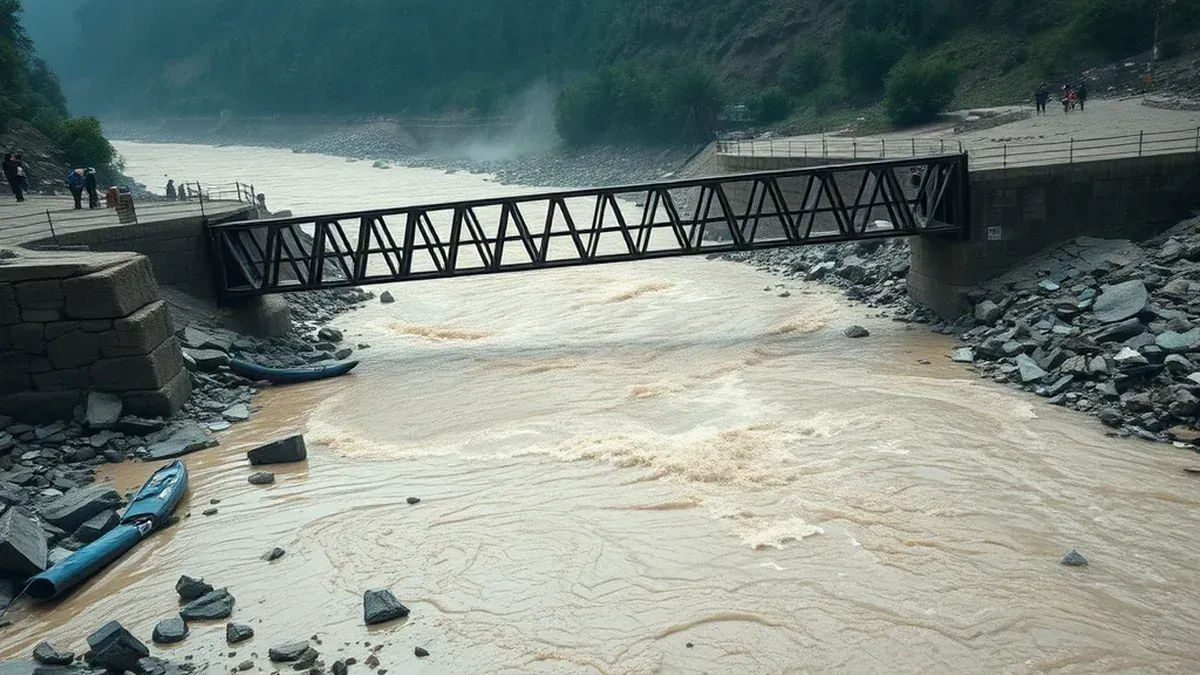
Union Home Secretary Govind Mohan chaired a high-level meeting on September 3, 2026, with representatives from five Himalayan states and Union Territories to review preparedness against Glacial Lake Outburst Floods (GLOFs) and snow avalanches. The directive follows a catastrophic glacial collapse near the Nepal-Tibet border on August 26, which resulted in significant loss of life and widespread destruction. The meeting, which included officials from Jammu and Kashmir, Himachal Pradesh, Uttarakhand, Sikkim, and Arunachal Pradesh, focused on shifting regional disaster management strategies from reactive responses to proactive, risk-informed mitigation.
During the session, the Home Secretary emphasized that states must prioritize community-level readiness and the implementation of robust early warning systems. The central government has urged these regions to accelerate the execution of GLOF mitigation projects that were originally sanctioned in 2024. Officials from the Ministry of Home Affairs, the National Disaster Management Authority, and the India Meteorological Department participated in the review, highlighting the critical need for continuous monitoring of vulnerable glacial lakes and the mapping of potential flood flow paths to protect downstream settlements.
Identifying High-Risk Glacial Lakes
In a specific development following the central review, the Sikkim government has identified 40 high-hazard glacial lakes within its borders. Of these, 16 have been classified as being at the highest risk of catastrophic outbursts. State authorities have pinpointed Shako Chho as the most vulnerable site, necessitating immediate attention and monitoring. This identification process is part of a broader effort to catalog and assess the stability of glacial bodies across the Himalayan range, which are increasingly susceptible to climate-induced instability.
These findings are particularly urgent given the recent disaster in Nepal, where a glacial collapse triggered massive flash floods. The data from Sikkim serves as a baseline for other states to conduct similar risk assessments. The central government has directed all participating states to ensure that these technical assessments translate into actionable district-level plans, ensuring that local administrations are equipped to handle potential emergencies before they escalate into regional crises.
Strengthening Early Warning and Response
Beyond the identification of high-risk sites, the meeting underscored the necessity of improving the last-mile dissemination of alerts. The Home Secretary directed states to bridge the gap between technical monitoring and community-level awareness. This includes ensuring that early warning systems are not only operational but also effectively communicated to residents in remote, high-altitude areas who are most exposed to the immediate impact of a GLOF event.
State representatives outlined their current preparedness strategies, which include the mobilization of response resources and the establishment of coordination channels between state agencies and technical institutions like the Defence Geoinformatics Research Establishment. The focus remains on maintaining close coordination to ensure that data from meteorological and geological monitoring stations is translated into timely evacuation orders. The central government has mandated regular reviews of these plans to identify and rectify any remaining gaps in the existing disaster response infrastructure.
Shifting to Preventive Mitigation
Addressing the assembled officials, Govind Mohan stressed that the Himalayan region must move beyond a response-oriented approach. He advocated for a paradigm shift toward preventive mitigation and risk-informed planning. This strategy involves integrating disaster risk reduction into regional development projects, ensuring that infrastructure in the Himalayas is built with an understanding of the evolving climate risks associated with glacial instability.
This shift in policy is intended to reduce the long-term vulnerability of Himalayan communities. By focusing on preventive measures—such as the construction of protective barriers, the implementation of controlled drainage for high-risk lakes, and the enforcement of stricter land-use regulations in flood-prone zones—the government aims to minimize the potential for loss of life and property. The directive to accelerate the 2024-sanctioned mitigation projects is a core component of this long-term strategy, reflecting a commitment to building resilience against the increasing frequency of climate-related disasters.
Coordination and Future Milestones
Looking ahead, the central government has mandated sustained inter-agency coordination and the regular exchange of risk information among the Himalayan states. The effectiveness of these measures will be monitored through periodic reviews, with states expected to report on the progress of their mitigation projects and the status of their early warning system upgrades. The integration of scientific research into administrative decision-making remains a priority for the Ministry of Home Affairs.
While the immediate focus is on the upcoming high-risk periods, the long-term success of these initiatives depends on the consistent application of risk-informed planning at the local level. Unresolved questions remain regarding the funding and technical capacity of smaller districts to implement complex mitigation projects, a challenge that the central government intends to address through continued technical support and inter-state knowledge sharing. The next phase of implementation will require rigorous adherence to the timelines set during the September 3 meeting to ensure that the Himalayan region is better prepared for future climate shocks.