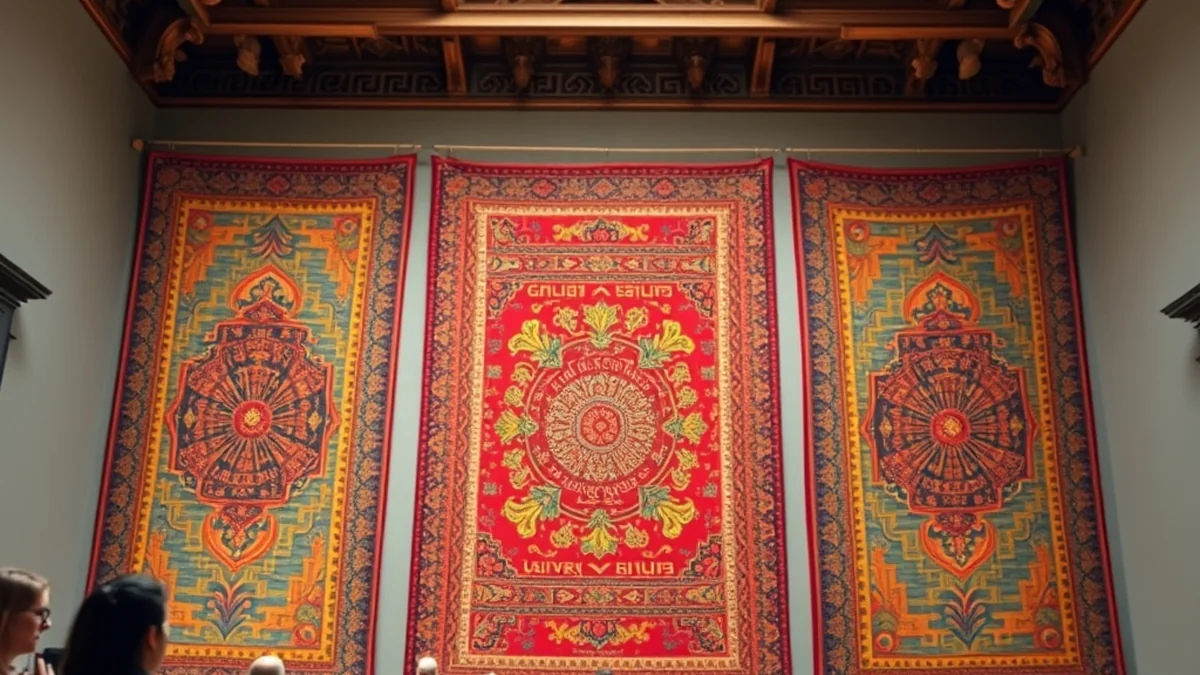
The V&A East Storehouse in London has unveiled a new exhibition, I Was Born Here, featuring three large-scale tapestries by artist, architect, and researcher Shahed Saleem. The collection, which occupies a prominent space on the gallery’s first floor, is displayed beneath a 536-year-old carved and gilded wooden ceiling originally from a palace in Torrijos, Spain. This juxtaposition of Islamic-inspired medieval Spanish architecture with contemporary textile art serves as the focal point for an exploration of migration, belonging, and the historical presence of Muslims in Europe. The exhibition, which opened this week, aims to challenge prevailing ethnonationalist narratives by documenting the lived experiences of British Muslims against a backdrop of rising xenophobia and political tension.
Saleem’s work draws heavily on the intersection of historical revisionism and modern-day policy. One of the primary tapestries, titled Home Office, incorporates verbatim text from the British government’s 2013 “Hostile Environment” signage, which urged undocumented immigrants to self-deport. These phrases are woven into fabric featuring intricate geometric Alhambra patterns, a design choice that highlights the historical continuity of Islamic art in Europe. By placing these modern intimidation tactics alongside medieval artistic traditions, the exhibition forces a confrontation between the state’s current exclusionary policies and the long-standing, often overlooked, Islamic heritage of the European continent.
Weaving History and Modern Hostility
The exhibition does not limit itself to policy critique; it also serves as a memorial for individuals impacted by racial violence. A panelled tapestry within the collection honours Altab Ali, a 24-year-old Bangladeshi textile worker who was murdered in a racially motivated attack in a London park in 1978. By including this portrait, Saleem connects the historical struggle of early South Asian migrants to the contemporary challenges faced by Muslim communities in the UK. The artist noted that he began the project while observing a surge in racial politics and a hateful climate directed at migrants, which he felt necessitated a visual record of these experiences.
Another section of the exhibit addresses the broader historical context of Islamic influence in Europe. The tapestries include imagery of the Santa Maria, the ship used by Christopher Columbus in 1492, a year that marked both the beginning of Spanish colonisation of the Americas and the start of the Spanish Inquisition. Historian and author Tharik Hussain, who has written extensively on the 1,400-year history of Muslims in Europe, explained that this period, while often celebrated as the dawn of Spain’s Golden Age, was simultaneously a time of devastating religious and ethnic homogenisation. Hussain noted that hundreds of thousands of Muslims and Jews were forced into exile or killed during this era, a history that is frequently erased in modern narratives that position Europe as exclusively Christian.
The Politics of Belonging and Public Space
Beyond historical and political commentary, the exhibition highlights the importance of local community spaces. One tapestry depicts the bustling atmosphere of Newham’s Queen’s Market, a publicly owned space that local residents have recently fought to protect from corporate redevelopment. Saleem chose to feature this market because it represents the richness of multicultural Britain and the tangible process of settling, labour, and life. For many visitors, the inclusion of such a familiar, everyday space underscores the exhibition’s central theme: that Muslim life is not a foreign concept but an integral, lived reality within the city’s fabric.
This theme of belonging is encapsulated in the exhibition’s title, I Was Born Here. Saleem described the title as a satirical response to a phrase that many non-white and Muslim Londoners are forced to repeat to justify their presence in the country. “It’s something that we would have to use to justify our existence here, in England, to counter racist attacks,” Saleem explained. “It’s part [of] a parody of having to continuously claim one’s space in the palace where you actually belong.” The artist views the exhibition as an artefact that will serve as a marker of the current historical moment for future generations, documenting the wave of Islamophobia and anti-migrant sentiment that defines the present era.
Community Resonance and Future Legacy
For younger visitors, the exhibition provides a rare opportunity to see their personal histories reflected in a major cultural institution. Imran Haque, a 25-year-old visitor, noted that the exhibition resonates deeply with his own family’s history, as his mother and her friends shopped for fabrics at the same market that Saleem sourced for his work. Haque stated that the prominence of the tapestries in the gallery allowed him to feel free to occupy space with his own story. He emphasised that the exhibition serves as a vital reminder that faith has no borders and that Muslims have been part of the British landscape since the 16th century.
As the exhibition continues its run at the V&A East Storehouse, it remains a point of reflection on the irony of presenting Islamic-inspired art in a climate of increasing Islamophobia. While Islamic art has recently fetched record-setting prices at London auction houses, the communities that created and sustained these traditions continue to face systemic exclusion. Saleem’s work acts as a bridge between these two realities, ensuring that the stories of migration, labour, and resilience are not lost to historical revisionism. When viewed in the context of the current political climate, the exhibition stands as a defiant assertion of identity and a call to recognise the long-standing, indigenous nature of Muslim communities in Europe.