
August 9, 2026 at 10:16 AM 2 min readaiAI Insights
Union Health Minister Unveils Roadmap for AI Integration in Medical Devices
The report highlights that artificial intelligence-enabled medical technologies are struggling to move from pilots to routine clinical use.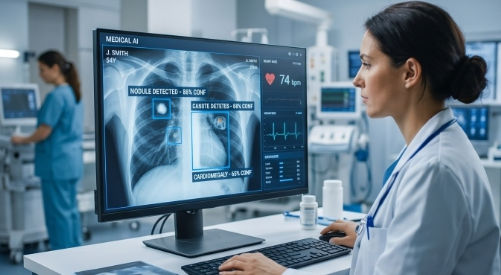
[Unveiling MedTech Policy Framework]:
Union Health Minister J.P. Nadda released a new knowledge paper titled AI in MedTech: Revolutionising Healthcare Through Artificial Intelligence at the 9th edition of India Medical Device 2026 in New Delhi. Developed jointly by Praxis Global Alliance and FICCI, the report highlights that artificial intelligence-enabled medical technologies are struggling to transition from successful pilot projects to routine clinical use due to fragmented data, evolving regulations, and limited reimbursement pathways.
[Addressing Structural Healthcare Deficits]:
The report emphasizes that artificial intelligence can help bridge India's widening healthcare gap, which faces severe pressure from an aging population, rising chronic diseases, and acute shortages of doctors, nurses, and hospital beds. India currently maintains 9.6 doctors per 10,000 population compared to a global average of 18.3, and 15.9 hospital beds per 10,000 against a global average of 33, making AI diagnostics essential for extending specialist expertise to primary and secondary healthcare delivery.
[Strategic Priorities for National Deployment]:
The publication outlines five key priorities to accelerate responsible artificial intelligence adoption and underscores India's opportunity to become a global leader in medical device manufacturing. Experts at a FICCI conference in Hyderabad noted that targeted technological implementation could shift India's healthcare system from late diagnosis to early prediction and from standardized treatment to personalized care.
Pulse Intelligence
Context & ImpactContext & Background
- The knowledge paper was launched at the 9th edition of India Medical Device 2026 in New Delhi.
- India currently lags behind global averages with 9.6 doctors and 15.9 hospital beds per 10,000 population.
Key Consequences
- AI-enabled diagnostics are expected to become the first major application deployed at scale across primary healthcare centers.
- Stakeholders will need to navigate evolving regulations and establish structured reimbursement pathways for clinical technologies.
Market & Economic Impact
Not applicable.
The Indus Pulse is committed to accuracy and transparency.