
21 Aug 2026, 09:26 AM 2 min readworlddeveloping
Tunisia Protests Escalate: Thousands Demanding President's Ouster
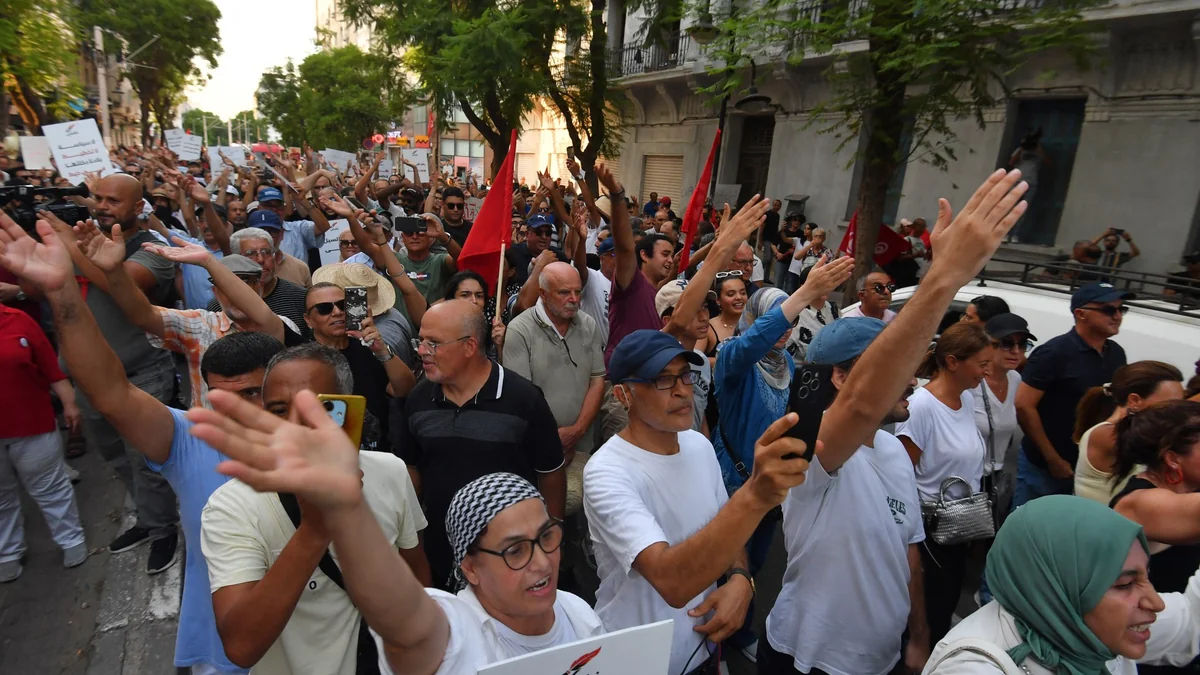
Mass Demonstrations in Tunis:
Thousands of opposition activists and citizens marched through the streets of the capital city, Tunis, demanding the departure of President Kais Saied. The protest represents the latest and largest demonstration in an ongoing wave of public anger that has stretched into its second consecutive month. Marchers chanted slogans calling for the immediate restoration of democratic institutions and the release of political dissidents. Security forces deployed in large numbers across central Tunis, setting up blockades along major thoroughfares to contain the crowds.
Deteriorating Economy and Autocracy:
This widespread civil unrest stems from a combination of severe economic hardship and growing political frustration under President Saied's administration. Tunisia's economy is struggling with soaring inflation, high unemployment rates, and chronic shortages of basic food supplies. Opponents accuse Saied of systematically dismantling the democratic gains of the 2011 revolution by consolidating power, suspending parliament, and rewriting the constitution. The government's failure to secure foreign financial assistance has further aggravated the country's fiscal crisis, pushing ordinary citizens to the brink.
Implications for North African Stability:
The political instability in Tunisia threatens to destabilize the broader North African region, which has long struggled with irregular migration and security challenges. European nations are closely watching the developments, fearing that a total economic collapse in Tunisia could trigger a massive influx of migrants across the Mediterranean. For India, the instability highlights the volatile environment in North Africa, a region where Indian companies hold investments in phosphate mining and agricultural trade. The unrest could disrupt supply chains of key raw materials essential for India's fertilizer manufacturing sector.
Pulse Intelligence
Context & ImpactContext & Background
- President Kais Saied suspended the Tunisian parliament in 2021 and moved to rule by decree, a transition that opponents have repeatedly called a coup.
- Tunisia was widely considered the sole democratic success story of the 2011 Arab Spring uprisings before the current political consolidation.
Key Consequences
- Continued street demonstrations are likely to result in periodic clashes between security forces and pro-democracy activists.
- Failure to stabilize the economy could prompt further crackdowns on political opposition, media outlets, and civil society organizations.
Market & Economic Impact
Persistent political instability may delay crucial international loans, weakening the Tunisian dinar and raising costs for regional trade partners.
The Indus Pulse is committed to accuracy and transparency.