
July 25, 2026 at 11:34 AM 2 min readindiabreaking
India Launches High-Speed Bullet Train Infrastructure Project
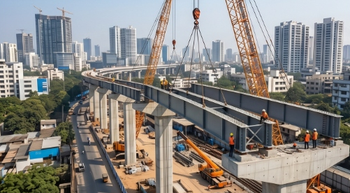
Project Infrastructure Milestone:
The Indian government has officially commenced major construction phases for the upcoming Ahmedabad-Mumbai high-speed rail corridor. This landmark project, utilizing Shinkansen technology, aims to connect two of India's most significant economic centers via a state-of-the-art bullet train network. Officials confirmed that tunneling and bridge construction activities are accelerating across multiple segments, marking a shift from the initial planning and land acquisition phases toward active deployment of transit infrastructure.
Strategic Regional Connectivity:
Long-standing delays in land acquisition, particularly in Maharashtra, hindered progress during previous years. Recent administrative breakthroughs resolved these territorial bottlenecks, allowing the National High-Speed Rail Corporation Limited to mobilize resources at scale. The project reflects India's broader push to modernize its railway backbone, moving beyond conventional passenger trains toward high-capacity, electrified rapid transit corridors designed for enhanced safety, punctuality, and reduced travel times for millions of commuters.
Economic and Future Impact:
The operational rollout of this corridor expects to redefine regional economic integration by enabling sub-three-hour travel between Gujarat and Maharashtra. Analysts suggest the bullet train will stimulate industrial growth along the route and set a benchmark for future HSR projects in the country. Observers are now monitoring the project's timeline to ensure adherence to the revised completion schedules, as the successful execution of this route remains critical for justifying further high-speed infrastructure investments in other densely populated Indian industrial hubs.
Pulse Intelligence
Context & ImpactContext & Background
- The project faced persistent delays in land acquisition and environmental clearances over the past three years.
- A formal agreement between India and Japan established the foundation for the Shinkansen technology transfer in 2017.
Key Consequences
- Travel time between Ahmedabad and Mumbai will decrease to less than three hours once the line is fully operational.
- Increased regional employment opportunities will likely emerge in sectors surrounding the newly constructed rail stations.
- Successful integration of high-speed rail could accelerate the planning and approval process for subsequent corridors across India.
Market & Economic Impact
The initiative is expected to boost infrastructure and construction stocks linked to the railway sector.
The Indus Pulse is committed to accuracy and transparency.