
31 Aug 2026, 01:28 PM 6 min readindiaanalysis
INDIA Bloc's Leadership Fault Lines Exposed by Tamil Nadu Ultimatum
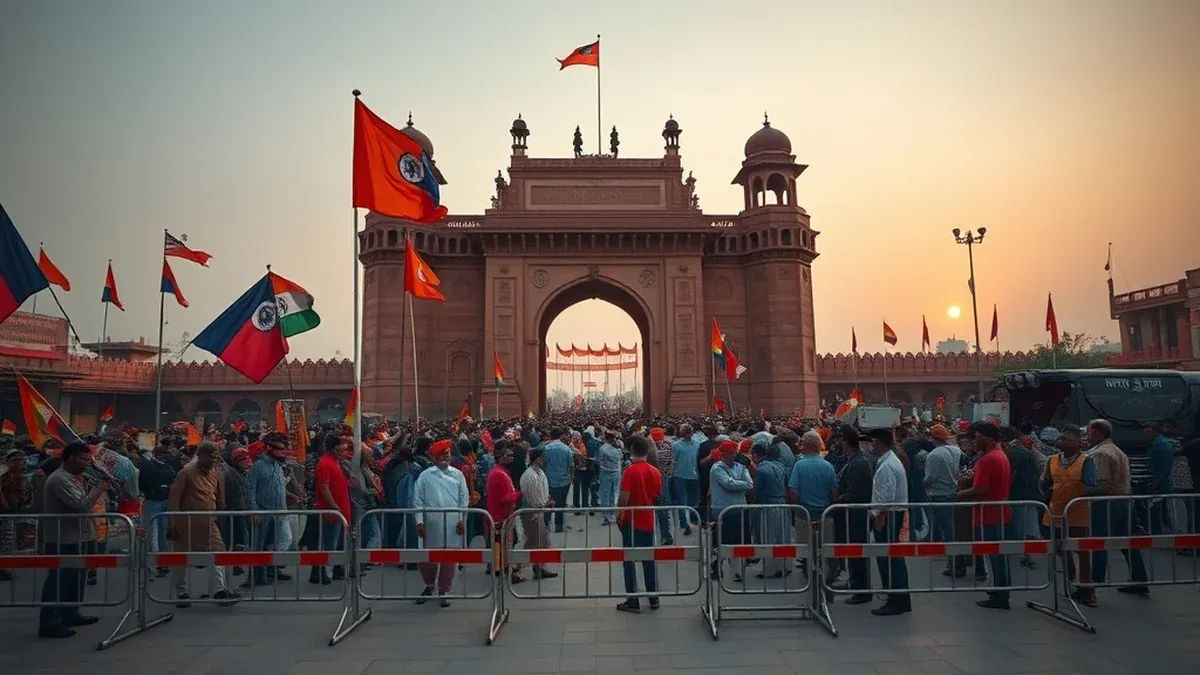
A recent declaration by a Tamil Nadu Minister, P. Viswanathan, that the Congress party would withdraw its ministers from the state cabinet if Rahul Gandhi is not accepted as the INDIA bloc's prime ministerial candidate for the 2029 Lok Sabha elections, has laid bare the deep-seated fissures within the nascent opposition alliance. This statement, coming from a Congress leader who also holds the Higher Education portfolio in the Tamil Nadu government, underscores the profound internal power dynamics and strategic calculations threatening the viability of a united front against the ruling party.
Viswanathan's assertion, made on August 28, 2026, is not merely a rhetorical flourish. It reflects a growing impatience within the Congress regarding the leadership question, particularly as regional allies increasingly project their own leaders for a national role. The statement specifically targets the Tamilaga Vetri Kazhagam (TVK), the party of Tamil Nadu Chief Minister C. Joseph Vijay, which has seen its own ministers and legislators advocating for Vijay as a potential prime ministerial candidate. The Congress currently holds two ministerial berths in Chief Minister C. Joseph Vijay's cabinet, with P. Viswanathan and K. Rajesh Kumar (Tourism) being inducted in May 2026, marking the party's return to the state government after nearly six decades. The five Congress MLAs are crucial for the TVK-led government's majority in the Tamil Nadu Assembly, lending significant weight to the threat of withdrawal.
## The Contested Crown: INDIA Bloc's Leadership Conundrum
The Tamil Nadu ultimatum is a microcosm of the broader leadership struggle plaguing the Indian National Developmental Inclusive Alliance (INDIA) bloc. Formed with the ambitious goal of presenting a unified challenge to the Bharatiya Janata Party (BJP), the alliance has consistently grappled with the absence of a universally accepted leader. While Congress, as the largest national party within the bloc, naturally positions Rahul Gandhi, regional satraps harbor their own aspirations. Leaders such as West Bengal Chief Minister Mamata Banerjee, Delhi Chief Minister Arvind Kejriwal, and even Tamil Nadu Chief Minister M.K. Stalin have been floated as potential prime ministerial faces.
This competition of ambitions has led to calls for a "rotational leadership model" within the bloc, a concept that, while aiming for inclusivity, also highlights the difficulty in achieving consensus around a single figure. Shiv Sena (UBT) chief Uddhav Thackeray recently emphasized the urgent need for the INDIA bloc to name its prime ministerial candidate before approaching the electorate, acknowledging the public's demand for clarity. The BJP has predictably seized upon these internal rifts, branding the opposition as "directionless" and highlighting the perceived instability.
Adding another layer of complexity, the TVK, despite its alliance with Congress in Tamil Nadu, has not formally joined the INDIA bloc. Its strategy for the upcoming Lok Sabha elections remains unrevealed, even as it actively campaigns to project C. Joseph Vijay as a national leader. A recent television survey, for instance, placed Vijay in third place for preferred prime minister, behind Narendra Modi and Rahul Gandhi, further fueling these regional aspirations. This independent posturing by a key state-level ally significantly complicates the INDIA bloc's efforts to project a cohesive national image.
## Echoes of History: Precedents in Coalition Politics
India's political history is replete with examples of coalition governments navigating treacherous waters, often with leadership questions at the heart of their instability. The first non-Congress national government, the Janata Party, formed in 1977, was an amalgamation of diverse parties united by an anti-Congress plank. However, internal contradictions and leadership tussles ultimately led to its fragmentation. Similarly, the National Front government in 1989, and the United Front government in 1996, both saw multiple prime ministers and eventually collapsed due to internal disagreements and the withdrawal of crucial external support.
The 1996 United Front experience is particularly instructive. V.P. Singh declined the top post, Jyoti Basu was vetoed by his own party, and H.D. Deve Gowda eventually became prime minister with the outside support of the Congress, which was later withdrawn, leading to the government's fall in less than a year. These historical precedents underscore a critical lesson: while forming an alliance to counter a dominant force is achievable, sustaining it requires a delicate balance of power, mutual trust, and, crucially, a clear and accepted leadership structure. Successful coalitions, such as the BJP-led National Democratic Alliance (NDA) under Atal Bihari Vajpayee (1998-2004) and the Congress-led United Progressive Alliance (UPA) under Manmohan Singh (2004-2014), managed to complete their full terms largely due to a relatively stable leadership.
## Implications for National Elections and Alliance Stability
The Tamil Nadu Minister's ultimatum, and the broader leadership debate it highlights, carries significant implications for the INDIA bloc's electoral prospects. A united opposition is often perceived as a credible alternative, capable of challenging an incumbent. However, public displays of disunity, particularly over the pivotal question of who will lead, can erode voter confidence. It projects an image of internal discord rather than a coherent vision for governance.
For the INDIA bloc, the immediate challenge is to reconcile the national ambitions of the Congress with the growing assertiveness of regional parties. If a compromise on the prime ministerial candidate cannot be reached, several scenarios could unfold: a weakening of the alliance, with regional parties prioritizing their state-level interests over national unity; a formal fracture of the bloc, potentially leading to multi-cornered contests that could benefit the ruling party; or a continuation of a fragile, internally conflicted front that struggles to present a compelling narrative to the electorate. The Congress's leverage in Tamil Nadu, where its MLAs are vital for the TVK government's majority, creates a high-stakes negotiation. A withdrawal would plunge the state into political instability, potentially forcing fresh elections and diverting resources and attention from national electoral strategy.
## Governance and Economic Ripples
Beyond electoral calculations, the specter of political instability, whether at the national or state level, has tangible consequences for governance and the economy. Coalition governments marked by internal friction often face accusations of "policy paralysis and ineffective governance," as decision-making becomes protracted and compromises dilute policy intent. This uncertainty can deter both domestic and foreign investment, impacting economic growth and job creation. Industries thrive on predictability and stable policy environments, which become elusive amidst constant political wrangling.
For consumers, a government preoccupied with internal power struggles may struggle to address pressing issues like inflation, unemployment, and essential services, which the INDIA bloc itself has vowed to tackle. In Tamil Nadu, a potential collapse of the state government due to Congress's withdrawal would disrupt administrative continuity, potentially stalling ongoing projects and creating an environment of uncertainty for businesses and citizens alike. The focus on internal political survival overshadows the imperative of effective public service delivery. The current situation demands a pragmatic approach from the INDIA bloc, where individual ambitions are tempered by the collective goal of offering a stable, credible alternative to the electorate. The path forward for the alliance hinges on its ability to forge a cohesive leadership narrative, a task that has historically proven to be the most formidable challenge for multi-party fronts in India.
The Indus Pulse is committed to accuracy and transparency.