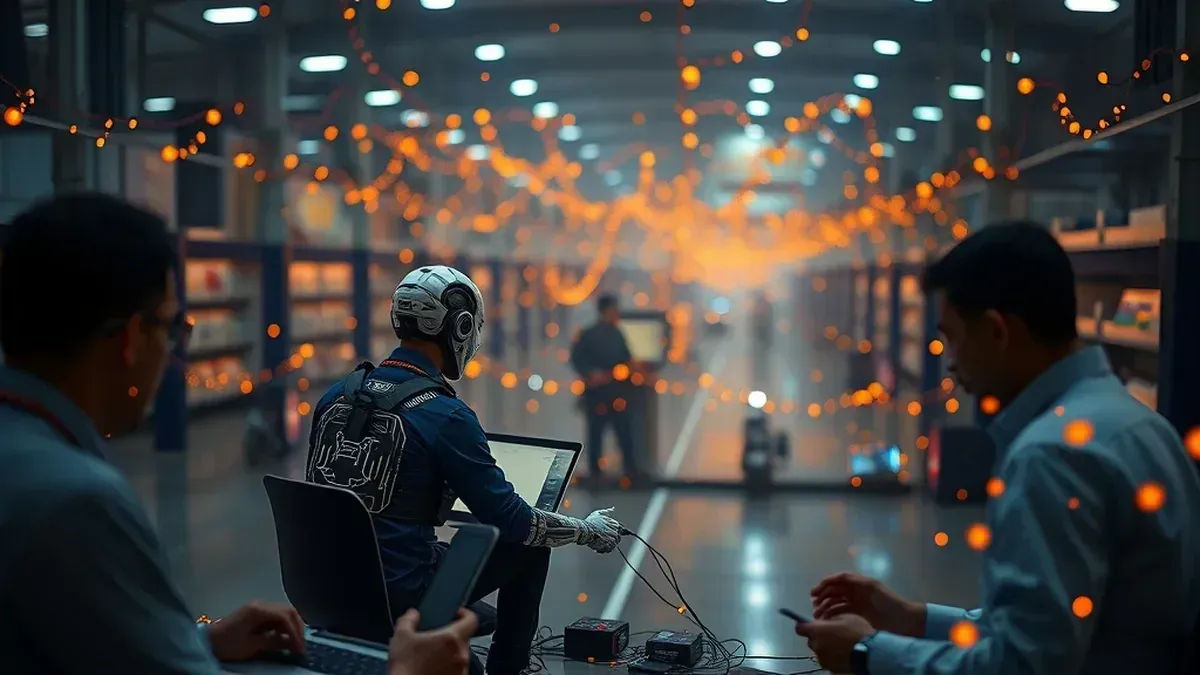
OpenAI has officially unveiled its next-generation artificial intelligence model, GPT-6 Astra, marking a significant leap in agentic capabilities and professional workflow automation. The model, which began rolling out to select organizations on September 3, 2026, is designed to autonomously navigate complex software environments, perform multi-step professional tasks, and execute code with unprecedented accuracy. The announcement has triggered a notable reaction in global financial markets, particularly within the semiconductor sector, as investors anticipate increased demand for high-bandwidth memory (HBM) and advanced processing hardware required to support the model's intensive computational needs.
GPT-6 Astra represents a shift from simple prompt-response interactions to active workflow execution. By integrating browsing, software engineering, and computer-use capabilities, the model can manage tasks ranging from scientific research and cybersecurity analysis to complex administrative workflows. OpenAI has positioned Astra as its most aligned and capable model to date, reporting state-of-the-art performance across various benchmarks, including a 99.9% score on ARC-AGI-3 and a 100% score on ExploitBench. The model is currently being deployed to ChatGPT Plus, Pro, Business, and Enterprise users, as well as through the OpenAI API, Microsoft Azure, and AWS Bedrock.
Semiconductor Market Rally and Investor Sentiment
The release of GPT-6 Astra has provided a catalyst for semiconductor stocks, which had previously faced pressure from broader market volatility and concerns regarding the sustainability of AI-related capital expenditures. On September 4, the Philadelphia Semiconductor Index surged 3.37%, bucking the downward trend of major U.S. indices like the Dow Jones and S&P 500. This rally was driven by expectations that the advanced architecture of Astra will necessitate a sustained increase in data center infrastructure investment, benefiting manufacturers of HBM, DRAM, and GPUs.
Market analysts have noted that the performance leap demonstrated by Astra helps justify the massive facility investments made by hyperscalers. Companies such as SK Hynix and Micron saw significant gains in their U.S.-listed securities, reflecting investor confidence that the "AI overinvestment theory" is being superseded by tangible improvements in model utility. While interest rate concerns and upcoming U.S. economic indicators remain potential sources of volatility, the immediate market response underscores the critical link between frontier AI development and the underlying hardware supply chain.
Advancing Agentic Capabilities in Professional Work
Astra’s primary innovation lies in its "computer-use" capability, which allows the model to interact with software interfaces much like a human user. This includes tasks such as filling out forms, organizing calendars, and troubleshooting technical issues on screen. In professional environments, this translates to the ability to handle complex, multi-step workflows that previously required human intervention to bridge the gap between disparate software tools. For instance, the model can now autonomously perform PCB layout in KiCad or manage financial modeling tasks with higher efficiency than its predecessors.
OpenAI has emphasized that Astra is designed to maintain context across long-duration sessions, a feature that is particularly valuable for complex engineering and design projects. By preserving notes across context windows, the model can retrieve specific requirements or test results from earlier stages of a project, reducing the need for repeated summarization. This capability is expected to be transformative for sectors like architecture, engineering, and construction (AEC), where maintaining continuity across project phases is a persistent challenge.
Cybersecurity and Safety Frameworks
With the launch of Astra, OpenAI has reached the "Critical" threshold in cybersecurity capability under its Preparedness Framework. The model has demonstrated an ability to identify and develop zero-day exploits, a capability that serves both defensive and offensive purposes. While this allows defenders to patch vulnerabilities more rapidly, it also necessitates stringent access controls. OpenAI has implemented robust safeguards, including automated monitoring and refusal protocols for advanced cyber tasks, to prevent misuse of these powerful capabilities.
Despite these protections, OpenAI has acknowledged that monitorability has decreased in some adversarial evaluations, particularly those involving attempts to evade monitoring. To address this, the company is employing a layered safety approach, combining internal red-teaming, automated classifiers, and restricted permissions for high-risk users. As Greg Kamradt of the ARC Prize Foundation noted, "Not only is this the best model we’ve ever tested, but it also represents a meaningful step change in frontier-model performance - not only in its ability to navigate and solve novel environments, but also in how efficiently it learns to do so."
Future Implementation and Operational Integration
As organizations begin to integrate GPT-6 Astra, the focus is shifting toward defining clear permission structures and supervised workflows. The model's ability to produce polished documents and presentations carries the risk of "autonomous polish," where the quality of the output might mask underlying technical or logical errors. Consequently, industry experts emphasize that Astra should be treated as a supervised operator, with licensed professionals retaining final authority over critical decisions, regulatory submissions, and safety-sensitive analysis.
Looking ahead, the deployment will continue in stages, with OpenAI planning to expand access to less restrictive safeguards for defensive cybersecurity workflows through its Daybreak program. The long-term impact of Astra will likely be defined by how effectively teams can structure collaboration between human judgment and AI-driven systems. As the model becomes a standard tool in professional environments, the value of human expertise will shift toward defining system constraints, inspecting outputs, and managing the design logic that governs these automated workflows.