
15 Sept 2026, 09:48 AM 2 min readai
Oncology Experts Detail AI Integration in Clinical Workflows and Diagnostics
Sources & Citations
Reporting basis: one publisher; no matching primary record was attached.
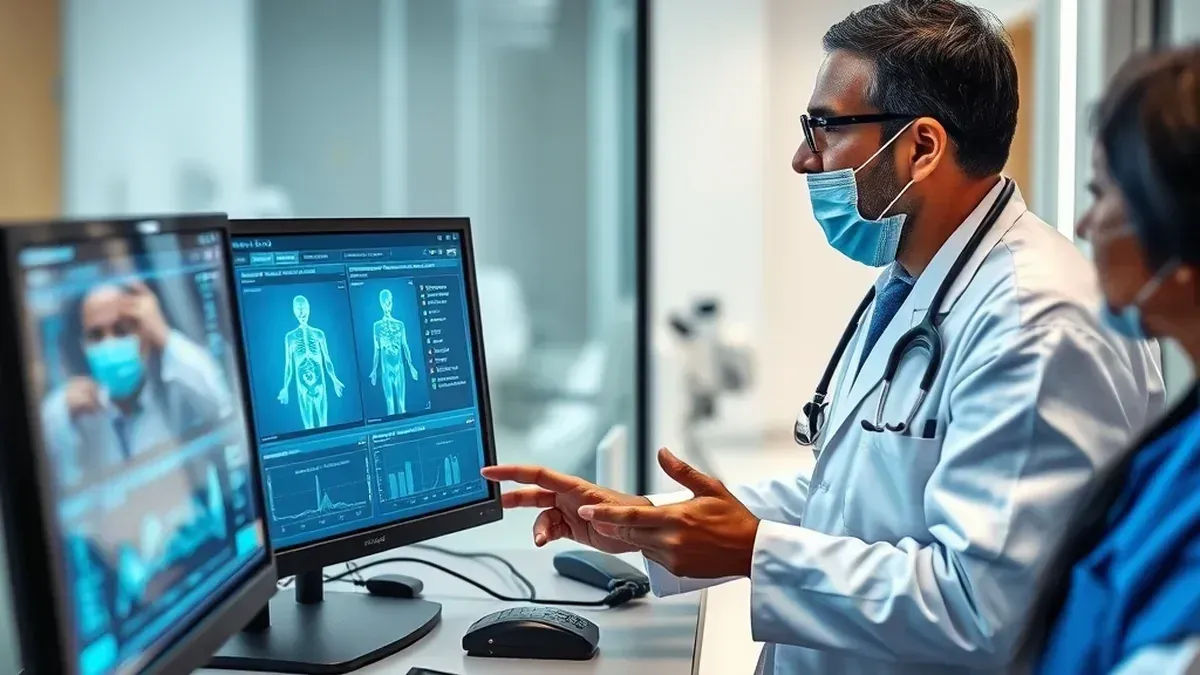
Artificial intelligence is rapidly transitioning from a theoretical concept to a functional tool in oncology, with clinicians increasingly adopting specialized large language models and foundational models to streamline research and patient care. While early applications were often dismissed as prone to errors, current deployments are focusing on reducing administrative burdens, accelerating clinical trial matching, and enhancing diagnostic precision in radiology and pathology. Experts emphasize that the primary value of these tools lies in their ability to act as connective tissue within the oncology continuum, rather than replacing human practitioners.
Clinical Workflow Optimization and Agentic AI
Oncologists are leveraging specialized large language models to assist with high-stakes, point-of-care decision-making. Tools such as OpenEvidence are being utilized to synthesize data from major medical journals and clinical guidelines, serving as an AI copilot for clinicians. Beyond simple documentation, the field is moving toward agentic AI, which utilizes orchestration to coordinate multiple machine learning models. This technology allows systems to autonomously perform complex tasks, such as supporting tumor boards and coordinating care, thereby removing friction points in routine practice. The goal is to allow medical teams to spend more time on direct patient engagement rather than navigating complex administrative systems.
Advancements in Diagnostic Imaging and Pathology
AI is demonstrating significant utility in early cancer detection, particularly in mammography and lung cancer screening. Recent data suggests that AI-assisted CT scans can identify early-stage pancreatic cancer, a condition historically difficult to detect until later stages. Furthermore, multimodal models are being deployed to predict breast cancer recurrence with greater accuracy than traditional genomic scores. In pathology, foundational models are being used to address global shortages of specialists. By analyzing whole slide imaging, these models can identify potential biomarkers, such as EGFR mutations or PD-L1 positivity, remotely and at scale, providing critical support in underserved regions.
Industrialization and Governance in 2026
Industry leaders characterize 2026 as the year of AI industrialization in oncology, as pharmaceutical companies increasingly license and train foundational models on proprietary data to compress drug discovery cycles. However, experts warn that these systems must be governed by clinical involvement and evidence-based guardrails to prevent misinformation. The focus remains on ensuring that AI deployments directly contribute to faster therapy access and guideline-concordant care, moving the technology from a peripheral novelty to a foundational component of modern medical practice.
Sources & Citations
Reporting basis: one publisher; no matching primary record was attached.
The Indus Pulse is committed to accuracy and transparency.