
Developer Fits Tiny 2.1 AI Transformer Onto a 1.44 MB Floppy Disk
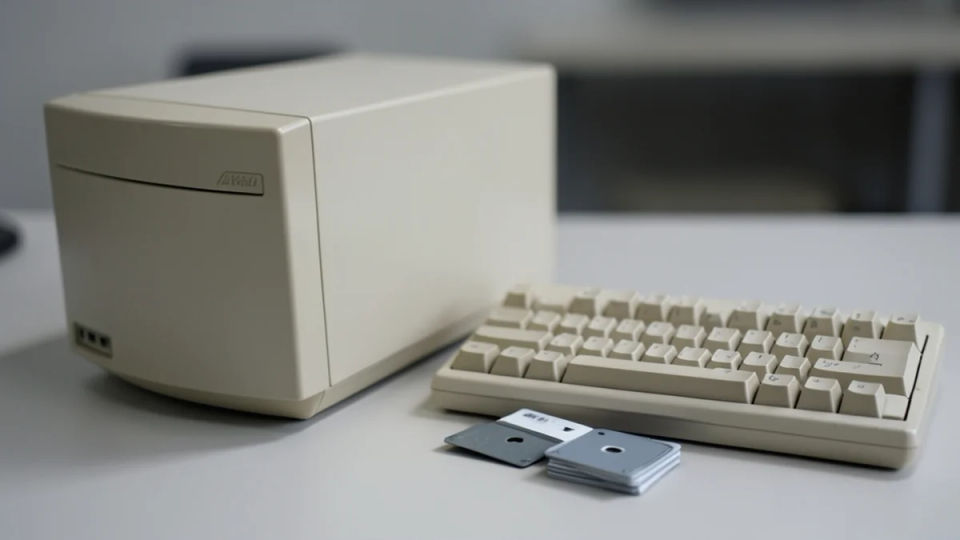
A developer going by WollyMonjac has released Tiny 2.1, a miniature question-answering transformer model designed to run under MS-DOS on vintage 486DX and Pentium PCs from a single 1.44 MB floppy disk. Written in Turbo C 2.0, the program occupies 435 KB in total on a disk whose formatted capacity is nearly 1,475,000 bytes. Tom's Hardware noted that users still running a 486SX processor may need to upgrade, as the project targets 486DX and Pentium machines.
Tiny 2.1 packs 367,000 parameters across four layers with a hidden dimension of 96 and processes text one letter at a time. Its 8-bit integer weights, using one scale factor per row, take up 380 KB, and the application requires about 540 KB of free conventional memory to run.
Tom's Hardware noted that Tiny 2.1 shares the transformer architecture of larger models while remaining a modest question-answering program rather than a full large language model.
How Tiny 2.1 Was Built and Trained
According to the project's GitHub repository, cited by Tom's Hardware and Notebookcheck, Anthropic's Claude Fable 5.2 wrote the transformer code while Opus 5.5 generated the training dataset. That dataset covers more than 3,500 facts alongside small talk and math, phrased in multiple variations for question-answering.
While the model handles the facts it was trained on, Notebookcheck noted that it is not equivalent to running Claude on a floppy and hallucinates on complex or overly long queries. Outside those trained topics, WollyMonjac noted that Tiny 2.1 makes things up confidently, similar to hallucinations in larger models. Because the MIT-licensed release includes a training folder and scripts on GitHub, users can recompile the code with TCC -ml TINY.C and train the model on custom topics. Users retraining Tiny 2.1 can run gen2.py and train2.py on a normal CPU with Python 3, NumPy, and PyTorch, while three data files derived from public datasets retain ODbL and CC BY-SA licenses, according to Adafruit Blog.
Retro Interface and Emulator Support
Tiny 2.1 presents a Norton Commander-style DOS interface featuring a conversation history pane, a neural network activity monitor, an Ask Tiny input box, and bottom F-key shortcuts. Responses can also be spoken aloud in a robotic voice through the PC's built-in speaker. Notebookcheck noted that the 435 KB package leaves ample space on a 1.44 MB disk and lends itself to school labs, museums, and performance art demos. Tiny 2.1 outputs its synthesized robotic voice directly through the PC speaker, whereas Yeo Kheng Meng's 2023 DOS ChatGPT client (doschgpt) required at least an 8 MHz CPU for reasonable text-to-speech playback, according to Hackster.io and YKM's Corner on the Web.
Tom's Hardware noted that users without a 3.5-inch floppy drive can download the ZIP archive from GitHub and launch it in an MS-DOS emulator using the commands CD \TINY and TINY, joining other retro-computing projects such as a DOS ChatGPT client, Minecraft on a Game Boy, generative AI images on a C64, and Doom on an Atari ST. The doschgpt client targeted a 1984 vintage IBM 5155 Portable PC powered by a 4.77 MHz Intel 8088 CPU and 640KB of RAM, according to Tom's Hardware. Tiny 2.1 executes locally on a 486DX or Pentium processor without specialized hardware, whereas Yeo Kheng Meng's doschgpt client relies on a modern PC running a Golang http-to-https-proxy to forward requests to OpenAI's servers, according to Hackster.io.