
Blue Origin to Launch Google AI Server Satellites in 2029
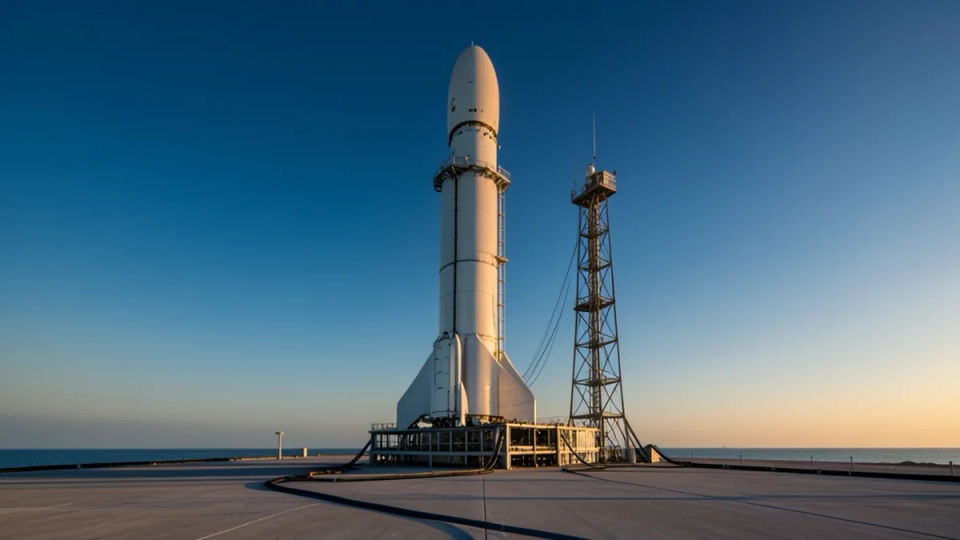
Google has selected Jeff Bezos' Blue Origin to launch AI computing satellites into orbit aboard the New Glenn rocket in the first quarter of 2029, the companies announced on Thursday, according to The Verge and Reuters. The mission will be the first dedicated heavy-lift launch for Project Suncatcher, Google's long-term moonshot exploring solar-powered AI data centers in space, The Verge reported.
Mission Scope and Confirmed Details
Each satellite will carry Google's custom Tensor Processing Units (TPUs) with computing capacity roughly equal to a conventional data center server rack, according to Reuters and Google Senior Director for Paradigms of Intelligence Travis Beals, quoted by shattered.io. The satellites are slated for a sun-synchronous orbit that provides near-continuous sunlight, allowing Google to test whether solar energy can support intensive AI workloads beyond Earth, Reuters reported. Google's Project Suncatcher system-design paper specifies that satellites in dawn-dusk sun-synchronous low-Earth orbit will use a thermal system of heat pipes and radiators, according to arXiv.
Beals said in Google's blog post, quoted by shattered.io, that the agreement "builds on our ongoing work with other satellite and launch partners and represents a crucial milestone on our long-term roadmap as we expand the boundaries of what's possible for the future of compute." Shattered.io noted that neither Google nor Blue Origin disclosed the exact launch date, satellite count, specific TPU generation, contract value or mission duration, and the official announcements included no on-record quote from Jeff Bezos. On August 5, 2026, Blue Origin confirmed that the GS1-3 hotfire test anomaly, for which a debris notice was posted May 29, 2026, originated at the main oxygen valve on one of the BE-4 engines, according to Blue Origin.
Prototype Testing and Radiation Findings
Before the 2029 heavy-lift mission, Google and Planet Labs launched a first Project Suncatcher prototype satellite aboard SpaceX's Falcon 9 rocket in October as part of a rideshare flight, The Verge and Reuters reported. Google successfully booted up its TPUs and used the onboard Gemma 4 model to transmit an AI-generated haiku back to Earth, The Verge said, while Reuters reported that the prototype is operating as expected after establishing contact. That testbed evaluates how the chips handle launch forces, radiation, extreme temperatures and cooling without Earth's airflow, Reuters noted.
Shattered.io reported that Google also tested its Trillium TPUs under proton radiation at the University of California, Davis Crocker Nuclear Laboratory, where the chips survived a total ionizing dose exceeding a five-year space mission without permanent failure, though high-bandwidth memory showed irregularities near 2 krad(Si). Google's Suncatcher explainer and The Space Wiki also describe plans to test optical inter-satellite laser links between two satellites so orbital nodes can share workloads, shattered.io added.
Launch Vehicle Record and Orbital Rivals
For Blue Origin, the deal adds a major commercial mission for New Glenn following delays and a launchpad explosion in May, Reuters reported. Launch databases cited by shattered.io show a short record for New Glenn: through April 19, 2026, Flight Atlas records two successes across three launches, while Orbital Radar lists four launches including a May 29, 2026 flight recorded as a failure. On November 10, 2026, Blue Origin reported that its modified BE-4 main oxygen valve completed qualification testing, was incorporated into engines slated for upcoming flights, and is being rolled out across the remaining fleet.
A learning-curve analysis in Google's Suncatcher paper estimated low Earth orbit launch costs could drop to about $200 per kilogram by the mid-2030s, shattered.io noted, though experts cited by Reuters cautioned that high launch costs, engineering hurdles and limited satellite production keep commercial orbital data centers years away.